Category: speakers

  • The River by Jana Winderen

    The River by Jana Winderen

    The River is a 32 channel sound installation composed for the Jerwood Gallery in the Natural History Museum in London. The River is made in collaboration with Tony Myatt.

    Jana has based her composition on recordings she has done over the last year from the source to the mouth of the river Thames. From the website of the Natural History Museum:

    The River is a captivating art installation by sound artist Jana Winderen in collaboration with sound specialist Tony Myatt. Listen to the watery depths of the River Thames, featuring captivating recordings from an underwater habitat that’s often inaccessible to our ears. Discover the beauty and importance of underwater sound and explore how human-made noises can contribute to sound pollution in our waters.

    Sound plays a crucial role in underwater ecosystems, enabling animals to communicate, breed and migrate. In this installation, listen out for the diverse sounds of mammals, fish, insects and crustaceans living in the River Thames, alongside human-made noises found from source through the bustling city and into the sprawling estuary. These sounds highlight how noise pollution is affecting how aquatic life interacts and communicates.
  • Party / After-Party by Carl Craig

    Party / After-Party by Carl Craig

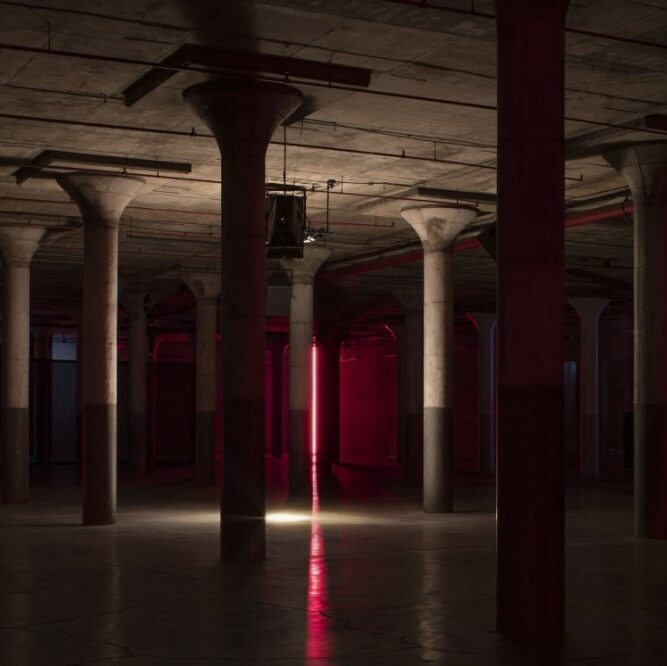
    Detroit-based techno DJ and producer Carl Craig’s immersive environment, Party/After-Party, 2020, is a visceral sound and somatic experience that evolves with each new iteration. Drawing on Craig’s 30-year career as an internationally touring DJ, Party/After-Party guides visitors sonically through a club night from the perspective of the DJ. Starting in those moments before the crowd arrives and the DJ spins alone, before reaching its crescendo with the party’s pulsing apex, and finally slipping towards the melancholic embrace of the after-party, the work evokes the collective ecstasy and desolation found only on a club dance floor.

    Originally commissioned by Dia Art Foundation, this sonic statement responds directly to the architecture of The Geffen Contemporary at MOCA and reclaims the former manufacturing site and police storage facility as a space for agency and radical experimentation.

    Upon entry, visitors are enveloped by Craig’s soundscape which honors the Black pioneers of techno and electronic music. As one moves through WAREHOUSE techno beats fill the space, the darkness broken intermittently by neon strips, before the skylights above flood everything with natural light, signaling the cycle’s peak and the transition towards “dawn.”

    While Party/After-Party was conceived before the COVID-19 pandemic, the context of the past three years makes it impossible to enter the space and not crave the heat and thudding bass of clubs such as Berlin’s iconic Berghain, which Craig has headlined, while also acknowledging the collective loss of communal experiences. Beats build and recede, evolving slightly with every 30-minute evolution so that no two are the same, and at times incorporating references to Craig’s tinnitus, a byproduct of a lifetime of loud music; Party/After-Party is Craig’s invitation into his personal world and the spaces he shapes through sound.

    Party/After-Party is accompanied by Party/After-Party Sessions, a series of three live concerts co-presented with Insomniac and Secret Project that are a continuation of the collaborations at the heart of Craig’s practice.

  • Cardiff & Miller

    Cardiff & Miller

    Canadian artists Janet Cardiff and George Bures Miller live and work in British Columbia. They are best known for their immersive multimedia sound installations and audio/video walks.

    Since the early 1990s, they have created interactive “walks,” site-specific experiences in which a viewer is guided through a space with the use of a binaural audio soundtrack and video. The artists’ seamlessly blend reality with a fictional narrative, manipulating the perception and experience of a physical environment. Their “walks” have been staged in locations ranging from the Walt Disney Concert Hall in downtown Los Angeles to Villa Medici in Rome, and in sections of cities including London, Sydney, the Old Town district of Edinburgh, Scotland, and New York’s Central Park.

    In addition to their “walks,” Cardiff and Bures Miller also work with installations, creating immersive environments that use sound and other elements to surround viewers. The pair created FOREST (for a thousand years…) for Documenta in Kassel, Germany. The piece is set in a clearing in the forest, where, rather than moving through the space, the audience is seated on wooden stumps. A soundtrack that includes airplanes and explosions, wind, birds, horses, and gunfire plays around them on more than 30 speakers, building into chaos and then retreating. Originally created in 2012, the piece was reprised in 2018, when it was presented in the University of Califonria’s Santa Cruz Arboretum and Botanic Garden. In Art in America, Gregory Volk describes the uncanny experience of hearing the natural and recorded sounds, layered together. “A remarkable thing about Janet Cardiff and George Bures Miller’s utterly captivating sound installation is how it blurs distinctions between site and art,” he writes. “In turn frightening and deeply touching, ominous and serene, Cardiff and Bures Miller’s forest soundscape is a wonder.”

  • Pirouette by Adam Basanta

    Pirouette by Adam Basanta

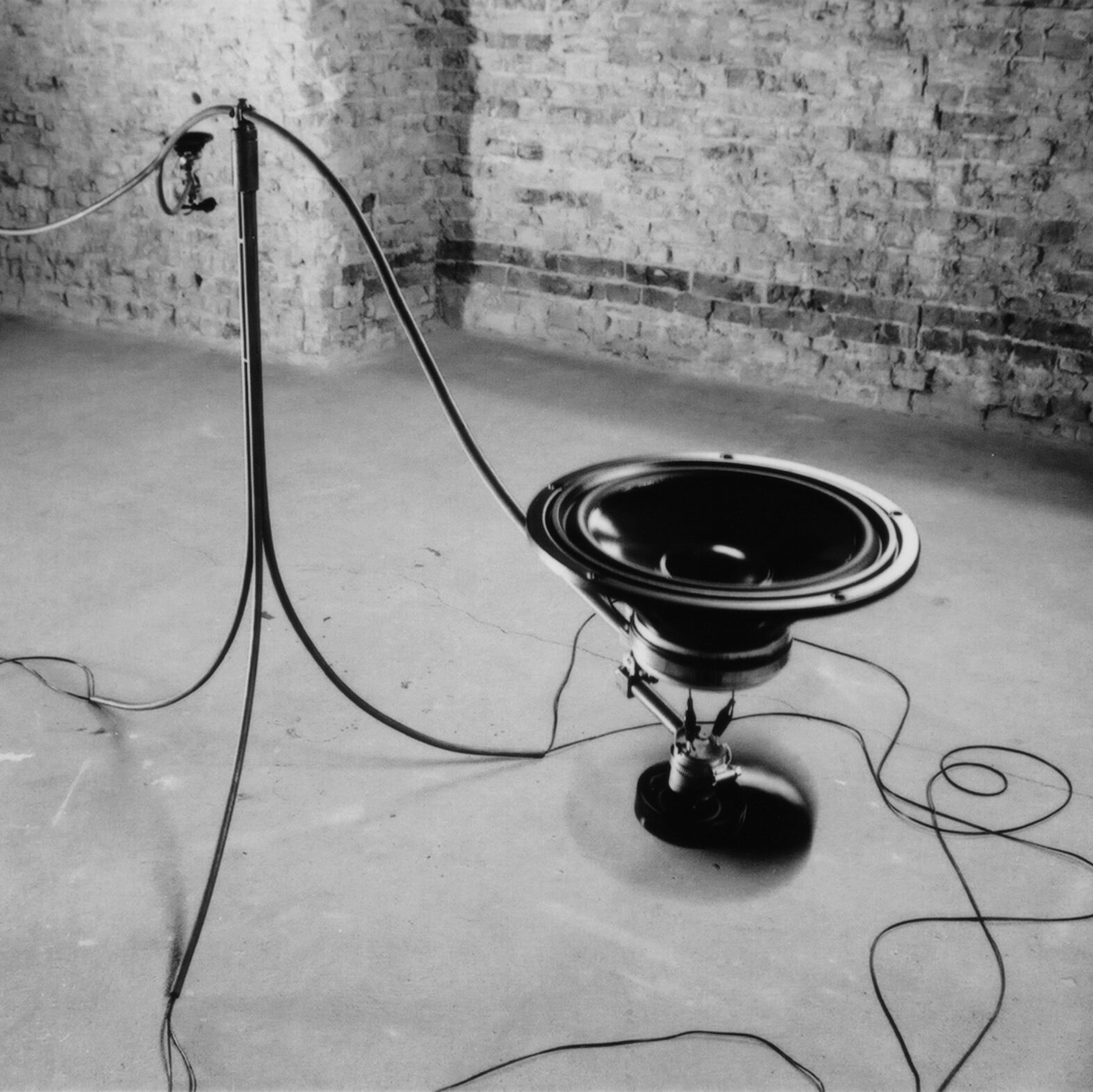
    Pirouette is part of a series of works exploring relationships between microphones, speakers, and surrounding acoustic environments through controlled, self-generating microphone feedback. Amplifying and aestheticising the acoustic inactivity between technological ‘inputs’ and ‘outputs’ – stand-ins for their corporeal correlates, the ear and mouth – the notion of a causal sound producing object is challenged, and questions are posed as to the status of the ‘amplified’. By building flawed technological systems and nullifying their intended potential for communication, the ear is turned towards the empty space between components; to the unique configurations of each amplifying assemblage.

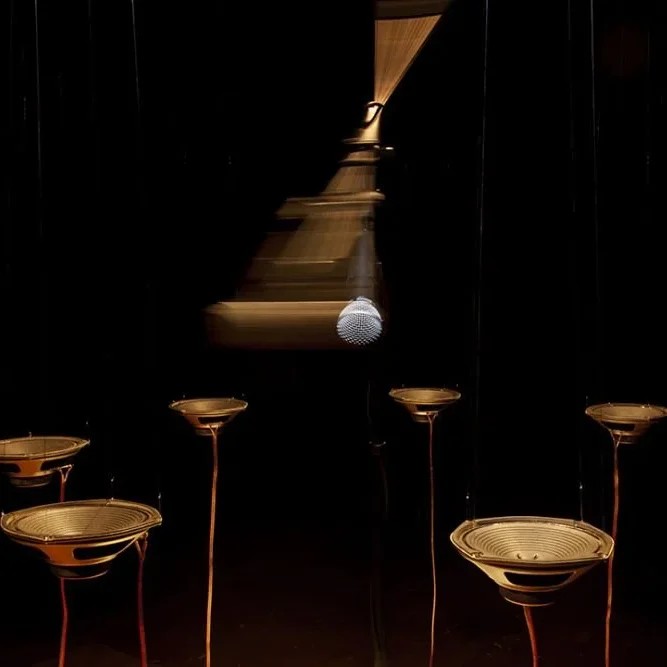
    In Pirouette, a microphone rotates slowly, like a life-sized ballerina atop a music box, bringing it in proximity to seven mounted speaker cones. As the microphone hovers over each speaker in sequence, a tuned feedback melody emerges. Throughout nine full rotations, a skeletal version of the main theme from Tchaikovsky’s Swan Lake ballet can be heard.

    another (better?) video

  • Janet Cardiff and the Forty Part Motet

    Janet Cardiff and the Forty Part Motet

    The Forty Part Motet (A reworking of “Spem in Alium” by Thomas Tallis 1573)

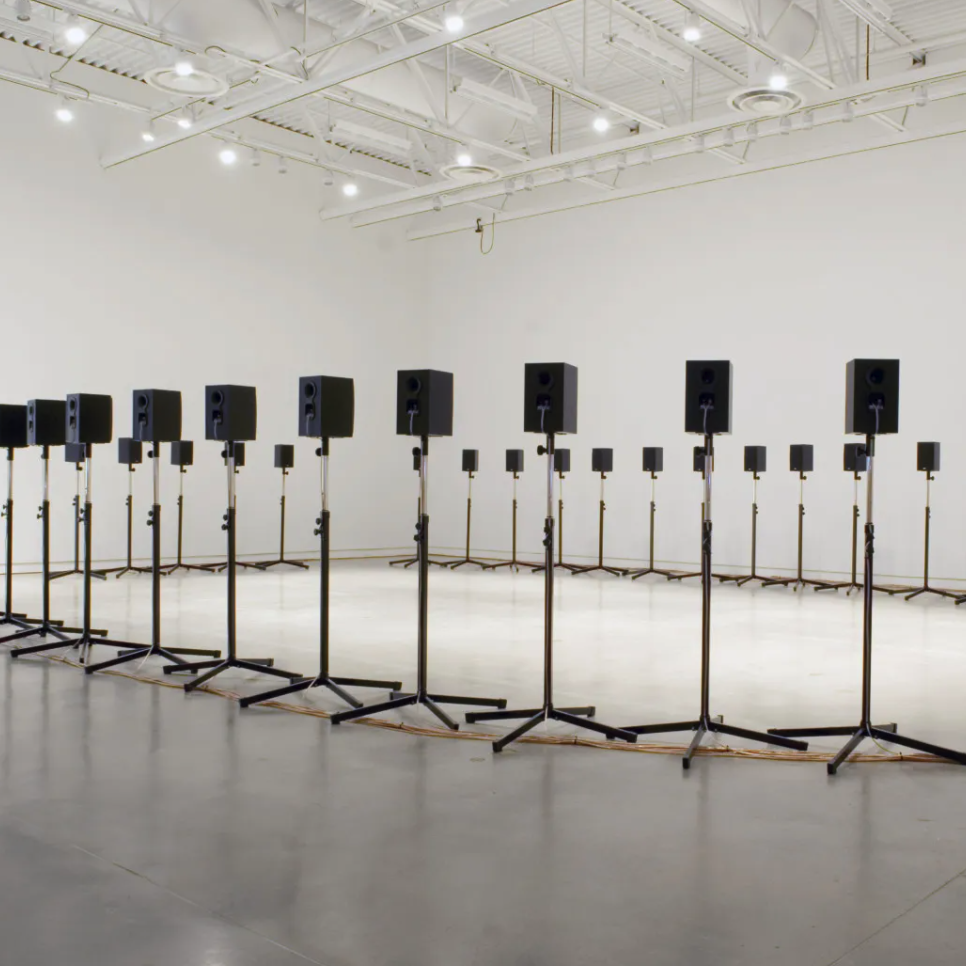
    Forty separately recorded voices are played back through forty speakers strategically placed throughout the space.

    Comments by the artist:
    “While listening to a concert you are normally seated in front of the choir, in traditional audience position. With this piece I want the audience to be able to experience a piece of music from the viewpoint of the singers. Every performer hears a unique mix of the piece of music. Enabling the audience to move throughout the space allows them to be intimately connected with the voices. It also reveals the piece of music as a changing construct. As well I am interested in how sound may physically construct a space in a sculptural way and how a viewer may choose a path through this physical yet virtual space.

    I placed the speakers around the room in an oval so that the listener would be able to really feel the sculptural construction of the piece by Tallis. You can hear the sound move from one choir to another, jumping back and forth, echoing each other and then experience the overwhelming feeling as the sound waves hit you when all of the singers are singing.”

  • Small Sonorities | Ellen Moffat

    Small Sonorities | Ellen Moffat

    The senses with which we engage with the world shape the sense we have of the world. Sound affirms embodied experience, sensorial knowing, and the dynamic relations of sound and space. The listener makes sense of sound from within the transience and ceaseless fluctuation of sound. The materiality of sound raises questions about what was heard. The certainty of the visual – the stability of objects, the centred subject, borders, and logocentric knowing – is contested. Sonic materiality and temporality cause doubt.

    How we listen to sound informs how we hear each other and the world. Sound connects the listener to others and to the world through embodied knowing, visceral sensation, and affect. The listener is in continual production with  sound’s non-sense while making sense of its fluctuation. Sound, bodies, forces of energy matter, and the world intertwine in their becoming relations and transpositions. The different rhythms of sounding bodies affirm the diversity of the sounds of others, the subjective and intersubjective engagement of listening, and the present-ness of sound’s fluctuation. We hear the world as relations, interrelations, and transformation.

    Small sounds draw me into their fluctuating tones and temporalities as if they are the beginning of language of the un(der)heard and (in)audible and of sound as a life force. The particularity of their soundings evokes the multiple subjectivities and pluralities of differences and otherness. Meaning is contingent, understanding incomplete. The listener constructs sense within the presence and absence, transience, and temporality of sound’s materiality. Listening and hearing intertwine in embodied relations of sense and nonsense, sonic materiality, and otherness as Voegelin’s sonic possible, an alternate world that reveals how the world might be and the social and political implications of this possibility.

    A lot of interesting work on Ellen’s site

  • David Tudor | Rainforest

    David Tudor | Rainforest

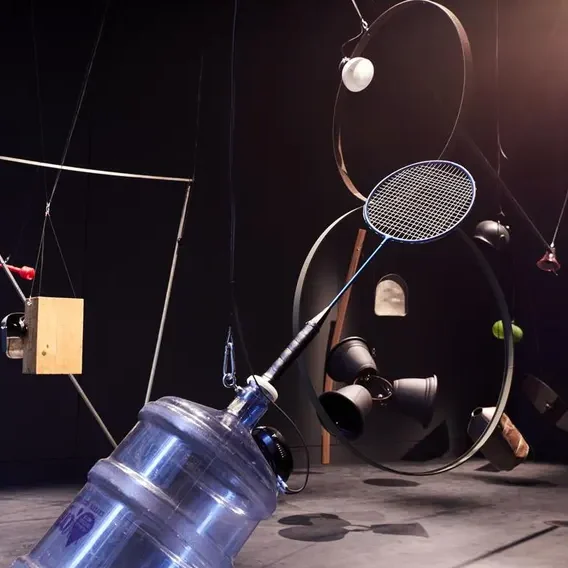
    Rainforest, a sound art installation from 1968 by David Tudor, uses audio exciters (or transducers) to vibrate physical objects, turning them into speakers.

    Rainforest Explanation 

  • Ed Osborn

    Ed Osborn

    Flying Machine #3

    Ed Osborn works with many forms of electronic media including installation, video, sound, and performance. Osborn has received grants from the Guggenheim Foundation, the Creative Work Fund, and Arts International and been awarded residencies from the DAAD Artists-in-Berlin Program, the Banff Centre for the Arts, Het Apollohuis (Eindhoven, Netherlands), STEIM (Amsterdam), and EMPAC (Troy, NY).

    Ed Osborn – Sound Installations