Focus Area
Prototyping Local Policy + Guidelines
This topic invited organizations and businesses interested in collaboratively (re-) imagining how strategies for food waste reduction within business operations can be embedded within policies. As part of this topic, we focused on specific and actionable shifts that can take place at a city level, using current policy as precedent. Over a series of workshops and activities, members of this group worked together to develop new policy goals and regulations that can then be further developed, tested, and proposed as part of larger policy designs.
Approaches / Methods
Traditionally, design is brought into the policy process during implementation. However, the approach of prototyping policy advocates for design to be integrated throughout. The CFIL Design Team began by mapping the current landscapes of policies that impact food waste and circularity in the Canadian context, bringing together Indigenous, municipal, provincial, federal, non-government policies and guidelines into one visualization. We layered this initial research with a collective mapping exercise with Equitable Food Circle members, which generated insights about how little clarity surrounds these policies for those who might be impacted by them, and also that many policies bend more towards guidelines rather than enforceable laws or acts.
We also conducted precedent research on policy design. We were interested in how we could use our roles as designers within a policy space. We found articles and publications sharing how design strategies such as prototyping, iteration, and collaboration/participation (co-design/participatory design) could be used within policymaking to give agency to stakeholders earlier in the policy development process. This research helped us see how a typical design process cycle matched up to a policy development cycle and reaffirmed that our team was most interested and best able to support early-stage policy design work.
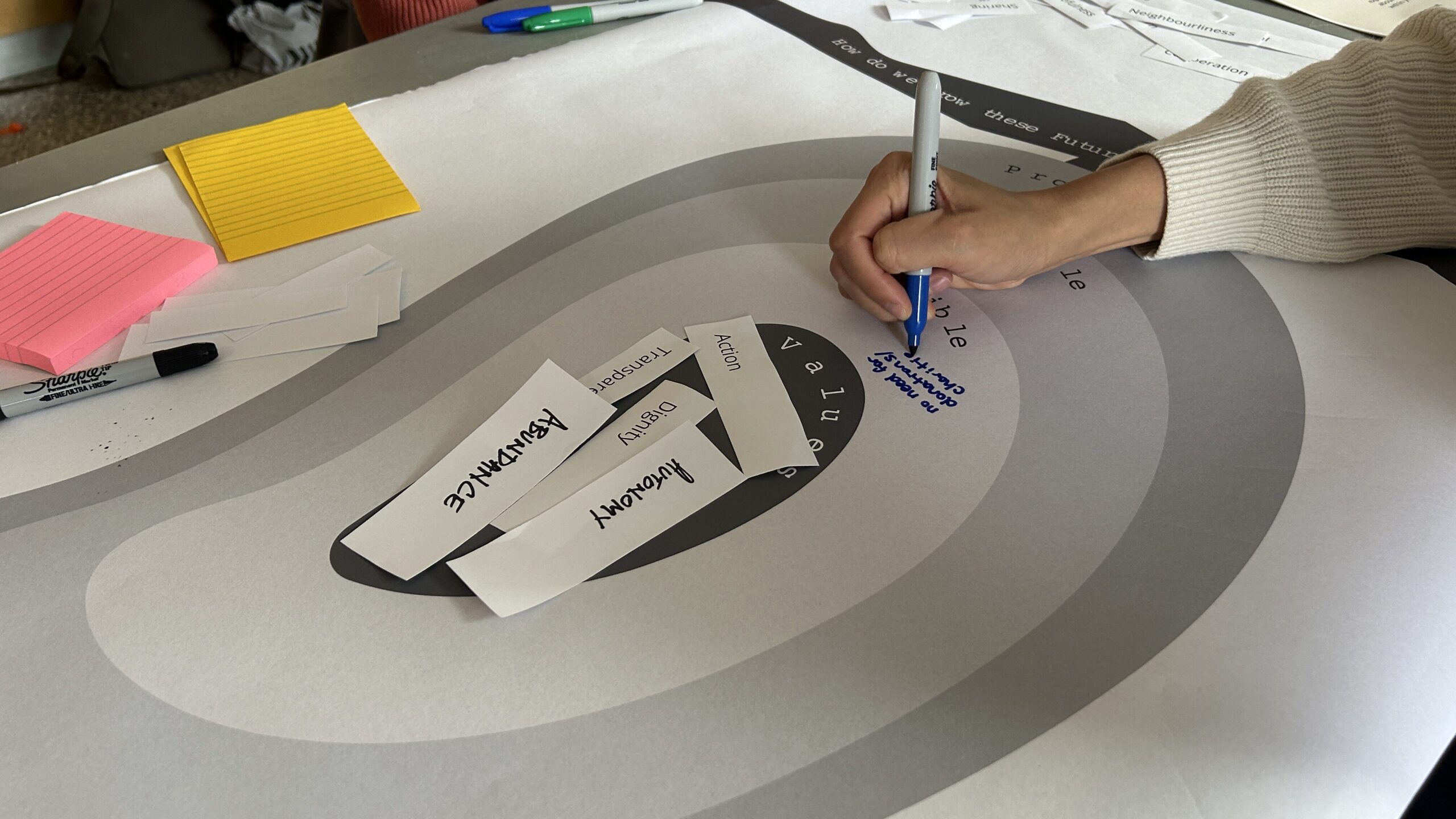
As we were entering the policy development process at a very early stage, we saw an opportunity to begin this work by asking our collaborators to identify the core values that they wanted to underpin the food system they wanted to be a part of. This emerged from reading about desire-based and value-based design practices, such as those outlined by Renata Marques Leitāo. By asking our collaborators to start this work with imagining a desirable future through values, we hoped to help break out of the current food system paradigm and work backwards to see how we could design a pathway towards a more desirable system. This shaped our first co-design workshop with participants.
The second workshop built directly off the ideas and conversations generated during the first workshop, with a goal of bringing the values and ideas generated into a more tangible and actionable space. What would have to actually happen if a specific policy was put in place? What are the intended/unintended consequences? We created a list of possible “what if?” scenarios that imagined policies that could impact the local food system. These workshops were supported by a variety of materials, including the Stone Fruit Map and the Speculative Policy Deck, described below.
Some key themes that emerged from these conversations included: using different combinations of incentives and enforcements to help businesses reduce food waste; different ways of tracking, reporting, and communicating food waste data; and food waste education from a public and business facing perspective. We also had many group members discuss how Indigenous worldviews, values, and policies could be incorporated and centred in policy approaches to these scenarios.
Following the workshops, we synthesized learnings and followed up with business participants with one final activity, the CFIL Policy Probe Kit. After asking about what values need to be embedded in food-related policy work and our broader food system, the goal with this kit was to invite more specificity for each participant on what would need to change for their operations or work in order to achieve some of the desired goals that were named in our previous co-design sessions.
Knowledge Sharing
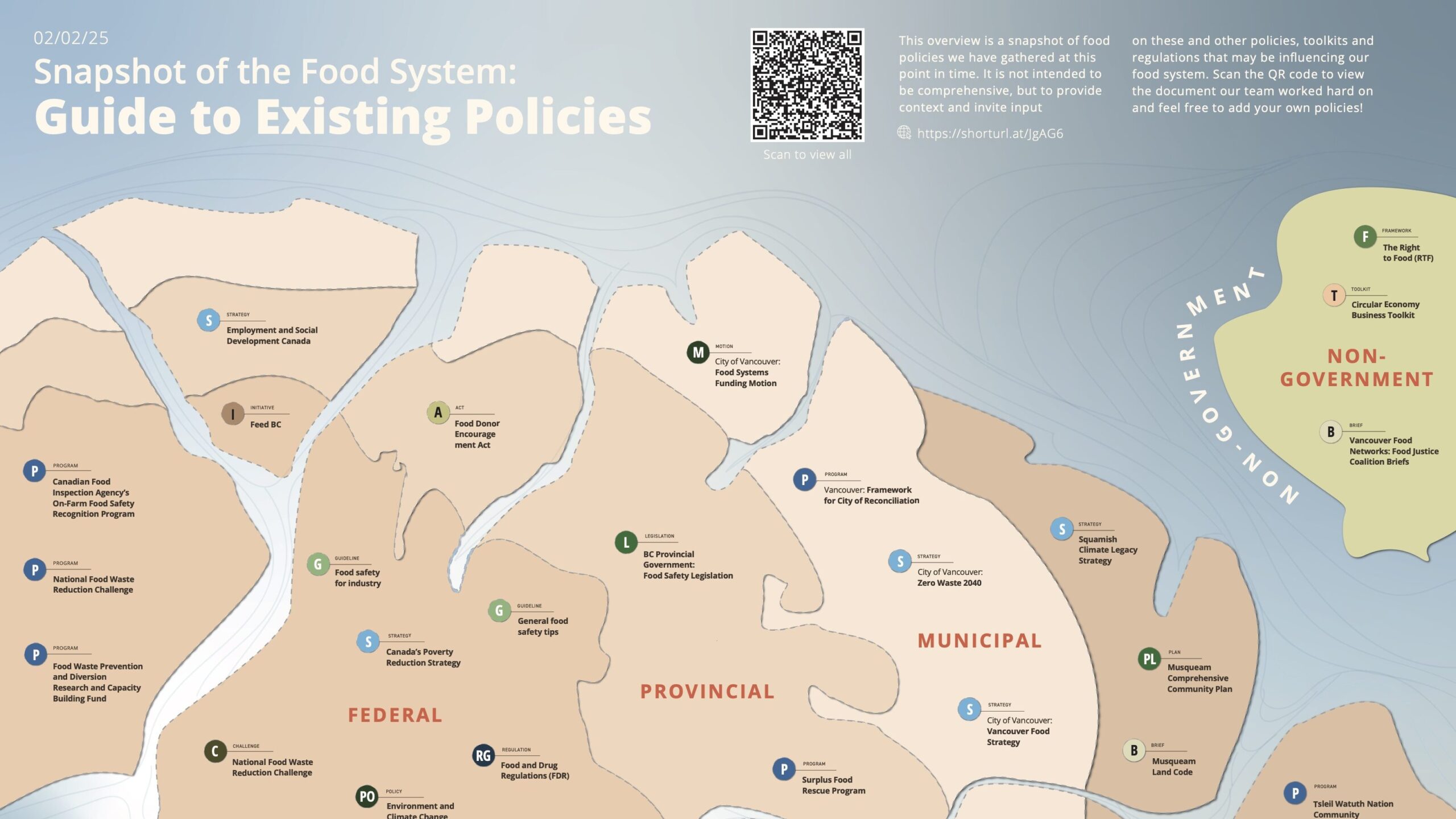
This map visualizes the landscape of food policy that impacts Vancouver, bringing together Indigenous, municipal, provincial, federal, non-government policies and guidelines into one visualization. It served as a launching point for deeper discussion and co-design with Equitable Food Circle members.
The stone fruit maps were based on Dunne and Raby’s “PPPP” diagram from their research Speculative everything: Design, fiction, and social dreaming. (2013). Each fruit had three rings, labeled “Plausible”, “Probable”, and “Possible”, with the stone pit in the centre labeled “values”. During the event, participants worked in groups of ~3-4 to identify values that they want to embed/centre in their desired food system. We had some pre-written values printed on paper cards that were ready to be used, along with the option for participants to write their own on blank paper cards. These values were placed in the pit of each group’s stone fruit diagram. The design team acted as facilitators (one per group) to help discussion flow and probe further when needed.
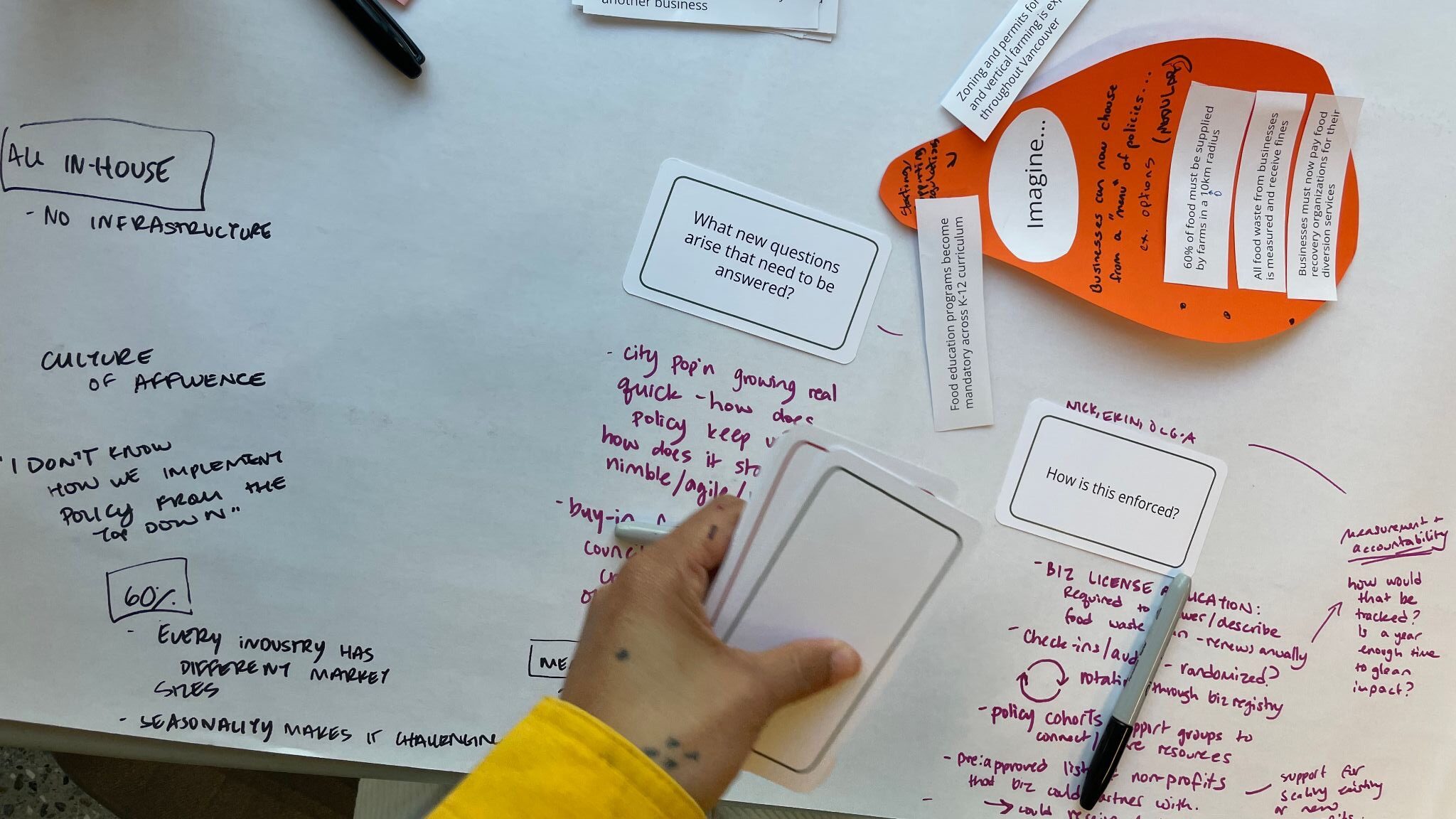
To facilitate conversation and idea generation around policy development, our team developed a series of speculative policies and a deck of cards. The cards were written in plain language and included questions that could help further and focus the conversations about corresponding speculative policy scenarios shared with the group. These included speculative questions, such as “What emotions drive this?”, “What fears arise?”, “How are our grandchildren impacted?”, “As a result of this intervention, what can we say we are proud of?” and so on.
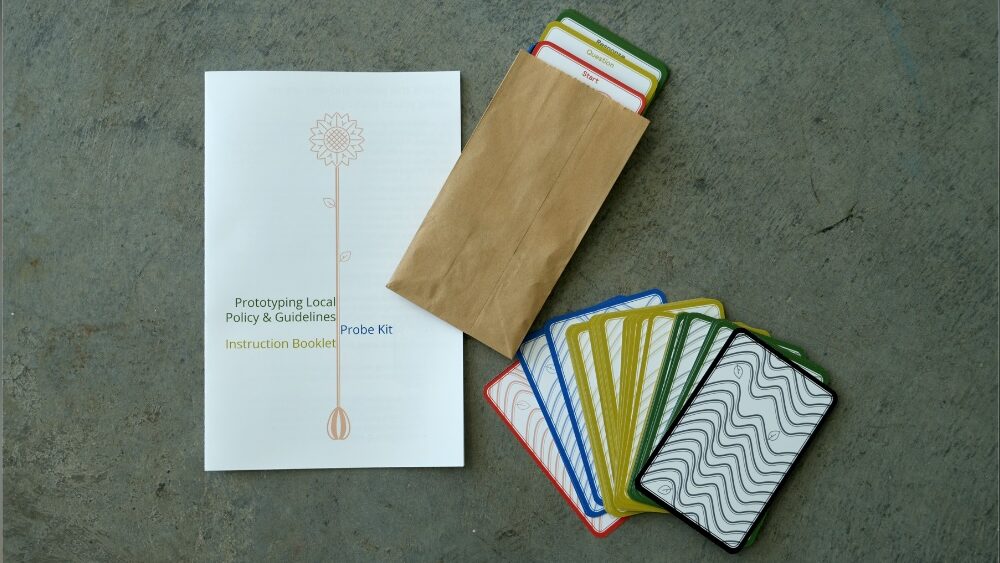
The probe kit invited participants to imagine what steps their business or organization might take to reach a specific goal related to reducing food waste. Facilitated through a card deck containing self-led reflective questions, this activity was intended to help us identify: What existing resources can businesses and organizations currently leverage to achieve these goals?; and, What support or incentives would be especially helpful, relevant, and desirable for the municipalities to consider offering to support businesses and organizations in achieving these goals?