Categories
news S3D

Meetup : Higher, Faster, Better? S3D and Frame Rates :: Feb 16, 2012

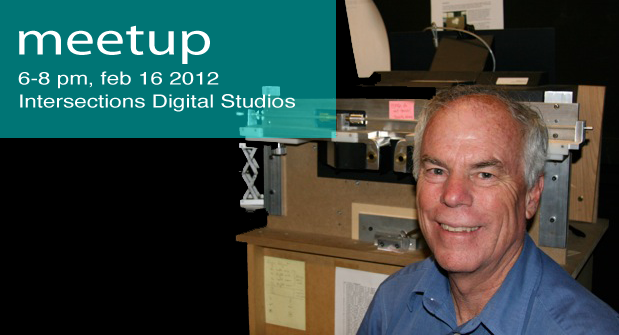
The S3D Centre at Emily Carr in partnership with Grand NCE presents UC Berkeley Professor and Vision Scientist Martin Banks 

This event is FREE and open to the public, but space is limited!
Register now at: 
http://s3dmeetup4.eventbrite.com/

We often hear about the famous ‘3D headache’ some people report when watching an S3D movie. Other times we are able to see image artifacts including flicker and unsmooth motion, either due to the captured image or even the projection itself. There are known issues that are associated with S3D content that we must acknowledge and work to improve. Martin Banks has been a key figure in the S3D world where his research has become definitive in understanding the topic of visual perception. His presentation is a must-see for anyone interested in the future of S3D delivery and production. He will discuss how different presentation methods affect the visibility of flicker, motion artifacts, distortions in perceived depth, and examines the properties of these methods in the spatio-temporal frequency domain. From this examination, he has been able to generate a series of predictors of which experiments were conducted and reported on. Martin will summarize in his research on why these issues occur, and will recommend how we can minimize these undesirable effects.

There will be the usual draw for a great door prize, so don’t forget to bring your business cards for a chance to enter! Stay tuned for more upcoming Meetup events from the S3D Centre.

**********************************
S3D Centre Meetup :: Higher, Faster, Better? S3D and Frame Rates with guest Martin Banks
This event is FREE and open to the public but space is limited! 
Register: http://s3dmeetup4.eventbrite.com/

Thursday, February 16, 2012
Emily Carr University of Art + Design
North Building | Intersections Digital Studios
Event 6–8:30 pm (door 5:30)
**********************************

Martin S. Banks received his Ph.D. in Developmental Psychology in 1976 from University of Minnesota. In 1985, he joined UC Berkeley School of Optometry where he has been an Associate and Full Professor of Optometry and Vision Science until the present. He was Chairman of the Vision Science Program from 1995-2002, and again in 2012. Banks has received several awards for his work on basic and applied research on human visual development, visual space perception, and on the development and evaluation of stereoscopic displays. He has also been appointed Fellow of Universities and Societies since 1988 to as recent as 2011.  Read more about Martin and his work at UC Berkeley BanksLab at their website.http://bankslab.berkeley.edu/

Emily Carr’s S3D Centre is a national centre of excellence dedicated to advancing the art of stereoscopic 3D through research, education and training.

 Visit us online: http://www.s3dcentre.ca
Follow us on Twitter: @emilycarrs3d
Categories
news S3D

Masterclass: The Art of 3D Storytelling :: Feb 10 + 11, 2012

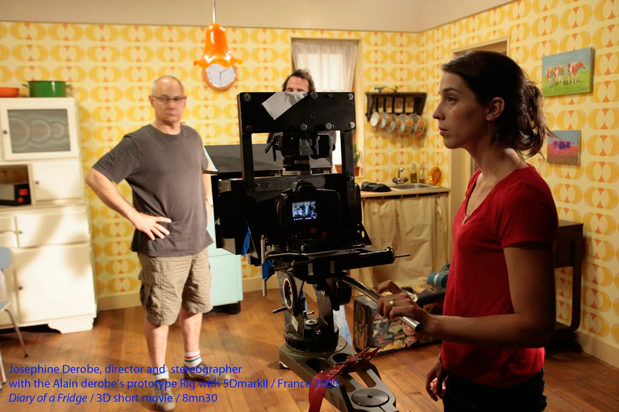
The S3D Centre at Emily Carr with the support of GRAND NCE & the Consulate General of France in Vancouver presents a very special event: The Art of 3D Storytelling with special guest Joséphine Derobe. This Masterclass will introduce the concepts of scriptwriting, directing, and a variety of storytelling techniques that are unique to Stereoscopic 3D productions. Joséphine Derobe is an award winning filmmaker and 3D Stereographer currently based in Paris, France. She first began working as a reporter and photographer, and her career in Stereoscopic 3D began in 2006 when her father Alain Derobe (also a Stereographer) suggested she learn about the industry. She fell in love with the medium during her first production and at that point switched her full time job to learn the art of S3D.

In the past six years, she has worked on S3D feature films, corporate films, short films and commercials as a Stereographer. One of her achievements to date has been the creation of the Natural Depth Method (also known in the industry as the Derobe Method) an innovative 3D filmmaking technique that she co-created with her father Alain Derobe. As a S3D Director, Joséphine is very interested in the 3D language and attempts to explore the full capacity of this wonderful medium in an artistic way.

Her first short film as writer, director and stereographer is called Diary of a Fridge (2011). This award winning film features live action and stop motion and having been selected in many 3D film festivals during 2011, it has won the grand prize at International Rimouski Festival (Quebec/Canada ), 37th NSA Convention (Colorado /USA), Be-Film Festival (New-York / USA), and Dimension3 Expo (Saint-Denis/ France).

Curriculum 

The Masterclass begins Friday, February 10th at 7pm for a screening of the award winning film “Pina” at The Park Theatre (3492 Cambie Street). Masterclass attendees receive VIP seating and Joséphine will be present to introduce the film and answer a Q&A.

The Masterclass continues Saturday, February the 11th from 10am to 3pm where Joséphine will present on the Art of 3D Storytelling. Joséphine balances her work in both technical and artistic roles, which makes her especially talented and very popular within the filmmaking industry. Within this intimate class size, attendees will be encouraged to interact with Joséphine as she demonstrates a variety of techniques and discusses theory. She will present her short film, “Diary of a Fridge”, and will show clips from the ‘Making of Pina’, and other films she has worked on. Joséphine will answer questions and provide some suggestions for successful S3D projects for everyone to keep in mind for their first or next S3D endeavour.

***************************************

Filmography as a Stereographer:

 * Recently completed “Astérix et Obélix”, “On Her Majesty’s Service”, dir. Laurent Tirard (Coming October 2012)

* Currently filming “Minuscules”, dir. Thomas Szabo and Helen Giraud (Coming 2013)

*  “Pina” (2011), dir. Wim Wenders *  “If Buildings Could Talk” (2010) dir. Wim Wenders

* “Sea Rex 3D, IMAX” (2010) dir. Ronan Chapalain and Pascal Vuong

Filmography as a Director:

* “Diary of a Fridge” (2011)

* Currently in production for a 2012 short film.

***************************************

The Art of 3D Storytelling with Joséphine Derobe.

Only 30 spots available, register soon!

http://s3dmasterclass.eventbrite.com/

$60 registration fee includes the evening screening of “Pina” with Joséphine Derobe at The Park Theatre, a five hour workshop, and a full lunch.

***************************************

Screening of “Pina” Friday, February 10th, 2012 at 7pm

The Park Theatre, 3492 Cambie Street

Workshop on Saturday, February 11, 2012 10am-3pm

Emily Carr University of Art + Design North Building | Intersections Digital Studios

***************************************

Emily Carr’s S3D Centre is a national centre of excellence dedicated to advancing the art of stereoscopic 3D through research, education and training.

Visit us online: http://www.s3dcentre.ca

Follow us on Twitter: @emilycarrs3d
Thank you to the Consulate General of France in Vancouver for their support of this event! The Consulate General of France in Vancouver, through his cultural office, is dedicated to promote cultural and artistic exchanges between France and Western Canada, with a particular emphasis on the digital media and visual arts sectors.www.consulfrance-vancouver.org email: culturel@consulfrance-vancouver.org

Thank you to GRAND NCE for their sponsorship of the event! GRAND is a research network and commercialization engine whose goal is to address complex issues in digital media and transform multidisciplinary research into user-centred solutions. GRAND will explore the use and application of digital media in a variety of settings including entertainment, healthcare, education, environmental sustainability, and public policy. GRAND is a federally-funded Network of Centres of Excellence supporting 34 research projects divided into 5 cross-pollinating themes involving researchers at 25 universities across Canada with more than 60 industry, government, and nonprofit partners.

Categories
Projects S3D

Meetup: IMAX the evolution of 3D :: Jan 19, 2012

This event is FREE and open to the public, but space is limited! 

Register now at: http://s3dmeetup3.eventbrite.com

We are in for a real treat with guest Dylan Reade, a freelance camera operator and stereographer who has specialized almost exclusively in IMAX 2D and 3D formats for the past twenty years. He will present a historical overview of the evolution of large format 3D over a twenty five year period, including an explanation of the technological breakthroughs that allowed IMAX to move beyond the technology of beamsplitters and into far simpler and more portable systems than those in current theatrical use. His presentation will include personal stories, photographs and an acknowledgement of some of the key players that kept 3D thriving prior to its current mainstream renaissance (including several from the Vancouver film industry). He will discuss the IMAX philosophical approach to 3D and an appraisal of how it has relevance for the broader industry. Clips from several soon to be released and also high profile IMAX 3D films will be shown.

**********************************
S3D Centre Meetup :: IMAX: The Evolution of 3D with special guest Dylan Reade 
This event is FREE and open to the public but space is limited! 
Register: http://s3dmeetup3.eventbrite.com/

Thursday, January 19, 2012
Emily Carr University of Art + Design
North Building | Intersections Digital Studios
Event 6–8:30 pm (door 5:30)
**********************************

Emily Carr’s S3D Centre is a national centre of excellence dedicated to advancing the art of stereoscopic 3D through research, education and training.
Visit us online: http://www.s3dcentre.ca
Follow us on Twitter: @emilycarrs3d
IMAX Corporation is one of the world’s leading entertainment technology companies, specializing in immersive motion picture technologies. The worldwide IMAX® theatre network is among the most important and successful theatrical distribution platforms for major event Hollywood films around the globe, with IMAX theatres delivering the world’s best cinematic presentations using proprietary IMAX, IMAX® 3D, and IMAX DMR® technology. 
http://www.IMAX.com

Categories
news S3D

HOTBOX by Nick Kalish

Nick Kalish is a 4th Year Film Video and Interactive Media student at Emily Carr University of Art + Design. Justin Alm interviewed Nick prior to the shooting of HOTBOX – the first undergraduate film shot in S3D at Emily Carr.

What are you guys doing here today?

We are testing out the “Derobe” method for my film, and tracking a person that is walking back and forth in order to keep them on screen plane, and in my film there is a conceptual reason for it. I am trying to lead my audience into the mental state of the character. I am hoping to use the “Derobe” method to achieve that, by keeping the character on screen plane while effectively having the set change its perspective to accommodate him.  It connotes a sense of narcissism and an egocentricity that is very important to the story and that character.

What is the story about?

HOTBOX is a psychological character study about a disturbed boy. I hope to develop a discourse around school shooters and adolescent mass murderers, and what accounts for such a profound annihilation of youthful innocence, how someone could transform from a child into a monster. Aesthetically, I am exploring various spaces.  I am exploring theatrical space. How S3D is sort of a return to theatrical space.  As well as the capacity for various 3-dimensional and 2-dimensional aesthetic conventions to portray mental space, how distorted perceptive and depth perception or different variations of perspective can lead you into the reality of the character.

So S3D is an essential component for your film?

Definitely. I am not going to release a 2D version of the film. I may make compromises later on, but for my first S3D film I want to make something that is entirely self reflexive and reliant on the medium itself. It is not something that will be the same in 2D. It is a completely different medium and should be regarded as such. Things that work best in S3D are very different than 2D conventions. Much more time can be spent within locked frame because your eyes are exploring it, looking around it, absorbing it in a way that doesn’t happen in 2-dimensional imagery. In 2D, we expect to a cut every couple of seconds because that is the pace that we are accustomed to.  The brain processes the majority of a 2D image within seconds, while stereo depth cues take longer to process. Thus S3D allows us the opportunity to slow things down.  That, along with a return to volumized theatrical space, is why I am choosing to maintain a fixed perspective for this film.

Did you write this film?

I co-wrote it with my lead actor, Jon Lachlan Stewart.

Were the technical components of the production’s concept considered while it was being written?

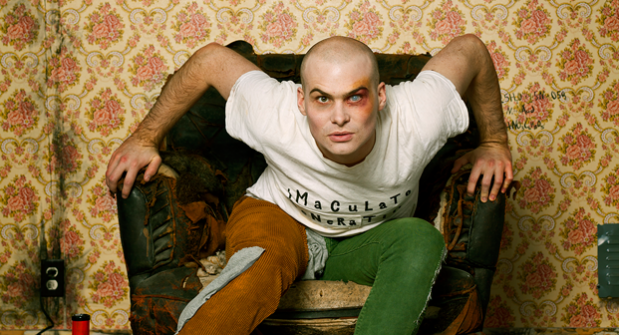
I actually had all of the technical components predominantly figured out before I even started writing. I knew exactly what I wanted it to look like. The writing portion was primarily the development of the monologue. However I did weave the 3D aspect of the film into the story in a self reflexive manor. For instance, the main character has one blind eye, a birth defect or sorts. It is ironic because he cannot perceive depth.

Who is the audience that you are hoping to reach with a film like this?

It is potentially going to be very controversial, I know that already. It’s a bit twisted. It is something that I am going to have to defend it in a lot of different ways, and that is why I have done my homework on the topic. School killers, bombers, it is a very touchy subject. I wanted to make sure that while I am very fascinated by these sort of characters who make light of their situation while the are in the midst of doing something terrible, I want to make sure that I am not glorifying them as much as I am attempting to understand them.  Though to me their criminal psychology is titillating, and looking at recent film and television content, I don’t think I am alone. So in that case, I am looking at a very broad audience. Anyone who enjoys watching characters like Hannibal Lecter or Jack Torrence should appreciate this film.  I am also making it with the S3D community in mind.  There are brief moments that I intentionally stress the eyes through divergence for dramatic effect, which may polarize peoples opinions as well. It will be interesting to hear what the 3D folks have to say about that.

How are you funding this film?

I am funding the film through Kickstarter.com. Kickstarter is an awesome website for raising money for projects, in a central location with an all or nothing funding model. Basically I have until January 8th to meet a funding goal of $1500 or we don’t get anything, and we really need the help. They aren’t just donations though, I am offering awesome backer rewards like the fantastic poster we have created, copies of the film with anaglyph glasses, as well as associate and executive producer credits on the film itself. Check it out! http://www.kickstarter.com/projects/nickkalish/hotbox

Is there anything else you would like to say?

I would just like to thank the S3D centre at Emily Carr for all of their generosity and support.  They welcomed me with open arms as both a content creator and an intern, donating their fantastic resources and wealth of knowledge. I would love to continue my relationship with them and help them any way I can to become the renowned establishment they deserve to be.

Check out HOTBOX at http://synapscinema.com/hotbox

Categories
news S3D

Meet the Gear :: hurricane rig

At a recent S3D Centre Meetup event S3D Production and Post Workflow, guest presenter Ron Steinberg, Brand Manager & Buyer for Amaya Foto, gave a demo of the Hurricane Rig. A few minutes before Ron stepped on stage, Justin Alm interviewed him about the history, usability, and films currently being produced on the Hurricane Rig.

First things first, is Hurricane the name of the company that manufactures the rig?

No. The rig is manufactured by a company called GenusTech; Hurricane is the name of the rig itself. It was designed by the British filmmaker Alister Chapman. Alister called the rig the Hurricane because he predominantly shoots natural weather phenomenon. About 5 years ago, he got into shooting his films in 3D and started designing his own rigs. The Hurricane rig as we know it today is a 5th generation design. The rig has been under development for several years but has been on the market since February of 2011.

HurricaneRig_with_cameras


The Hurricane Rig with cameras.

What kind of filmmaker uses the Hurricane Rig?

The Hurricane has a broad user-group. It is being used for educational purposes here at Emily Carr University of Art + Design. The Hurricane has found its home in many education institutes around the world because it is completely manual; when making an adjustment to the rig, you have to do everything by hand. For the student, their decisions become more intentional and they develop a deeper understanding of the mechanics of Stereoscopic 3D filmmaking.

Documentary filmmakers are another large user-group for the Hurricane. The rig can be setup quickly — in about 10 minutes not including mounting cameras. It packs down into a small flight case that can be checked as airline luggage. As Alister Chapman is a documentary filmmaker, who travels all over the world, one of his primary goals in designing the rig was to have it pack down into a small flight case.

A third group using the Hurricane Rig are independent feature filmmakers. Night of the Living Dead — 3D Reanimater used the Hurricane’s. That production company bought 2 rigs because they are inexpensive for their capabilities. It is liberating for a production company to purchase a couple of Hurricanes instead of renting rigs for thousands of dollars per day. The Night of the Living Dead production has been able to achieve great results using Canon cameras with Steadicam® stabilization.

OnLocationHurricane2_0

Image of the Hurricane Rig as used on location.

I recently interviewed Sean Arden, who works for the S3D Centre, about the Kerner Rig. How does the Hurricane Rig differ from the Kerner Rig?

Essentially, the Kerner and Hurricane rigs do exactly the same thing. They are both beam splitter or mirror rigs but the major difference between them is that the Kerner Rig is completely motorized. The interaxial, focus pull, zoom, convergence are all motorized; whereas, the Hurricane is a completely manual rig with optional motorization. Alister designed it to keep the price-point down, keep it light-weight, and simple to use and maintain. Apart from those differences, the rigs achieve essentially the same results.

The Kerner may be slightly easier to use when making a zoom change but we generally don’t make those sorts of adjustments when filming in 3D. Usually, we don’t adjust the zoom or interaxial during a take when shooting in 3D because the human eye doesn’t make those adjustments in reality. Also, the Kerner is designed to use a particular camera system whereas the Hurricane is camera agnostic, as long as those cameras can Genlock [Synchronize their frame rates]. As it is an open platform, we can put anything from small DSLRs to RED EPIC’s on the Hurricane. Nothing has to be changed on the rig to use a wide variety of cameras, although the use of the Bolster Bracket triangulation kit stiffens the unit up for heavier payloads. As I said earlier, the Hurricane shines when people have to travel to remote locations. Although the Kerner can be transported, it doesn’t have the same portability or option for shooting hand-held like the Hurricane.

So I’ve probably watched a lot of productions made on the Hurricane?

I don’t know if you’ve had much of an opportunity. In North America, we’re behind the times in terms of exposure to 3D content but I do know the rig has been used in many productions over the past year. We’ll be seeing content produced on it more and more.

Categories
news S3D

Meet the Gear :: Sandde

In this installment of Meet the Gear we bring you Sandde, a freehand stereo 3D animation software that allows you to ‘draw in space’. Justin Alm chats with Director/Animator Munroe Ferguson, an expert in Sandde who led a Masterclass at Emily Carr in the Spring to find out how it works.

Let’s start with the basics, what is Sandde?

Sandde stands for Stereoscopic Animation Drawing Device so there’s two ‘d’s and one ‘e’ – a lot of people misspell the name. Essentially, instead of drawing on a two dimensional surface, like on a piece of paper, we draw in three dimensional space. SANDDE is also an animation tool, as it has some motion capabilities. 

How long have people been using Sandde?

People have been using the software for about 10 years. Currently, it is more available for students. As it is a Canadian invention, the first place you’ll find Sandde is Canadian institutions.

Who would use Sandde?

People who use Sandde are between the practices of drawing and sculpture. They want a different look than what you get using computer graphics in Maya or Softimage. Those programs use math but Sandde is closer to drawing. Drawn animation was often referred to as 2 dimensional until Sandde. Now people are baffled because we’re doing something between 2 and 3D. If you drawn something computer generated, there is a perfected quality that seems cold. When you see something drawn with Sandde, the imperfections make the image look more like a drawing.

IMG_0182

GRAND Research Associate Steve Oldridge working with Sandde

So Sandde doesn’t produce perfect-polished images?

While other computer programs are more about producing shapes and surfaces, Sandde is more about lines – edges of things. For example, if I want to draw a face, I can produce the image with 4 lines but in CG you’d have to spend more time working on producing surfaces, forcing imperfections, to get things looking natural. With those 4 lines in Sandde, we get down to the essence of cartooning. If you draw a circle with a line and 2 dots and show it to a new born baby, the child will smile at the image. We are hard-wired to take minimal amounts of information and interpret this info as a face or any other kind of image.

What are the components of Sandde?

The system is comprised of an input device and the Sandde software. The one being used here at Emily Carr is a cam wand [a device with 4 LEDs you can move around in front of a webcam]. The computer extrapolates where you’re holding the wand in 3 dimensional space, interprets that location, and enables the artist to draw. I have been consulting with graduate students at Emily Carr who want to use the motion capture studio as an input device for Sandde. The motion capture stage enables people to draw with their entire body. Usually, the artist needs an unusual input device because you need something that can draw width, height, and depth.

IMG_0185

GRAND Research Associate Steve Oldridge working with Sandde

Traditionally speaking, drawing requires 2 physical objects to interact with to create an image. With Sandde, you seem to be drawing pictures in the air. How does it feel?

You don’t have the pressure of the page to orient yourself so there’s a period of two weeks when you relearn your eye-hand coordination. If you’re proficient at drawing, it can be disheartening to pick up a wand and move it around and produce drawings like you did in kindergarten. After a couple weeks, you start to realize, you don’t need a surface and you start drawing the way you used to. Your style comes back. I can look at an artist’s portfolio before they use Sandde and know what style they will have. It turns out that style is not dimensionally dependent. Style is inside of you and linked to your personality. Whenever human beings encounter a new tool, we find a new way to look at ourselves.

Can you talk about how Sandde crosses over from research institutions into industry?

Sandde was developed by IMAX and I was one of two animators that made Paint Misbehaving – the first 3D film to screen in IMAX theatres. Since then, we’ve made a few films with Sandde at the National Film Board. I did Falling In Love Again, which was very successful as a 2D film in 2003. At that time, 3D theatres were scarce. Apart from IMAX, there wasn’t a lot of opportunity to see 3D content. Now there is a proliferation of 3D monitors, TVs, gaming consoles, and theatres investing in projection equipment. The Wobble Incident was purchased by Sony and comes with the Playstation. At the moment, the amount of good 3D content is limited so experimental short films are being supported by industry.

So you see Sandde sticking around long-term?

Yes. There’s been a lot of development over the last year. Janro Imaging has invested a lot into improving the system. It’s great that Emily Carr has fostered cooperation between industry and academics. In the Stereoscopic 3D Centre, there is a creative back-and-forth between sectors. Good things will come from Emily Carr playing around with tools and for companies to get feedback from artists who are using their tools. In this environment, artists can influence the development of these tools. Sometimes people think we are helpless in the face of technology. In an R&D situation like the S3D Centre, we can be part of the process of developing tools. Technology isn’t just science; it’s a relationship between art and science.

Categories
news S3D

Meetup: Parallax Film Productions foray in to 3D :: Nov 2, 2011

This event is FREE and open to the public, but space is limited!

Register now at: http://s3dmeetup2.eventbrite.com/

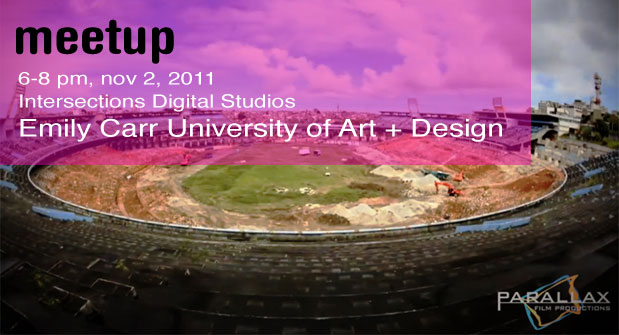
Hot on the heels of this week’s first S3D Centre Meetup event, we’re busily preparing for our next Meetup. This time, we’ve partnered with Parallax Film Productions to present: Parallax Film Productions Foray into 3D. 

What does an implosion of a major stadium in Brazil look like, and what does it take to capture it in 3D? How does a production progress from concept through to a major broadcaster like National Geographic Channel? Come to The S3D Centre’s 2nd Meetup to satisfy your curiosity from some of the best in the local industry.

Executive producer and director Ian Herring from Parallax Film Productions, and director, DOP and stereographer Sean White will present their work from “3D Blowdown: Fonte Nova Stadium” and talk about their journey into Stereoscopic 3D production. At this event, clips will be projected in 3D onto the big screen and attendees will hear exclusive behind the scenes details about one of the most unique productions to date. All attendees will be entered into a draw for a number of products, including a BluRay of “3D Blowdown”! Stay posted for more upcoming Meetup events from the S3D Centre including some high profile guests soon to be announced.

**********************************
S3D Centre Meetup :: Parallax Film Productions Foray into 3D 
This event is FREE and open to the public but space is limited!
Register: http://s3dmeetup2.eventbrite.com/

Wednesday, November 2, 2011
Emily Carr University of Art + Design
North Building | Intersections Digital Studios
Event 6–8pm (door 5:30)
**********************************

Parallax Film Productions delivers factual and dramatic programs to broadcasters all over the world. Parallax specializes in science and engineering documentaries, and produces content in HD and 3D for multiple media platforms.
http://www.parallaxfilm.com

Ian Herring, Blowdown 3D executive producer and director founded Parallax Film Productions to produce his own special brand of content – exploring the world of science and history for Canadian and international audiences. Working closely with his team in Vancouver, Ian emphasizes great storytelling above all else.http://www.parallaxfilm.com/about-us

Sean F. White is an award-winning photographer, cinematographer and film director whose assignments and personal projects take him to all corners of the globe. From indigenous cultures to extreme engineering, from adventure sports to nature’s splendors on seven continents, Sean embraces his subjects with passion and wonder. 
http://www.seanwhite.net

Categories
Uncategorized

Meetup: S3D Production and Post Workflow

The S3D Centre at Emily Carr in partnership with Genesis Matrix Video presents our inaugural Meetup for the Vancouver film and television community: “S3D Production and Post Workflow”.

This Meetup will focus on an easy to use stereo 3D rig with 3 unique camera setups. Come discuss the practical and conceptual considerations involved in S3D productions from a low or indie budget perspective.

The event is FREE and open to the public, but space is limited! Register online.

Ron Steinberg of Amaya Foto will demo the Genus Hurricane 3D Rig, one of the best light-weight beam-splitter rig solutions on the market. Attendees will have the opportunity to see 3 Hurricane setups in action (SI-2K, Sony EX3, Canon T3i). S3D post-production workflow, data management will also be covered. Snacks and beverages will be provided! And if that’s not enough, every participant will be entered into a draw for a GoPro 3D Hero system!

Also stay posted for details on our next Meetup event on November 2nd 2011, 6-8pm: “Parallax Film’s Foray into 3D”.

Emily Carr’s S3D Centre is a national centre of excellence dedicated to advancing the art of stereoscopic 3D through research, education and training.
Visit us online: http://www.s3dcentre.ca
Follow us on Twitter: @emilycarrs3d
Genesis Matrix Video provides creative professionals with the latest tools and technologies required to realize their vision in the fast changing technological landscape of today’s production and communication industries.
http://www.matrixvideo.ca

Ron Steinberg after attending York University’s Film School, Ron worked in the visual effects industry, producing effects work for feature films and television. He then spent 16 years as a commercial advertising photographer, and now works as a Brand Manager specializing in video at Amaya Foto. Ron has recently returned from Hong Kong where he underwent specialized training with Alister Chapman, the designer of the Hurricane 3D Camera Rig.
http://www.genustech.ca

Categories
Uncategorized

Nazi 3D, Philippe Mora and Me

[September 30, 2011 | By Alan Goldman]

Meeting Mora

Philippe Mora and I recently met at the Toronto International 3D Conference. He told me how in 1971 he knocked on Albert Speer’s door in Heidelberg (Speer designed buildings, monuments and decorations, as well as the parade grounds at Nuremberg and became Hitler’s Armaments Minister). Mora was invited in for lunch. He spent the day with Speer, who even showed him his 9.5MM home movies. I listened with a certain amount of incredulity, wondering how he could have met someone who was so integral to the malevolent aesthetic of the third Reich. This factual tale seemed like it was straight from a fictional Hollywood script. However, any doubt that I had about the veracity of Mora’s story was erased when he presented his most recent research, titled The Search For 3D in The Third Reich. He told the audience about two Nazi stereoscopic films (shot using a process that the Nazi’s called Raumbild) that he discovered last February. Yet, what was even more unbelievable was the fact that German scientists had employed the 3D film and projection medium during the 1936 Berlin Olympics

“We subsequently discovered that a Technical unit of engineers working with Zeiss Ikon at the Technical and Physics institute in Braunschweig in 1935 and 1936 built special 16MM high-speed stereoscopic units to film certain events at the Olympics. Why? We believe they had determined that in a close race a still photo may be an inaccurate image of who won, depending on the position of the camera. They initiated a plan: They built two stereoscopic rigs to film the events in 16MM at 50 frames per second from a special tower over-looking the finishing line. The cameras were triggered by the starter’s pistol. Even more enterprising they developed the film within seven minutes of the races finishing, and projected them with two projectors to examine the races in 3D. Many results were corrected when the judges viewed the stereoscopic films” (Mora).

philippe_mora_benwolf10_144_905

photo by Ben Wolf Photography

The Film Project

Man Made Mora is a study of Philippe Mora in 3D. Mora in his art and films continues to assess and understand his own life in relationship to the statement made by late German/American political theorist Hannah Arendt (in her unfinished book “The Life And Mind”), “The sad truth is that most evil is done by people who never make up their minds to be good or evil”. The film also documents Mora as he presently attempts to locate Nazi 3D stereoscopic footage (aided by German researcher Harald Grosskopf as together they search for the Holy Grail, i.e., Jessie Owens crossing the finish line in 3D at the 1936 Olympics).

Man Made Mora is also an exploration of Mora the man beginning with his journey, starting in Melbourne, followed by his move to London where he was an avant-garde artist and then to Hollywood where he became a famous film director. Interwoven will be a discourse regarding Mora’s relationship with his father (whose partner in the resistance was Marcel Marceau).

“I discovered that my father was one of few surviving Jews of the 14,000 murdered from that city. He was known in the Resistance by the nickname Mr. Mayonnaise, because he had observed that Nazis would not open sandwiches if mayonnaise was dripping out of them. Because of this, the Resistance would put identity cards into wax paper in mayonnaise dripping sandwiches” (Mora).

Although Mora has made four films about the scourge of Nazism, it is too simplistic to categorize him as a filmmaker obsessed with everything to do with the Third Reich. He has directed over 30 films in all genres. However, there are similar elements flowing through all of his art (Mora was an integral part of the late 1960’s London Avant-garde art scene) and films. Mora is interested in deconstructing and understanding Hannah Arendt’s phrase ‘the banality of evil’ (Arendt, 1906-1975). His latest revelation is a discovery of 3D films in the Third Reich, which parallels Mora’s controversial 1973 documentary Swastika. The film examined the Nazi appropriation of art, culture and media, thus transforming them into an instrument of servitude and evil.

philippe_mora_benwolf10_088_905

photo by Ben Wolf Photography

Why Mora in 3D?

In a recent email Mora told me about his motivation to continue to examine and make films about the history of 3rd Reich whether they be in 3D or otherwise.

“The fact is the more you study it; the more mysteries emerge about why it happened. 3D is just another angle of looking at it. I find the current histories and there are many, unsatisfactory. So I keep searching myself and Kafka in many ways was prescient about the coming catastrophes with his stories Metamorphosis, The Castle and The Trial”.

In the documentary film Man Made Mora, interviews conducted in interior spaces with limited depth cues can be accentuated by shooting them in 3D. Action sequences in exterior spaces (or 3D footage found by Mora) with the natural environmental depth cues will be given greater emphasis by employing three-dimensional cameras. The film is a mixture of biography, historical discovery and an investigation into the banality of evil. The documentary’s narration will be told through the director’s voice as I describe my various personal interactions with Mora as they unfold. Man Made Mora is process film; production of the film takes place as the events occur.