Trees and forests have a crucial role to play in climate change mitigation and they are critical multispecies habitats. The Branching Songs project aims to draw attention to the ecological significance of trees, their importance to sustaining life on Earth, and how listening to them may grow empathy for multispecies flourishing.
Branching Songs seeks to expand our perceptions about trees and forests by investigating how multispecies sound art may offer insights into the vital contributions of trees to human and more-than-human life. Focusing on old trees in Vancouver area and the Sunshine Coast, including those affected by the Transmountain Pipeline expansion and clear-cutting, the project elevates the voices of these inhabitants and ecosystems, highlighting their role in supporting both human and nonhuman life.
Led by Julie Andreyev, an artist, ECU associate professor, and co-director of the Basically Good Media Lab along with a team of ECU and community researchers —Maria Lantin, Simon Overstall, Lara Felsing, Giorgio Magnanensi, Sam Street, Keira Madsen, Cara Jacobsen, Leanne Plisic, Myles Feltenberger and Emma Pallay — Branching Songs draws inspiration from acoustic ecology, multispecies creativity, and performance, to forge new relations with trees as participants in immersive media and sound art.
Interspecies sounds, land-based practices, and Indigenous ways of knowing
By integrating creativity, technology, Indigenous ways of knowing and scientific inquiry, projects like Branching Songs invite us to reimagine our relationship with trees and forests, inspiring a renewed sense of wonder and reverence for the intricate web of life that surrounds us.
The project explores decolonial and land-based methods, by adapting Indigenous ways of knowing into the artistic process. Lara Felsing, an interdisciplinary Métis artist and recent MFA grad from ECU, created a noninvasive method for attaching contact microphones to trees. Drawing inspiration from Métis Ribbon Tree healing ceremonies, Lara devised ‘ribbons’ fashioned from recycled plant-based fabrics and combined them with her own harvesting and natural dying techniques. Through this adaptation, trees become active collaborators, woven into the fabric of sound art.
With Felsing, the team created Tree Feelers, instruments, sourced from the land, as touch interfaces to compose interspecies sounds, forging a harmonious dialogue between humans and nature.
Watch Recital With a Forest
Branching Songs is a complex and multifaceted project, composed of performances, installations, and workshops.
One of the performances, called Recital With a Forest, is a site-specific multispecies sound art staged in an intact old growth forest on the Sunshine Coast threatened by clear-cutting by BC Timber. Hand-crafted instruments with contact mics, biosensors, and local cast-off materials facilitated the collaboration with trees. In the performance, the Ensemble responds to the emergent soundscape of the forest, improvising sonic dialogues with elements like wind and bird songs, silent pauses highlight human-made sounds, fostering a nuanced relationship with the living forest ecology. Rooted in care and gratitude, this immersive experience embodies reciprocity between humans and forests, weaving a sonic tapestry of touch, tree acoustics, and forest vitality—a harmonious multispecies dialogue.
1 – Branching Songs Ensemble (left to right: Julie Andreyev, Myles Feltenberger, Giorgio Magnanensi, Keira Madsen, Simon Overstall) performing Recital With a Forest in Tuwanek Springs Forest, Sunshine Coast 2023. Photo courtesy of Keira Madsen. / 2 – Julie Andreyev using a Tree Feeler, as part of the Recital With a Forest performance in Tuwanek Springs Forest, Sunshine Coast 2023. Photo courtesy of Keira Madsen.
On April 25th, 2024, the Basically Good Media Lab hosted Durations V2, a student-led deep listening party and video art show created to highlight emerging voices from the local arts scene and present works in new media, sound/video art, and performance.
Organized and curated by BGML’s research assistants Rafael Zen and Khalil Alomar, the event transformed ECUAD’s IMS into an immersive environment where students, instructors, and members from the community gathered to engage with artworks in the first stages of conceptualization, most being shown to the public for the first time, and provide artists with feedback that supports the early stages of their careers.
The project started with Durations V1 in 2023, supported by Massy Arts Gallery, when New Media + Sound Art students from Emily Carr University felt the need to create a space in which experimental compositions from the courses Sound Essentials and New Media + Sound Art Core Studio could be shared with local audiences. Through the collaboration with the Indigenous-led gallery in Vancouver’s Chinatown, eleven students showcased their works in sound art, guiding attendees in a 50-minutes deep listening session that invited sounds from the East Pender Street and the centenary Ming Wo building to become part of the field-recording-based compositions.
“Wishing to create a cost-free event open to all, it was important for us, students, to cultivate dialogue with our closest communities. The experiments we create only make sense when shared among the local cultural scene, knowing that the artwork becomes alive when audiences give us their time and attention, something so precious in this late stage of colonial-capitalism. For art students, it’s necessary to have a space where audience appreciation can be fostered, and direct/horizontal dialogue between artist/audience is possible”, said Zen.
Durations V2
As an incubator for new ideas and experimentations in new media + performance, Durations V2’s line-up was composed by: Rafael Zen, Khalil Alomar, Kaila Bhullar, Anat Elkayam, Yona Cha, Marina Morrison, Myles Veltenhill, Miranda Firmston, Joseph Lu, and Jonathan Tsang.
Click here to listen to compositions featured in Durations V2
Supported by the Basically Good Media Lab, Durations will have ongoing iterations in 2024/2025, following the schedule:
Durations V3 – June, 2024
Durations V4 – August, 2024
Durations V5 – November, 2024
Durations V6 – February, 2025
Local emerging artists that wish to show their artworks in sound art, video art, experimental composition, field recording composition, or performance, should send a proposal to Rafael Zen at: rzen@ecuad.ca
: :
Credits: 1 – Attendees gathered around the deep listening session – Courtesy of Khalil Alomar / 2 – Artworks in new media and sound art exhibited at V2 – Courtesy of Rafael Zen
On March 20th in The Basically Good Media Lab, we hosted an artist talk by our very own 3rd year NMSA Student and Free Tools Research assistant Kyla Dooley!
In contemporary art, where boundaries are constantly pushed and redefined, Kyla Dooley stands out from the crowds, blending New Media innovation with a playful spirit.
Drawing inspiration from eclectic sources, she meticulously crafts each piece, weaving together elements of humor, and technology. Rejecting the boundaries of traditional categorizations like “conceptual art,” Dooley embraces a label of her own making: “conceptually based”. Rejecting the elitism sometimes associated with contemporary art, she uses humor as both a tool of engagement and a form of protest.
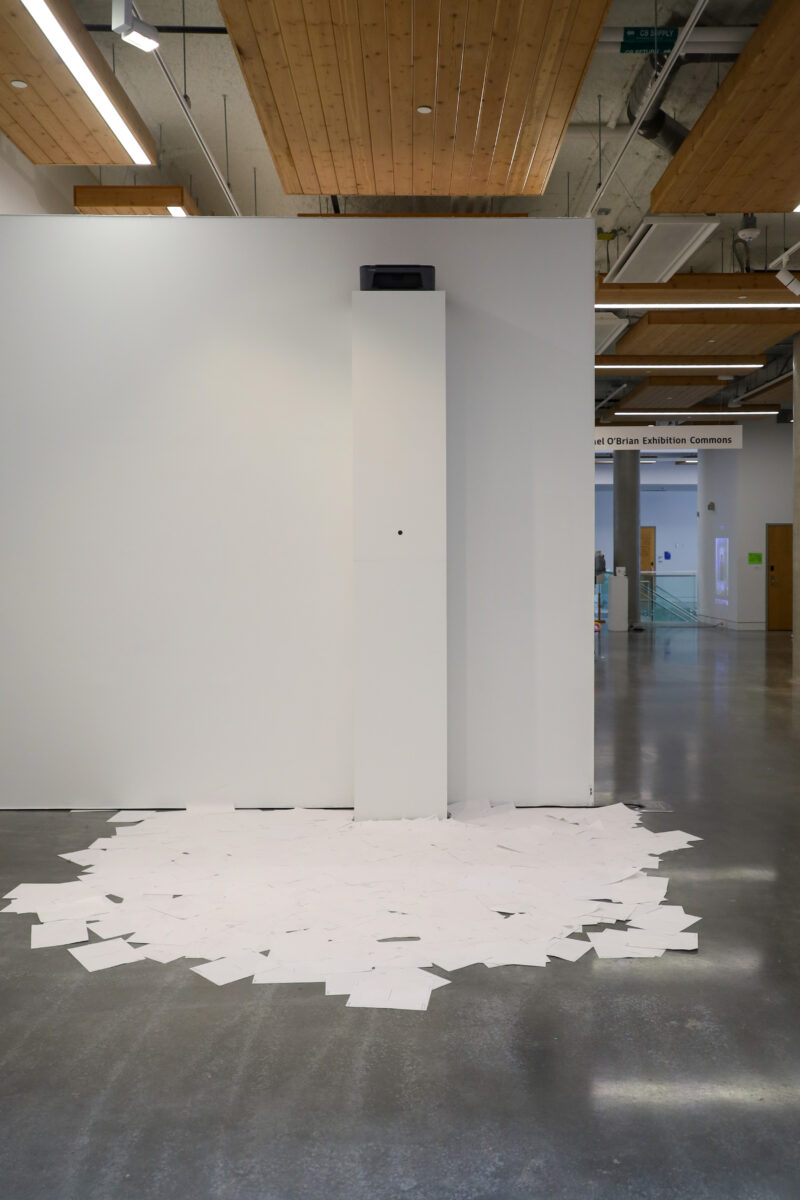
Dooley invites people from diverse backgrounds to join a conversation that goes beyond the gallery walls with her interactive art pieces. For example, her creation ‘the Printer’ acts like an oracle, changing how we see everyday objects, while ‘Fish Move in Three Dimensions’ disrupts the ordinary experience of walking downstairs by turning them into a space for showcasing videos that evoke feelings of melancholy and awareness of our physical movement in three dimensions.
In a one on one interview Kyla explains further her concepts, methods, and allows for a deeper understanding of her art in all its “conceptually based” ways.
Your label of “conceptually-based” art is intriguing. Could you elaborate on what that means to you and how it differs from traditional conceptual art? How does this label reflect your artistic philosophy and approach?
I think it’s easier to understand the label by talking about what it’s not. For explanation purposes, I would argue the opposite of a conceptually-based practice would be a material practice – as in, someone whose work derives from developing their work hands-on, eg. sketching out forms, testing a medium’s formal capacities, making lots of things and seeing what sticks, etc.
My process, on the other hand, is largely premeditated before I physically intervene with any of the material I intend to use. I start with an idea, like “What if a printer was voice-activated?” or “What if there was art in the stairwell?” and then cater the medium and process to supporting that idea. That said, I’m not working in a strictly purist conceptual art approach wherein every detail is laid out ahead of time. I’ll typically have the base idea and then get my hands on the material and try an approach then come back to the idea, think about what’s working and what’s not, iterate the material again, and continue this process until I’m (mostly) satisfied with the work. Alas, “conceptually-based” is the least pretentious and most accurate term I’ve come to refer to my practice with.
Your art seems to challenge conventional perceptions and expectations, inviting viewers to engage with ordinary objects in unexpected ways. What drives you to explore these unconventional approaches, and what do you hope viewers take away from interacting with your pieces? I think that challenging conventional perceptions and expectations is one of the best capacities of art (and maybe even one of the qualities that makes something art at all). If you take the piece I did with the printer as a case study, the reason that piece works is because I’ve developed an unusual interaction around the object. A printer that sits in an office is just a printer, but a printer that sits on a ten-foot-tall plinth and prints out cheeky responses at the beck and call of the audience is a special experience.
It’s unusual and surprising and because of that, gets us thinking and considering the object with a fresh set of eyes. For me, it’s a game of push and pull between the expected and unexpected. The work needs to have some point of recognizability that makes it approachable but in the same act, do something unusual and extraordinary that sets people out of their routine. Each piece has its own political agenda, but broadly speaking, I hope people can walk away from my art with a renewed sense of the malleability of the world around us. As artists, we’re in one of the few industries where play is not only encouraged, but required for the job. It’s a massive privilege to be in that head space and something I hope I can share even if it’s just for a moment through an art encounter.
Can you walk us through your creative process when developing interactive art pieces like “the Printer” or “Fish Move in Three Dimensions”? How do you blend humor, technology, and conceptual elements seamlessly in your work? Sneaky how you’ve woven compliments into these questions – thank you. I briefly touched on my process above so I’ll focus on the latter half of this question. Working with each of these individual components – humor, technology, conceptual elements – was/is rarely a conscious decision. I don’t think we have much say in the kind of art we make. And by that I mean, I don’t think we have much control in what we’re interested in. I don’t think I could force myself to be interested in painting if I tried (though ironically the endeavor in and of itself could be an interesting art project…). I’m interested in the things that I’m interested in, and I’m gonna make art that I think is interesting.
For me, those endeavours happen to be described as conceptual and playful but these aren’t attributes I willfully chose one day. However, I will say, that I have very consciously chosen to put the art first when making art. I realize this sounds like a redundant statement, but I think there’s a big push in contemporary art right now to linguistically proclaim virtuosity in art. Aka, the quality of the art has become inferior to the way you’re writing and talking about it. I loathe this condition. If an artwork is heavily relying on a written statement to communicate its “meaning” then the text has superseded the necessity of the artwork at all. At that point, you may as well just read an essay on the topic since the art itself isn’t contributing anything.
Within my own practice, I have to be excited about the art as art. If it’s not interesting to me then why the hell would anyone else care about it? And respectively, I grow tired of things pretty easily, so that standard of interesting is always in flux.
Humor appears to be a central element in your work, serving both as a tool of engagement and a form of protest against elitism in contemporary art. How do you navigate the balance between humor and deeper conceptual themes in your art? “Humor … as a tool of engagement and a form of protest against elitism in contemporary art” – damn, I’m gonna steal that line for my next artist statement (I’m only half kidding). This is a really thoughtful question and insightful analysis. I don’t think I’ve ever approached a work with humor at fear of it being disregarded as thematically unsubstantiated because of such qualities. Humor is complicated and nuanced and that complexity is often prime material to navigate a piece around conceptually. A good joke is usually a good artwork.
A friend recommended I watch the movie Brazil a couple of months ago (it was incredible and I would highly recommend it) and afterwards I was reading a review of the film that cited it as “a superb example of the power of comedy to underscore serious ideas, even solemn ones”; it was a really validating moment for my practice. So I wouldn’t say it’s a balancing act, so much as a matter of ensuring the humor is supporting the concept and vice versa.
Your art often extends beyond the confines of the gallery, inviting people from diverse backgrounds to join a conversation. How do you see the role of interactive art in fostering community engagement and dialogue, particularly in today’s digital age? I think that interactive art, like humor, is a great strategy for making art more accessible to a broader audience. As you mentioned above, the art world is ridiculously elitist. Artworks are put behind literal and metaphorical walls and described in unnecessarily complicated art world jargon; it all sends a very clear message about who is welcome in those spaces. It’s uncomfortable staring at a lukewarm oil painting feeling like you don’t get it. But when an artwork is interactive, there’s immediately an entry point to engage with the work that takes precedence over the forlorn quest to “get it.” And then once you’ve sustained engagement, you may actually have a shot at conveying some idea/experience/dialogue.
I’m not saying making art interactive is the only/best way to do this (in fact there’s a lot of shitty interactive art that doesn’t achieve this) but I do think it’s a particularly pertinent and effective method, especially within the state of our attention economy. I’m also a firm believer you can make your work accessible to a broad audience without sacrificing complex ideas. An elegant example of this duality is Nick Cave’s Soundsuits.
For more from Kyla, check her artworks @kyladooley on Instagram or at kyladooley.com!
At the beginning of 2023 the Basically Good Media Lab had to say goodbye to Director Maria Lantin, who had been at the helm of the BGML since 2009. Her journey in the research center has been one of innovation, creativity, and unwavering dedication to pushing the boundaries of immersive media and interaction. She shepherded numerous projects and initiatives through the BGML, always with grace, compassion and curiosity. Through her kindness and generosity, the BGML became a haven for many faculty and student researchers seeking a space of openness and experimentation.
Maria is an independent artist, computer scientist, thinker, and creative coder whose passion for exploring space and movement—both physical and metaphorical—has been the driving force behind her remarkable body of work. Throughout her tenure, Maria ceaselessly scanned the technological horizon, seeking out trends in human fascination and exploring the profound “why” behind our collective attention. She shepherded numerous projects and initiatives through the BGML, always with grace, compassion and curiosity. Through her kindness and generosity, the BGML became a haven for many faculty and student researchers seeking a space of openness and experimentation.
With a background spanning a BSc and PhD in Computing Science to groundbreaking experiences in animation and pioneering roles at institutions like Emily Carr University and the Banff New Media Institute’s Advanced Art and Technology labs, her journey is nothing short of extraordinary.
Her sixteen-year tenure at Emily Carr University, where she held various leadership roles, including Director of Intersections Digital Studios (2010) and Director of Research (2012-2015) speaks volumes about her profound impact on the intersection of technology and creativity at the institute.
Her choice of name for the Basically Good Media Lab speaks about her vision of how technologies can be at the heart of research while contributing to the greater good. As Maria embarks on the next chapter of her journey, the Basically Good Media Lab extends its deepest gratitude for her visionary leadership.
Please join us in the Motion Capture Studio (NB 285e) March 3rd 11:30-1 for a talk by Cream 360 Director and Cinematographer Andrew MacDonald.
Andrew will speak about his experiences in 360 production and his talk and presentation will focus on his experience in production and the future of the medium:
• Storyboarding in 360 (using Vray),
• Blocking in 360
• How to move the camera in 360
• Building custom camera rigs
• Nodal point 360 shooting
• Shooting 360 on remote locations
• Essentials tools such as the teredek sphere
• Plus ambisonic recording and finishing
Virtual reality and 360 filmmaking is rapidly becoming a fundamental part of the TV, Film and Advertising Industries. Introduction to VR/360 Filmmaking is a comprehensive 2-day workshop that empowers students with the tools, knowledge and skills required to create their own live action immersive experiences. Throughout the course, the instructor will provide a clear and precise explanation of the 360˚ filmmaking process; from pre-production to distribution. The content of the course includes but is not limited to VR/360 history, terminology, theory, technology, scouting, casting, storyboarding, scriptwriting, camera selection, camera operation, camera & actor positioning, lighting, stitching, editing, mastering content for headsets and online. This workshop is designed to offer a technical, immersive, and hands on approach to learning this new medium. Certification is available upon completion.
Prerequisite: Basic understanding and experience with traditional video workflow is beneficial. Students should bring a smartphone to review 360˚material in the lectures.
About the Instructor:
Chris Bedyk is a distinguished Cinematographer, immersive content creator, speaker, developer of 360˚cameras and founder of Perspective Films, a VR live action production agency and laboratory. Since 2013, he has been creating daring immersive VR/360 experiences for brands that include Vancouver Canucks and Idealens VR headset. He is the creator of VR Wonders of the World, a customizable virtual reality series that transports you to extraordinary destinations around the world. He was a speaker at 2016 CVR, the world’s first VR consumer conference, Factual West 2016, and soon at the 2017 Victoria Film Festival. He is a member of IATSE 669 International Cinematographers Guild.
Recently, I had the opportunity to be part of a panel discussion called ‘The Future of Augmented and Virtual Reality’. I was flattered to be asked by the organizer and my answer was of course ‘yes’. I thought of others who have tried to predict VR/AR’s future (e.g. Ray Kurzweil, Ted Schilowitz) and wondered what I could add to the now deluge of words on the subject.
The event, held at the Launch Academy, was sold out with 60 people packing into a space that normally holds 45. Before the session started the moderator, Mack Flavelle, polled the crowd trying to get a sense who had turned up. These people were true devotees: a mix of investors, educators and those who have fledging VR businesses. He asks the raucous crowd for quiet. We panelists assume our perch on the bar stools provided (with vinyl seat covers that I kept sliding on!).
Mack, ever the thoughtful provocateur, poses many important questions. The panels that I have been on or seen recently are more academic in nature, so I try to conceive of answers that are thoughtful and pithy. The other panelists, informed colleagues Kayla Kinnunen, Wren Handman, and Eric Hine, stick handle adroitly through Mack’s questions giving short snappy answers.
Then…he asks “Ok panel what is the one thing that is going to kill VR? But please don’t include lack of content in your answer.”
But surely that is the problem with VR right now? We groan in unison as we search for answers. I take a stab at it “I think it’s going to be advertising. I mean if you start to put ads in a virtual space surely that will be the death of it.” And so it goes. An hour goes by and it seems like 5 minutes. We provide answers to a dizzying array of questions: When will VR become like you cell phone, you can’t leave home without it so you drive home and get it? My answers seem to strike a chord especially regarding VR/AR’s lack of borders: “We seem to get inquiries almost daily about our research internationally especially China”.
Before I know it the panel is over and people come up and provide praise and validation for our contributions. But if those of us who are the so-called experts were really honest with each other we would just say that we can’t predict the future of VR/AR. Of course we can make some best guesses based on things we know today. But everyday there are new technological innovations that disrupt what we knew yesterday and we are all asking ourselves the same question. How does it affect what I do and where is it all going?
Maybe we should consider changing our approach. Instead of trying to figure out where it is all going we could tell each other our aspirations for the technology. We can’t control technological change. But we can help shape its growth making it something useful for the future. I hope Launch Academy asks me again to be on a panel. And if they do I will make sure I have Velcro’ed my pants!
Alan Goldman, Adjunct Researcher and Industry Liaison S3D Centre of Excellence Emily Carr University of Art + Design
This video is a proof of concept for a true digital colour infrared system designed by Jesse Andrewartha in collaboration with Emily Carr University’s S3D Centre.
The experiment replicates the colour shifts of Kodak Aerochrome 1443 color infrared film. This unique film used green, red and infrared wavelengths to produce a false colour RGB image. In the 90’s it was possible to purchase short ends of 9.5″ Aerochrome and cross-process in a custom C-22/E-6/C-41/E-4 hybrid formula. Cine film of this stock was a special order item and virtually non-existent. In 2011, the film became unavailable when the film was discontinued. Any remaining stocks on the market are dwindling fast, expired, exorbitantly priced, and Kodak has stated that it has no plans to reformulate the emulsion. A replacement was required, and digital cinema tools seemed a likely place to find a solution.
The method shown here, utilizing the RED Scarlet, distinguishes itself by not only achieving true spectral discernment and control over the individual Green, Red and Infrared channels but also permitting the application of the technology to 4K, or larger, sound-sync filmmaking.
We will be following up this work with a more comprehensive test and shoot next month.
Mike Pan will cover how textures interact with light. i.e. specular maps and gloss functions, with the ultimate goal being cinematic realism, which is actually different from what our eyes can see. His presentation will include some definitions of basic concepts and processes of texturing a model and how they are applied.
Aaron Hilton will talk about the cinematic use of Light and Shadow to drive the VR narrative; the art of light and shadow. He will also cover how the lack of an avatar representing the user can be worked around. Light and contrast can be used to direct attention. Creating a gradient of dark to light to help orient someone to where they need to go next.
The presentations will be followed by a period for Q & A.
We will close the evening with prize draws for: EA Games, Video Copilot Optical Flares plugins for Adobe After Effects and we will also be giving away three $99.00 licenses for Allegorithmic’s Substance Bitmap2Material 3. Bitmap2Material is an incredibly powerful tool that helps you generate full, seamlessly tiling materials from any bitmap image. This now includes all PBR (Physically-Based Rendering) channels, based on the most accurate conversion algorithm out there. Check it out here:
Snacks will be provided by our wonderful caterer Heather Ferguson.
Many thanks to our sponsors: Conquer Mobile, G-Technology & Emily Carr University of Art & Design.