As part of a residency at the Basically Good Media Lab (BGML) at Emily Carr University of Art + Design (ECU), Paris-based digital artist Pierre “Pyaré” Friquet has been working with students, staff and faculty on his latest VR video game, Captain Nemo.
This project is designed to foster a sense of interconnectedness and environmental awareness. Through symbiotic encounters, visitors gain a deeper understanding of the delicate balance within the marine ecosystem and the importance of interdependence among species. Stunning visuals, immersive soundscapes, and captivating interaction mechanics combine to create a mesmerizing experience.
One version of this multimedia project uses aquatic VR to showcase the beauty and complexity of the underwater world. PYARé’s startup, NiGHT, creates immersive travel experiences through virtual reality and aquatic installations. Safely floating in pool water, users wear our MeRCURY immersive diving mask to explore virtual worlds while comfortably breathing through a snorkel.
“Aquatic virtual reality raises awareness about the URGENCY of protecting the oceans without the need for polluting transportation or disturbing wildlife,” says Julie GAUTHIER, underwater filmmaker.
The residency will be through the month of November
About Pierre Friquet
PYARé has designed immersive experiences (VR, dome films, AR, video mapping, etc.) such as Spaced Out, Jet Lag, Vibrations, and Patterns. His vision is to enable people to reconnect with their bodies and sense of self through art and technology. His experiences have won awards at the Festival du Nouveau Cinéma, Kaleidoscope Festival, and Filmgate Festival. Notably, his aquatic VR project, SPACED OUT, was selected at Sundance Festival. Also, he has founded a company called NiGHT and designed an immersive diving mask, which immerses visitors in a pool while in VR, presenting it at the cultural program of the Paris 2024 Olympic Games. His work has been covered by media such as Wired, Vice, Forbes, The Verge, CNET, and IndieWire. After living in India, South Africa, and Canada, he’s now based in Paris.
Pierre Friquet’s XR residency is supported by The Basically Good Media Lab, ECU and the Consulate General of France in Vancouver.
On May 1st in The Basically Good Media Lab, we hosted an artist talk by our very own recent graduate and award winning New Media + Sound Art Student and Research Assistant Thomas “Myles Veltenhill” Feltenberger!
Feltenberger is a sound artist and musician from Chicago who is currently living in Vancouver, BC. With an extensive background in New Media and Sound Art from Emily Carr University, his creative expression sits at the intersection of digital media, sound, and video art.
With a mastery of sampling and synthesis techniques, Feltenberger crafts immersive soundscapes that cross diverse genres and realms. Their methods include digital audio manipulation using Ableton Live, modular synthesis exploration, hardware sampling, and experimental use of visual sampling techniques through Max MSP.
Drawing inspiration from many sources, Feltenberger’s reference points include the evolution of hip-hop from the Definitive Jux era of 2008 to the vibrant hip-hop scene of Chicago in 2017. They are inspired by RTJ (Run the Jewels) community, and artists like Nick Hook and Jordan Asher Cruz.
Feltenberger’s creative taste is further enriched by the works of Philip K. Dick and the realm of gnosis, infusing their compositions with an otherworldly feeling. Their practice is also imbued with a sense of Bush-era resentment and countercultural voices, echoing the dissent and resilience of underground movements throughout history.
In an interview, Myles explains further his influences, inspirations and views on this interesting intersection they find themselves in.
K: Your New Media and Sound Art background is unique. How do you believe it influences your approach to crafting soundscapes compared to more traditional methods?
M: My background is primarily in beat-based music, often alternative hip hop and electronic genre. Before I studied New Media and Sound Art at Emily Carr University, I was a no-name DIY musician in Chicago. At that time, I was generally unaware of sound art as a concept, yet I often practiced field recording techniques that are popular in Sound Art. Ultimately, I would use field recordings as sampling material to make beats. I also had an interest in digital, glitchy visual collage that I can now call “New Media.” It was interesting going from the DIY hip hop music scene into the world of art school, “Capital ‘A’ Art School” as some have called it. My formal education helped me learn the language associated with the practices I was already involved in, and as such, I am continuously influenced by hip hop in my sound works.
K: Your inspirations from the Definitive Jux era of hip-hop to artists like Nick Hook and Jordan Asher Cruz suggests a wide range of influences. How do you integrate these diverse influences in your work, both sonically and conceptually?
M: Integration of influence is inevitable in my practice; it is just simply impossible to ignore the information and sonic palettes of those whose music I enjoy. While these influences may seem very different sonically, they are all bound together by degrees of separation that I find fascinating. It is similar to a lineage of teachings, in that there are nodes I can connect to better understand how the music I enjoy progresses. In this example of Def Jux, Hook, and Cruz, the common thread is Jaime Meline, better known as EL-P of Run The Jewels. EL was the founder of Def Jux, and then went on years later to record the first Run The Jewels album at Hook’s studio. The second Run The Jewels Album featured Cruz on vocals and production. I met all these people throughout the years (usually on a Run The Jewels tour), and Hook ended up becoming a recurring mentor throughout my growth as an artist. As such, I feel like I am trying to continue a sort of lineage, as I have a personal connection with those who inspire me.
Sonically, I feel as though I am drawn in as a fan and try to study what I like in a song. I like EL-P’s production style of sampling and dense lyricism. I like Nick Hook’s use of synthesis and drum machines, and how he moves in this world. I like Cruz’s use of vocals as an instrument as well as implementation of sampling. I hear what I like, and I try to expand upon the work as if it is my turn to contribute something to the sonic lineage. Conceptually, these influences are all over the place. The vibe of Definitive Jux in the early 2000’s was a different sort of underground hip hop, and the ethos of that label as outsiders to a subculture was fascinating to me. Moreover, EL-P’s pointed political raps drew me in conceptually. In contrast, the concepts I have picked up from Nick Hook are more about music making itself, and how to utilize music for building community. In yet another contrast, Cruz makes music that touches on concepts outside of the material world, while still having an intimacy within this plane of existence. None of these concepts can be separated from the work I create.
K: Philip K. Dick’s works and the realm of gnosis are mentioned as inspirations. How do you translate these themes into your compositions, and what kind of atmosphere or mood are you trying to create?
M: Before I answer that, I wish to point out that I was only ever put onto the works of PKD by EL-P, as he has cited PKD as a source of inspiration. In fact, he used some of the wealth generated from the Run The Jewels project to buy the original manuscript for PKD’s “Radio Free Albemuth,” of which is one of my favorites of PKD’s catalog. It goes back to the idea of a lineage being passed down, and sometimes tracing the source back further gives me new insights and inspirations.
The themes presented in PKD’s work influence how I write lyrics, in that I try to veil the meanings of a song. I want to try to use symbols and language in a contorted context to give layers of meaning to be extracted and alchemized by the audience. I want to create an atmosphere that is as confusing as “Valis.” I want to point out the illusions of this world, in a sense, by creating illusions.
K: You mention “a Bush-era resentment” and countercultural voices. This suggests a political or social dimension to your work. How do you express these themes through your music, and what message or emotions do you aim to evoke in your audience?
M: Most of my political expression is through anger and resentment, especially in how I write my lyrics, and in aggressive performance on stage. The most overt example is the (not yet released) song “GOD IS AN AMERICAN,” which directly samples David Bowie, Queen, Nine Inch Nails, and Company Flow to create an abrasive sonic backdrop for a rant against American Imperialism, as well as rappers who co-opted leftist aesthetics only to stand in line with capitalism. It is a pretty straightforward performance; I am literally yelling into a microphone about how America promotes violence, and even the popular “counterculture” figures are just part of the machine.
The message in the music is admittedly convoluted. There are so many great writers who can spread a message more eloquently than I ever could, but that is my point. I am ranting into a microphone aggressively. I am not here to give anyone a beautiful, succinct lyric to quote. I am here to let some of that anger and disapproval of the war machine be put on full display for anyone who will look at it. It is almost the only catharsis I can get, and I hope the audience can find something in that.
In a more direct sense, I hope that the audience can see how Western imperialist violence is breaking down our sense of humanity, and how I feel driven to the edge of madness knowing that my tax dollars fund the military industrial complex’s mission to kill for profit. I think if there was something of an ideal audience reaction, it would be “huh, good point, this is all really fucked up. We are living in a fucked up structure that really doesn’t make any sense to any moral sensibilities. We really need to unfuck this fast.”
And most urgently: free Palestine.
K: Finally, how do you see your work evolving in the future, and what advice would you give to aspiring sound artists and musicians who are interested in exploring similar intersections in their work?
M: In the future, I hope to better hone my skills as a lyricist, in both concept and performance. I am in a moment of rediscovering my voice as an instrument, and I want it to come across as clear in intention. I want to continue to work on audio responsive visual collages to complement the music and sound works. As far as advice goes, I firmly believe that persistence is key. Keep practicing and exploring. Continue to learn as much as possible about anything sound related that is inspiring in the moment. Try to give your knowledge to others in the process and try to cultivate a community in any way possible. Make art in any way you can.
For more from Myles, Check out their work on Instagram @mylesveltenhill
Virtual reality and 360 filmmaking is rapidly becoming a fundamental part of the TV, Film and Advertising Industries. Introduction to VR/360 Filmmaking is a comprehensive 2-day workshop that empowers students with the tools, knowledge and skills required to create their own live action immersive experiences. Throughout the course, the instructor will provide a clear and precise explanation of the 360˚ filmmaking process; from pre-production to distribution. The content of the course includes but is not limited to VR/360 history, terminology, theory, technology, scouting, casting, storyboarding, scriptwriting, camera selection, camera operation, camera & actor positioning, lighting, stitching, editing, mastering content for headsets and online. This workshop is designed to offer a technical, immersive, and hands on approach to learning this new medium. Certification is available upon completion.
Prerequisite: Basic understanding and experience with traditional video workflow is beneficial. Students should bring a smartphone to review 360˚material in the lectures.
About the Instructor:
Chris Bedyk is a distinguished Cinematographer, immersive content creator, speaker, developer of 360˚cameras and founder of Perspective Films, a VR live action production agency and laboratory. Since 2013, he has been creating daring immersive VR/360 experiences for brands that include Vancouver Canucks and Idealens VR headset. He is the creator of VR Wonders of the World, a customizable virtual reality series that transports you to extraordinary destinations around the world. He was a speaker at 2016 CVR, the world’s first VR consumer conference, Factual West 2016, and soon at the 2017 Victoria Film Festival. He is a member of IATSE 669 International Cinematographers Guild.
Mike Pan will cover how textures interact with light. i.e. specular maps and gloss functions, with the ultimate goal being cinematic realism, which is actually different from what our eyes can see. His presentation will include some definitions of basic concepts and processes of texturing a model and how they are applied.
Aaron Hilton will talk about the cinematic use of Light and Shadow to drive the VR narrative; the art of light and shadow. He will also cover how the lack of an avatar representing the user can be worked around. Light and contrast can be used to direct attention. Creating a gradient of dark to light to help orient someone to where they need to go next.
The presentations will be followed by a period for Q & A.
We will close the evening with prize draws for: EA Games, Video Copilot Optical Flares plugins for Adobe After Effects and we will also be giving away three $99.00 licenses for Allegorithmic’s Substance Bitmap2Material 3. Bitmap2Material is an incredibly powerful tool that helps you generate full, seamlessly tiling materials from any bitmap image. This now includes all PBR (Physically-Based Rendering) channels, based on the most accurate conversion algorithm out there. Check it out here:
Snacks will be provided by our wonderful caterer Heather Ferguson.
Many thanks to our sponsors: Conquer Mobile, G-Technology & Emily Carr University of Art & Design.
VanVR, VanCG Meetup, and S3D Centre at Emily Carr University presents: “How To Build A Virtual World”
NOTE: doors will open at 6:30 PM. Presentations will begin at 7:30 PM. SEATING IS LIMITED. No tickets will be sold at the door.
Collecting the parts for your 3D world. Sourcing available 3D models, creating your own, capturing the world with photogrammetry and depth cameras.
Mike Pan will share his expertise with Blender: overview of the workflow in Blender, accessing models online, importing them into Blender, optimizing the model, exporting it for the VR platform of your choice.
PartickWirt from Corbel 3D will explain the process of creating models using photogrammetry.
Aaron Hilton of Conquer Mobile will discuss recent developments in 3D scanning technology and give us a demonstration of his Occipitals’ Structure Sensor used for on the fly object scanning.
Matthew McCauley founder of GeoSim will talk to us about their high end-to-end system for scanning and modeling entire cities in 3D. The models feature high spatial precision and visual fidelity, and are interactive and parametric. Proprietary street level data collection enables entirely new kinds of city analysis and visualization.
The presentations will be followed by a period for Q & A.
We will close the evening with prize draws for: EA Games, Video Copilot Optical Flares plugins.
Food will be provided by our wonderful caterer Heather Ferguson.
Dr. Ken Perlin
Professor & Researcher, NYU Media Research Lab
Ken Perlin, a professor in the Department of Computer Science at New York University, directs the NYU Games For Learning Institute, and is a participating faculty member in the NYU Media and Games Network (MAGNET). He was also founding director of the Media Research Laboratory and director of the NYU Center for Advanced Technology. His research interests include graphics, animation, augmented and mixed reality, user interfaces, science education and multimedia. He received an Academy Award for Technical Achievement from the Academy of Motion Picture Arts and Sciences for his noise and turbulence procedural texturing techniques, which are widely used in feature films and television, as well as the 2008 ACM/SIGGRAPH Computer Graphics Achievement Award, the TrapCode award for achievement in computer graphics research, the NYC Mayor’s award for excellence in Science and Technology and the Sokol award for outstanding Science faculty at NYU, and a Presidential Young Investigator Award from the National Science Foundation. Dr. Perlin currently serves on the program committee of the AAAS. He was general chair of the UIST2010 conference, and has been a featured artist at the Whitney Museum of American Art.
Dr. Perlin received his Ph.D. in Computer Science from New York University, and a B.A. in theoretical mathematics from Harvard University. Before working at NYU he was Head of Software Development at R/GREENBERG Associates in New York, NY. Prior to that he was the System Architect for computer generated animation at Mathematical Applications Group, Inc. He serves on the Advisory Board for the Centre for Digital Media at GNWC, and has served on the Board of Directors of both the New York chapter of ACM/SIGGRAPH and the New York Software Industry Association.
Series to assist Vancouver-area businesses and individuals in the creation of virtual reality experiences, environments. Read more.
PART 1: The Business of VR begins this month: Is VR a bubble? We’ll ask key content producers, investors, and luminaries to give us the broad perspective.
S3D Centre at Emily Carr University of Art + Design
Wednesday, 19 August 2015 from 5:00 PM to 10:00 PM (PDT)
Vancouver, BC RSVP and Register online
In It is Virtual Reality showcase co-sponsored by Emily Carry University and Immersive Media and will be held in the University’s Concourse Gallery from the 19th to the 23rd of August at 1399 Johnston Street, Granville Island in Vancouver. This week long showcase highlights the work of local and international artist practitioners who are working and creating in the virtual. The presentation is a conglomeration of works that act as a great introduction to the VR space. The showcase is co-located with ISEA (International Symposium on Electronic Art), and coincides with several other VR events on Granville Island. This event is the defacto closing reception of ISEA so come and join us for refreshments and VR.
A reception will be held on Wednesday, August 19th from 5-9 pm. Cash bar. There will be a food trucks outside the venue.
Credits: S3D Research Team: Dr. Maria Lantin, Sean Arden, Alan Goldman, Denise Quesnel
Participants:
Randal Kleiser Productions & IM360
Defrost-
DEFROST takes place in the year 2045, when liquid nitrogen is now commonly used to freeze patients until remedies for their illnesses are developed. The film follows the experience of Joan Garrison as she wakes up from her frozen state after thirty years. She reunites with her family, but the reunion is bittersweet, as the passage of time has caused her loved ones to become strangers. The short was filmed in 360°, allowing audience members to witness the story directly from Joan’s perspective. The result is an intimate and immersive experience.
Felix and Paul:
Herders-
Herders is a cinematic virtual reality observational journey that bears witness to the lives of nomadic yak herders in Mongolia. First screened at 2015 Sundance Film Festival 2015 Hot Docs.
National Film Board:
A Way to Go –
Way to Go is a walk in the woods. An astonishing interactive experience, a restless panorama, a mixture of hand-made animation, 360˚ video capture, music and dreaming and code. Created by Vincent Morisset, Philippe Lambert, Édouard Lanctôt-Benoit & Caroline Robert (AATOAA). Produced by the NFB & France TV.
Cardboard Car Crash –
In a world of artificial intelligence and self-driving cars, who determines the ethics algorithm to handle emergency situations? In this VR vignette, the user is slowed down to bullet-time, becoming the computer, and forced to confront difficult decisions where there is plenty of data, but no easy answer. Created by Vincent McCurley.
Moving Stories:
worlds –
The project worlds is a real-time networked augmented and virtual reality performance that explores the multiple and simultaneous experience of our collective and individual inner and outer, past and present, and physical and imaginary worlds. Bringing together 3 unique performance venues across 2 canadian cities, including the ECUAD lobby gallery the ECUAD IDS mocap studio in Vancouver and the CRIM motion capture studio in Montreal, worlds is a collaborative endeavor under the umbrella of the SSHRC funded movingstories research project and the CANARIE funded m+m: movement + meaning middleware software development initiative. worlds is part of a live networked collaborative VR performance showcase and will take place during the opening reception, beginning at 5pm on Wednesday, August 19th 2015. worlds has been created in partnership with the S3D Research Centre at Emily Carr University and Pepper’s Ghost New Media Arts Collective.
Creators: Athomas Goldberg, Thecla Schiphorst, Maria Lantin and Tom Landry; Composer: Stefan Smulovitz; Performers: Yves Candeau, Brittany Gee, Sarah Fdili Alaoui, Shannon Cuykendall, Caroline Barrierre. We are grateful to the software and technical development work by Dhruv Adhia and Norm Jaffe (m+m; h+technologies) and Tom Landry (Research Director: CRIM) as well as Sean Arden and Rick Overington (ECUAD).
Dryft Digital:
Beer With a Bear –
Sit down for a picnic in sunny Montana with Brutus the grizzly bear and his human companion, Casey Anderson, in this quirky VR short film by San Diego/Calgary based production house Dryft Digital.
Cloudhead Games:
The Gallery: Six Elements –
The Gallery: Six Elements, is a rich narrative, fantasy exploration game inspired by dark 80’s
fantasy movies and the Myst video game series. Experience the HTC Vive VR hardware in our sandbox style demo. Cloudhead Games is a local virtual reality development company working in VR since late 2012, specializing in compelling interactive VR content.
Marten Berkman:
Hart to Heart –
Hart to Heart is the interactive installation component of a documentary project inspired by the conflict over land use in the Peel watershed in Canada’s Yukon. Disrupting our omnipresent two dimensional representation of wilderness, h2h challenges the duality between human nature and the rest of nature conditioned by our manufactured spaces. As we discover ourselves in this landscape along the Hart river, how does technology become a part of our ecology?
VRVid.io:
Vrtist –
Vrtist is a drawing app that allows the user to draw in the 3D space around them. A key goal of the project is simple, intuitive interaction. Virtual reality is a highly expressive and personal medium for storytelling & expression, and Vrtist is a small sample of its creative potential.
Dare:
Destination BC’s “The Wild Within” Virtual Reality Video
In December 2014, DBC launched The Wild Within VR Experience, using Oculus Rift technology, making it the first destination marketing organization in North America to use virtual reality to promote the destination. The Wild Within VR Experience is an interactive, three-dimensional video that allows travellers to experience British Columbia in a truly immersive way, as if they were actually there.
Wavesine Solutions:
High quality virtual real estate and city visualization
This project has been in development for over a year now and early iterations were shown at a number of VanVR meetup events as well as many private showings at the Sawmill to Real Estate and VR enthusiasts alike.
We are going to try and have Ken’s experience available, depending on the logistics of the day. If you are interested in trying it, we’ll keep you posted via these Eventbrite notifications so be sure to register! We will also be showing demonstrations of games, apps, and VR experiences created by members of our community. They are fantastic so make sure to come early and give them a try.
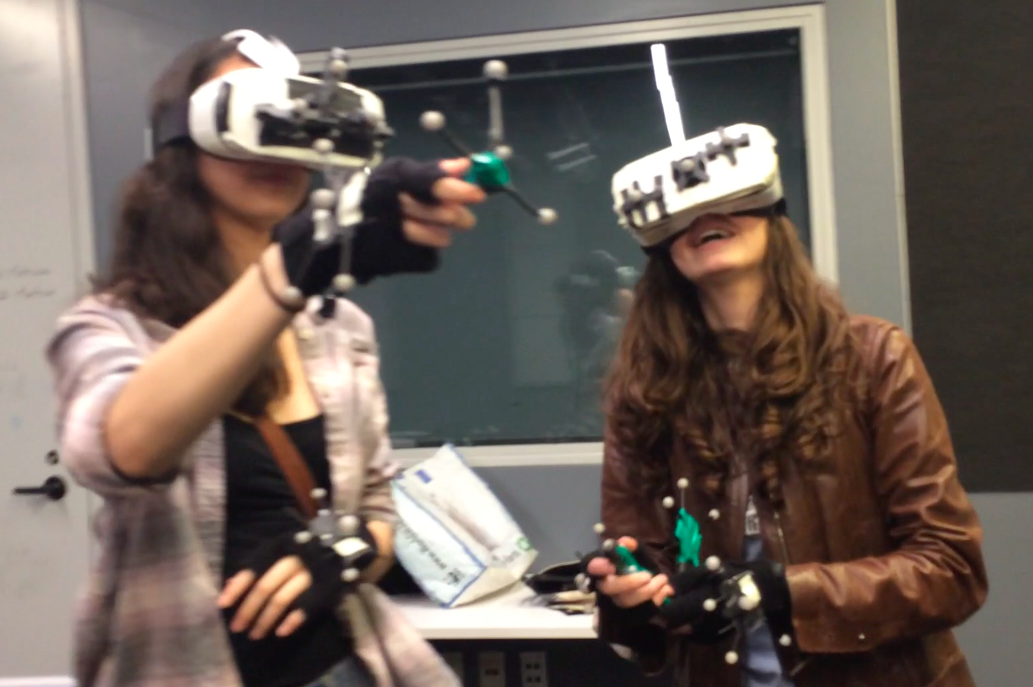
Prototyping the Future: The question our lab at NYU is asking is “How might people in the future communicate with each other in every day life, as computation and display technologies continue to develop, to the point where computer-mediated interfaces are so ubiquitous and intuitive as to be imperceptible?” To address this, we are doing sensor fusion between GearVR and OptiTrack technologies. Participants walk freely around and untethered by any wires, in physical space, interacting with other people and physical objects, just as they do in everyday life. Yet everything those participants see is computer-mediated, thereby allowing them to share any reality they wish, simulating the experience of future high resolution contact lenses.
BIOGRAPHY
Dr. Ken Perlin
Professor & Researcher, NYU Media Research Lab
Ken Perlin, a professor in the Department of Computer Science at New York University, directs the NYU Games For Learning Institute, and is a participating faculty member in the NYU Media and Games Network (MAGNET). He was also founding director of the Media Research Laboratory and director of the NYU Center for Advanced Technology. His research interests include graphics, animation, augmented and mixed reality, user interfaces, science education and multimedia. He received an Academy Award for Technical Achievement from the Academy of Motion Picture Arts and Sciences for his noise and turbulence procedural texturing techniques, which are widely used in feature films and television, as well as the 2008 ACM/SIGGRAPH Computer Graphics Achievement Award, the TrapCode award for achievement in computer graphics research, the NYC Mayor’s award for excellence in Science and Technology and the Sokol award for outstanding Science faculty at NYU, and a Presidential Young Investigator Award from the National Science Foundation. Dr. Perlin currently serves on the program committee of the AAAS. He was general chair of the UIST2010 conference, and has been a featured artist at the Whitney Museum of American Art.
Dr. Perlin received his Ph.D. in Computer Science from New York University, and a B.A. in theoretical mathematics from Harvard University. Before working at NYU he was Head of Software Development at R/GREENBERG Associates in New York, NY. Prior to that he was the System Architect for computer generated animation at Mathematical Applications Group, Inc. He serves on the Advisory Board for the Centre for Digital Media at GNWC, and has served on the Board of Directors of both the New York chapter of ACM/SIGGRAPH and the New York Software Industry Association.


 Ken Perlin, a professor in the Department of Computer Science at New York University, directs the NYU Games For Learning Institute, and is a participating faculty member in the NYU Media and Games Network (MAGNET). He was also founding director of the Media Research Laboratory and director of the NYU Center for Advanced Technology. His research interests include graphics, animation, augmented and mixed reality, user interfaces, science education and multimedia. He received an Academy Award for Technical Achievement from the Academy of Motion Picture Arts and Sciences for his noise and turbulence procedural texturing techniques, which are widely used in feature films and television, as well as the 2008 ACM/SIGGRAPH Computer Graphics Achievement Award, the TrapCode award for achievement in computer graphics research, the NYC Mayor’s award for excellence in Science and Technology and the Sokol award for outstanding Science faculty at NYU, and a Presidential Young Investigator Award from the National Science Foundation. Dr. Perlin currently serves on the program committee of the AAAS. He was general chair of the UIST2010 conference, and has been a featured artist at the Whitney Museum of American Art.