Categories
news S3D

Meet the Gear :: hurricane rig

At a recent S3D Centre Meetup event S3D Production and Post Workflow, guest presenter Ron Steinberg, Brand Manager & Buyer for Amaya Foto, gave a demo of the Hurricane Rig. A few minutes before Ron stepped on stage, Justin Alm interviewed him about the history, usability, and films currently being produced on the Hurricane Rig.

First things first, is Hurricane the name of the company that manufactures the rig?

No. The rig is manufactured by a company called GenusTech; Hurricane is the name of the rig itself. It was designed by the British filmmaker Alister Chapman. Alister called the rig the Hurricane because he predominantly shoots natural weather phenomenon. About 5 years ago, he got into shooting his films in 3D and started designing his own rigs. The Hurricane rig as we know it today is a 5th generation design. The rig has been under development for several years but has been on the market since February of 2011.

HurricaneRig_with_cameras


The Hurricane Rig with cameras.

What kind of filmmaker uses the Hurricane Rig?

The Hurricane has a broad user-group. It is being used for educational purposes here at Emily Carr University of Art + Design. The Hurricane has found its home in many education institutes around the world because it is completely manual; when making an adjustment to the rig, you have to do everything by hand. For the student, their decisions become more intentional and they develop a deeper understanding of the mechanics of Stereoscopic 3D filmmaking.

Documentary filmmakers are another large user-group for the Hurricane. The rig can be setup quickly — in about 10 minutes not including mounting cameras. It packs down into a small flight case that can be checked as airline luggage. As Alister Chapman is a documentary filmmaker, who travels all over the world, one of his primary goals in designing the rig was to have it pack down into a small flight case.

A third group using the Hurricane Rig are independent feature filmmakers. Night of the Living Dead — 3D Reanimater used the Hurricane’s. That production company bought 2 rigs because they are inexpensive for their capabilities. It is liberating for a production company to purchase a couple of Hurricanes instead of renting rigs for thousands of dollars per day. The Night of the Living Dead production has been able to achieve great results using Canon cameras with Steadicam® stabilization.

OnLocationHurricane2_0

Image of the Hurricane Rig as used on location.

I recently interviewed Sean Arden, who works for the S3D Centre, about the Kerner Rig. How does the Hurricane Rig differ from the Kerner Rig?

Essentially, the Kerner and Hurricane rigs do exactly the same thing. They are both beam splitter or mirror rigs but the major difference between them is that the Kerner Rig is completely motorized. The interaxial, focus pull, zoom, convergence are all motorized; whereas, the Hurricane is a completely manual rig with optional motorization. Alister designed it to keep the price-point down, keep it light-weight, and simple to use and maintain. Apart from those differences, the rigs achieve essentially the same results.

The Kerner may be slightly easier to use when making a zoom change but we generally don’t make those sorts of adjustments when filming in 3D. Usually, we don’t adjust the zoom or interaxial during a take when shooting in 3D because the human eye doesn’t make those adjustments in reality. Also, the Kerner is designed to use a particular camera system whereas the Hurricane is camera agnostic, as long as those cameras can Genlock [Synchronize their frame rates]. As it is an open platform, we can put anything from small DSLRs to RED EPIC’s on the Hurricane. Nothing has to be changed on the rig to use a wide variety of cameras, although the use of the Bolster Bracket triangulation kit stiffens the unit up for heavier payloads. As I said earlier, the Hurricane shines when people have to travel to remote locations. Although the Kerner can be transported, it doesn’t have the same portability or option for shooting hand-held like the Hurricane.

So I’ve probably watched a lot of productions made on the Hurricane?

I don’t know if you’ve had much of an opportunity. In North America, we’re behind the times in terms of exposure to 3D content but I do know the rig has been used in many productions over the past year. We’ll be seeing content produced on it more and more.
Categories
news S3D

Meet the Gear :: Sandde

In this installment of Meet the Gear we bring you Sandde, a freehand stereo 3D animation software that allows you to ‘draw in space’. Justin Alm chats with Director/Animator Munroe Ferguson, an expert in Sandde who led a Masterclass at Emily Carr in the Spring to find out how it works.

Let’s start with the basics, what is Sandde?

Sandde stands for Stereoscopic Animation Drawing Device so there’s two ‘d’s and one ‘e’ – a lot of people misspell the name. Essentially, instead of drawing on a two dimensional surface, like on a piece of paper, we draw in three dimensional space. SANDDE is also an animation tool, as it has some motion capabilities. 

How long have people been using Sandde?

People have been using the software for about 10 years. Currently, it is more available for students. As it is a Canadian invention, the first place you’ll find Sandde is Canadian institutions.

Who would use Sandde?

People who use Sandde are between the practices of drawing and sculpture. They want a different look than what you get using computer graphics in Maya or Softimage. Those programs use math but Sandde is closer to drawing. Drawn animation was often referred to as 2 dimensional until Sandde. Now people are baffled because we’re doing something between 2 and 3D. If you drawn something computer generated, there is a perfected quality that seems cold. When you see something drawn with Sandde, the imperfections make the image look more like a drawing.

IMG_0182

GRAND Research Associate Steve Oldridge working with Sandde

So Sandde doesn’t produce perfect-polished images?

While other computer programs are more about producing shapes and surfaces, Sandde is more about lines – edges of things. For example, if I want to draw a face, I can produce the image with 4 lines but in CG you’d have to spend more time working on producing surfaces, forcing imperfections, to get things looking natural. With those 4 lines in Sandde, we get down to the essence of cartooning. If you draw a circle with a line and 2 dots and show it to a new born baby, the child will smile at the image. We are hard-wired to take minimal amounts of information and interpret this info as a face or any other kind of image.

What are the components of Sandde?

The system is comprised of an input device and the Sandde software. The one being used here at Emily Carr is a cam wand [a device with 4 LEDs you can move around in front of a webcam]. The computer extrapolates where you’re holding the wand in 3 dimensional space, interprets that location, and enables the artist to draw. I have been consulting with graduate students at Emily Carr who want to use the motion capture studio as an input device for Sandde. The motion capture stage enables people to draw with their entire body. Usually, the artist needs an unusual input device because you need something that can draw width, height, and depth.

IMG_0185

GRAND Research Associate Steve Oldridge working with Sandde

Traditionally speaking, drawing requires 2 physical objects to interact with to create an image. With Sandde, you seem to be drawing pictures in the air. How does it feel?

You don’t have the pressure of the page to orient yourself so there’s a period of two weeks when you relearn your eye-hand coordination. If you’re proficient at drawing, it can be disheartening to pick up a wand and move it around and produce drawings like you did in kindergarten. After a couple weeks, you start to realize, you don’t need a surface and you start drawing the way you used to. Your style comes back. I can look at an artist’s portfolio before they use Sandde and know what style they will have. It turns out that style is not dimensionally dependent. Style is inside of you and linked to your personality. Whenever human beings encounter a new tool, we find a new way to look at ourselves.

Can you talk about how Sandde crosses over from research institutions into industry?

Sandde was developed by IMAX and I was one of two animators that made Paint Misbehaving – the first 3D film to screen in IMAX theatres. Since then, we’ve made a few films with Sandde at the National Film Board. I did Falling In Love Again, which was very successful as a 2D film in 2003. At that time, 3D theatres were scarce. Apart from IMAX, there wasn’t a lot of opportunity to see 3D content. Now there is a proliferation of 3D monitors, TVs, gaming consoles, and theatres investing in projection equipment. The Wobble Incident was purchased by Sony and comes with the Playstation. At the moment, the amount of good 3D content is limited so experimental short films are being supported by industry.

So you see Sandde sticking around long-term?

Yes. There’s been a lot of development over the last year. Janro Imaging has invested a lot into improving the system. It’s great that Emily Carr has fostered cooperation between industry and academics. In the Stereoscopic 3D Centre, there is a creative back-and-forth between sectors. Good things will come from Emily Carr playing around with tools and for companies to get feedback from artists who are using their tools. In this environment, artists can influence the development of these tools. Sometimes people think we are helpless in the face of technology. In an R&D situation like the S3D Centre, we can be part of the process of developing tools. Technology isn’t just science; it’s a relationship between art and science.

Categories
news S3D

Meetup: Parallax Film Productions foray in to 3D :: Nov 2, 2011

This event is FREE and open to the public, but space is limited!

Register now at: http://s3dmeetup2.eventbrite.com/

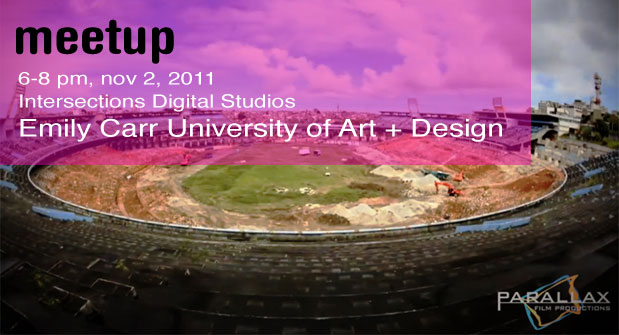
Hot on the heels of this week’s first S3D Centre Meetup event, we’re busily preparing for our next Meetup. This time, we’ve partnered with Parallax Film Productions to present: Parallax Film Productions Foray into 3D. 

What does an implosion of a major stadium in Brazil look like, and what does it take to capture it in 3D? How does a production progress from concept through to a major broadcaster like National Geographic Channel? Come to The S3D Centre’s 2nd Meetup to satisfy your curiosity from some of the best in the local industry.

Executive producer and director Ian Herring from Parallax Film Productions, and director, DOP and stereographer Sean White will present their work from “3D Blowdown: Fonte Nova Stadium” and talk about their journey into Stereoscopic 3D production. At this event, clips will be projected in 3D onto the big screen and attendees will hear exclusive behind the scenes details about one of the most unique productions to date. All attendees will be entered into a draw for a number of products, including a BluRay of “3D Blowdown”! Stay posted for more upcoming Meetup events from the S3D Centre including some high profile guests soon to be announced.

**********************************
S3D Centre Meetup :: Parallax Film Productions Foray into 3D 
This event is FREE and open to the public but space is limited!
Register: http://s3dmeetup2.eventbrite.com/

Wednesday, November 2, 2011
Emily Carr University of Art + Design
North Building | Intersections Digital Studios
Event 6–8pm (door 5:30)
**********************************

Parallax Film Productions delivers factual and dramatic programs to broadcasters all over the world. Parallax specializes in science and engineering documentaries, and produces content in HD and 3D for multiple media platforms.
http://www.parallaxfilm.com

Ian Herring, Blowdown 3D executive producer and director founded Parallax Film Productions to produce his own special brand of content – exploring the world of science and history for Canadian and international audiences. Working closely with his team in Vancouver, Ian emphasizes great storytelling above all else.http://www.parallaxfilm.com/about-us

Sean F. White is an award-winning photographer, cinematographer and film director whose assignments and personal projects take him to all corners of the globe. From indigenous cultures to extreme engineering, from adventure sports to nature’s splendors on seven continents, Sean embraces his subjects with passion and wonder. 
http://www.seanwhite.net