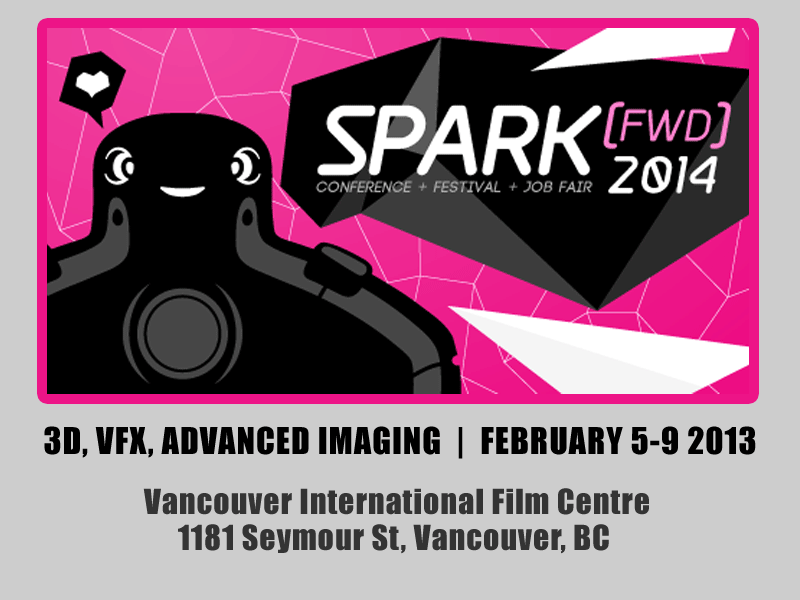
SPARK [FWD] IS CANADA’S PREMIERE EVENT IN 3D, VFX & ADVANCED IMAGING
For its 5th edition, SPARK FX and 3D[FWD] are merging into SPARK [FWD] 2014. We will continue to bring you 5 days of events, including a job fair, a conference, and a film festival.
The presentation series is complemented by film screenings chosen to exemplify innovation and excellence. If you are a filmmaker, producer, VFX artist, technology or CG enthusiast, this isn’t an event you want to miss.
VFX, STEREO 3D & ADVANCED IMAGING
This new event encompasses VFX, animation, live action, HFR (high frame rate), Stereoscopic 3D and other advanced imaging topics. We are releasing a schedule and lineup of great presenters very soon. We can confirm that ILM, Weta Digital, Prime Focus World, Geneva Film Co, Christie Digital & Warner Bros will be present.With its eyes firmly riveted on the cutting-edge, SPARK [FWD] is also an opportunity to reflect on the past, and celebrate the achievements of some of the VFX industry’s most prominent pioneers. This year will be no exception!
CONFERENCE PASSES NOW AVAILABLE
Come get your Early Bird Special before it runs out! You can now book your pass for the 3-day conference. It will run from Thursday February 6 through Saturday February 8 from 9 am to 6:30 pm. To book your reservation now, please go to the registration page.
The Festival will feature films, special guests and screenings in the evenings. Stay tuned as more information is coming and is constantly being updated.
JOB FAIR OPENS JANUARY 6
We give you one-on-one time with studios. You’re not just handing off a resume and a reel.
Attendance to the Job Fair is free. You can register online as of January 6th. There will be 11 participating studios this year:
Vancouver’s Emily Carr University of Art + Design chooses Pablo Rio for S3D Centre
Leading art, media, and design University invests in Quantel for HFR, UHD, and S3D research
Vancouver-based Emily Carr University of Art + Design has purchased a Quantel Pablo Rio colour correction and finishing system and two Pablo PA workflow assist stations to further research into advanced media techniques and workflows. The systems will be used for the production of S3D content, and research into high frame rate (HFR) 4K-8K S3D production pipelines. Quantel’s Canadian post-production reseller, Annex Pro, provided the systems- the first Pablo Rio 4K in Vancouver, Canada.
Emily Carr’s S3D Centre, located on Vancouver’s Granville Island, opened in May 2010 and leads a project within the GRAND Network Centre of Excellence, which links universities working on film and media topics across Canada. The S3D Centre applies technical knowledge towards aesthetic excellence in advanced media practices. The Centre plans to make the Pablo Rio accessible to the digital media industries with rentals and future post-production training programs.
Dr, Maria Lantin, Director of Research and the S3D Centre at Emily Carr, said, “Pablo Rio is a great addition to the S3D Centre at Emily Carr University, offering HFR, 4K and S3D real-time playback. Pablo Rio’s comprehensive toolset provides our faculty and students with great interactivity and performance for industry relevant advanced media research and services.”
Quantel Sales Director, Martin Mulligan, said, “We are delighted that Emily Carr University has chosen Quantel Pablo Rio and Pablo PA systems as it looks to further research into advanced media post production including the 4K-8K production pipeline. We look forward to seeing the results of the research in the near future!”
This system is particularly exciting at a time when knowledge on managing the post-production workflow for UHD and HFR is in its infancy. A leader in research and content creation of advanced media, the S3D Centre is excited to help pioneer workflows that can be used by the digital media industries. Research into HFR and Variable HFR content creation, dissemination and workflows have been ongoing since 2011, and can be found here: HFR (High Frame Rate) Research
Future post-production training programs will be announced early 2014. If you are interested in participating in a program and wish to gain hands on experience with the Pablo Rio 4K, HFR and UHD content please contact the S3D Centre for more information.
About Quantel
Quantel is a world-leading developer of innovative, high performance content creation and delivery systems across post, broadcast and Stereo3D. We are driven by a passion to create the most open and efficient tools for the digital age. Quantel’s product range unites the very best IT technology with brilliant software. Products include: Pablo Rio software color correction and finishing systems; Enterprise sQ fast-turnaround production systems; Mission media asset management; QTube global media workflow products; and a full range of professional services. All Quantel systems deliver the creative, productive and profitable workflows that give post houses and broadcasters the edge they need to thrive and grow in today’s highly competitive global media market. More about Quantel at http://www.quantel.com
About Emily Carr University of Art + Design
Emily Carr University of Art + Design, established in 1925, is a world leader in education and research. Encouraging experimentation at the intersection of art, design, media and technology, our learning community merges research, critical theory and studio practice in an interdisciplinary environment. Alumni and faculty are internationally recognized as award-winning creators and thought leaders who have enormous impact on both the cultural sector and economy. We engage students, industry, and society to continuously explore and think differently about creativity and how it shapes our world. Emily Carr is building a state-of-the art campus for 21st century learning at Great Northern Way. The University will be at the centre of a new social, cultural, educational, and economic engine for British Columbia. Find out more at ecuad.ca.
About Annex Pro
Since 1983 Annex Pro has provided technical solutions for creative professionals involved in video game development, film/TV, animation, visual effects, audio post and music, and corporate media in Western Canada. Located in Vancouver, BC, Annex Pro is a Value-Added Reseller authorized to supply software, hardware and services, as well as training, technical support and consultation. Find out more at annexpro.com.
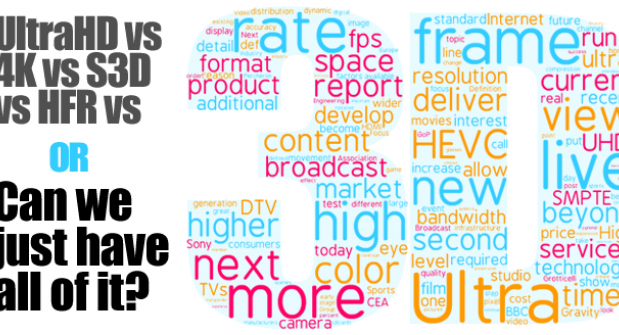
There has been a tremendous array of news the past month regarding the ‘demise’ of 3D, and the surge of UltraHD (4K, 8K) interest.
There are several opinions one can take, and here at the S3D Centre we know one thing- 3D isn’t going anywhere, and it is currently in limbo. With 3D capability on TVs now no longer a premium cost, we can be encouraged that 3DTVs and other 3D devices are now accessible at a fair price point to consumers. We also know that UltraHD televisions are currently extremely expensive for 99% of consumers, and the medium will be years off from seeing realistic uptake. There is truth that it is simple to create and deliver 4K and beyond content for broadcast, online or cinema. Similarly, 3D content is also becoming more reasonable to create and deliver. Many 3D ‘experts’ are blaming several factors for the consumer disinterest in 3D: glasses, viewing angles, and lack of content. Other experts claim that without impelling 3D content, consumers simply will not love 3D and this is the fault of the broadcaster for not understanding the medium and its marketability.
Unlike in many parts of Europe (where 3D is driven by broadcasters and creative professionals alike) North America’s 3D topics has largely been handled by 3DTV and camera manufacturers who are trying to sell products, and not by broadcasters and content creators who determine unique content.
While this controversy is going on, it is important to note that cinemas just had their most exciting Spring/Blockbuster year ever. Movies such as The Great Gatsby, Iron Man 3, Jurassic Park, Star Trek: Into Darkness, Man of Steel, Pacific Rim, The Wolverine, World War Z, Despicable Me II, and Monsters University were launched with as many having created in native 3D as converted 3D.
And with Gravity, The Little Mermaid, 47 Ronin, and The Hobbit: The Desolation of Smaug (also in High Frame rate) set to come out in the fall/winter months, we see only more experimentation, learning, and creativity on the horizon.
Here is a breakdown of all the most relevant articles we could gather on the topic of UltraHD, 4K, 8K., HFR, 3D and more.
From SMPTE: “Michael Grotticelli recently posted some interesting coverage about the state of the push toward widely implementing 4K Ultra High Definition (UHD) on the Broadcast Engineering website. Inthe article, he summarizes the Consumer Electronics Association’s (CEA) newest report on the topic, dubbed “Ultra High Definition: State of the Industry.” Grotticelli suggests there is a gradually emerging market developing for 4K broadcast content designed for home viewing. He reminds readers that various technology companies are hard at work researching what he calls “next-generation compression and decompression chips” built around the HEVC codec for eventual implementation in 4K home viewing monitors.
Additionally, “the CEA report cites the upscaling of high-definition resolution content and a trend toward more affordable pricing as two of the most important factors affecting the 4K market in these early days,” Grotticelli writes. “Ultra HD displays can upscale HD video to Ultra HD resolution using video processing to fill in the extra resolution.” Grotticelli also posted a second article that suggests the current broadcast industry infrastructure’s limitations remains “the biggest hurdle to Ultra HD distribution.” That article discusses the promise of HEVC, other developments, and interesting recent tests, but points out those developments are still a long way away from being implemented.”
“The recent announcement that ESPN is shuttering its 3D sports network has triggered another round of “3D is dead” articles. But 3D isn’t dead. I do think, though, it has plateaued and is going to be stuck at about this level until the technology improves.
Steve Schklair of 3D tech supplier 3ality admitted pangs of doubt after the ESPN announcement. “3D television in the U.S., for many reasons, is just not going to happen in the current climate,” he said. “The audience is not being built.” But Schklair notes that BSkyB’s 3D TV service in the U.K. is doing well. “It succeeds in the U.K. because of the quality and the non-repetitiveness of their offerings,” he says. Pace also observes that in England, the major driver behind 3D has been a broadcaster promoting shows in the format, not manufacturers trying to sell TVs.
(Vince) Pace says the next window of opportunity for 3D will come with the arrival of 4K Ultra-High-Def TV. Creatively, he says, 3D and UHD match up well: Both benefit from wider camera angles and less camera movement than today’s HDTV.”
—
Dr. Ryan Stone (Sandra Bullock) hurtles into space in Gravity. Image: Warner Bros
From the article: “Not only did [Cuarón] want to ensure that the 3D was an integrated and value-added aspect to his film, he decided at the beginning to make it so. This approach allowed 3D to be a supporting element and enabler of the outstanding story. And what’s great is [that] audiences are validating that decision.”
In its opening weekend, 80 percent of all Gravity ticket-buyers chose to see the film in 3D (compare that to 71 percent of Avatar’s opening audience). The following weekend, that number rose to 82 percent and remained steady through the third weekend. Despite its continued description as “game-changer,” at the end of the day can Gravity — or any other movie that successfully utilizes 3D as a tool for immersive storytelling for that matter — truly change the course of which films studios deem worth of being given the 3D treatment? Will Gravity’s success inspire a rash of pictures that look at 3D as a meaningful way to enhance the storytelling, and not just the studio’s bottom line?
“In a short interview with 3D Focus, Chief Technologist HD & 3D, BBC Technology, explains why higher resolution ultra-HD broadcasting will require dramatically increased frame rates, even beyond 120fps.
3D Focus: What are your thoughts about shooting in multiple frame rates like Showscan Digital or showing certain scenes in HFR like when movies show certain scenes in IMAX?
Andy Quested: Would not work on TV – it takes time for displays and receivers to change (5 -6 seconds) and that assumes we can do it at the broadcast end. But I assume you mean the projector runs at the same speed all the time but plays frames at different repeat rates?
That would work for non-live but for live you would have to run the chain at the same speed and there is no saving for repeated frames. Also we can use Long GoP so the higher the frame rate the more efficient. At the moment production GoPs are around 12-15 (but we could go to 20- 22) based on a 25fps system. If we were to run at 120fps we could run a GoP of over 100-110 and at 300fps around 280-290.”
The author makes some significant points about the age of progressive films rates, the demise of interlacing, and the advantages to wider colour spaces.
“As some have speculated, the recent push for 4K/UHD may have as much to do with hype as it does with quality. And, as has been stated time and time again: you may not get a huge benefit from 4K in your home, depending on viewing distance and screen size. There are some other factors, however, that make ‘Ultra HD’ technology desirable, regardless of clarity so crisp you can’t even tell how crisp it really is. These factors are the other important goals defined in the ITU-R’s (aptly dubbed) Rec. 2020 spec for 4K/UHD. Namely, they are (larger) color space and (progressive-only) frame rate.”
“Also note support for 120 Hz imaging… in a sense, Doug Trumbull foresaw the benefits of a 120-based future with his digital Showscan technology. The good thing about 120 is that pretty much everything divides into that rate evenly — 30, 60, and yes, 24. This is partially already in play with 120 Hz sets, but media actually delivered in 120 (for whatever reason) means the sets wouldn’t have to perform that great ‘motion smoothing’ trick they do.”
“Cameron noted that while he hoped “to get as many people shooting in 3D as possible” with the release of Avatar, the production of 3D movies has “become a studio-driven top down process to make money,” and that control is often taken out of directors’ hands as 3D effects are added in post production.
While Cameron doesn’t want to stop making 3D movies, he appears to be calling for studios to fully commit to the craft and not tack on the experience as an afterthought.”
“Ultra-High-Definition 4K television is poised to be the next standard, the TV that will dominate the living room of the mid-21st century.
But to hear the technologists assembled for the Society of Motion Picture and Television Engineeers’ day-long symposium on UHD TV tell it, Ultra-TV will tread a hard and thorny path on its way to wide adoption.”
“Ultra-HD is often called “4K TV” but as the SMPTE panels explored, it’s really far more. It is to include improved color standards; wider dynamic range (brighter highlights and darker shadows); and higher frame rates. The clarity and vibrancy of a UHD picture is startling even compared with a full HD 1080p image.”
image courtesy of Broadcast Engineering : OdeMax is a new Internet download service offering 4K movies over the Internet. New types of compression are needed to free up bandwidth to make it practical.
From the article: “Clearly, the closed test is not representative of the “real world,” and 4K’s bandwidth-hungry file sizes — basically four times the pixels of standard 1080p HD — make it tough to use the existing distribution infrastructure (whether over the air, via cable/satellite/Telco, Blu-Ray disc or even the Internet). Can it be done technically? Sure. Is it practical? Far from it. The answer, many agree, is a better form of video compression than the H.264 standard that is widely available today.”
“Here’s the real behind-the-scenes story: The cost of manufacturing an ultra high-def TV isn’t anywhere close to the prices that TV makers are currently charging. Along with premium pricing and a lack of available content, the required transmission standards for ultra high-def TV aren’t yet in place.
Also, the current-generation digital interface found on new ultra high-definition TVs, called HDMI 1.4b, can’t handle signals in the 60 frames-per-second rate used by existing HDTVs. (The next generation of HDMI chips that would make this possible are expected to arrive in early 2014.) And even if you get to see a movie in the ultra high-def format, you’ll need to sit much closer to the screen than the typical 9- to 10-foot viewing distance in order to see all the added detail.” Continue reading
The next-generation HEVC compression format, for example, stepped to the fore as a means to deliver new TV services featuring higher resolution, more frames per second, and expanded color accuracy in bandwidth levels that would have been beyond comprehension five years ago.
“HEVC is the key to deliver an enhanced viewing experience that is beyond HD,” said Sophie Percheron, product marketing manager for live distribution, ATEME, during her presentation. “First is more resolution, but ‘beyond HD’ must not only be defined by resolution. Increased frame rates and wider color gamut can increase the color space to 60%, giving more accuracy to the image and higher dynamic range.”
Percheron laid out the case for HEVC with respect to new TV services, explaining that it will allow Ultra HD (UHDTV) 4K services to be delivered between 11 and 18 Mbps, putting it in line with the requirement to deliver HD via MPEG-2 in 2005.
And, for those looking to move from 60 to 120 fps, she offered even more good news: as the frame rate increases, the percentage of additional bandwidth required decreases. For example, going from 25/30 to 50/60 frames per second requires between 19% and 42% additional bandwidth. But going from 60 to 120 frames per second requires only an additional 17%-28% of bandwidth.
“You can deliver up to four channels of Ultra HD per transponder with HEVC at bit rates that are comparable to HD services today,” she added.
“The difference between 3DTV and 4K here is obvious as the screen you view it on. The only impediment is cost. If you can afford a 4K TV, and the prices are quickly coming down, I believe there’s potential. Last year Sony was saying 4K TVs would cost about $15,000. This year the company showed a 55-inch model for under $6,000 and a 65-inch TV for $8,000.”
“It will still take many years before we see it in our living rooms in any real numbers, but for me, 4K does not feel like 3DTV—8K does, in terms of immersive picture quality—and that’s foreshadows a higher resolution future for everyone.”
“ESPN 3D launched in 2010 with coverage of 25 FIFA World Cup matches, but word that the channel will be shut down by the end of the year has the international football association reviewing whether it will use the technology at all in 2014.”
“The Associated Press reported that FIFA has sent questionnaires to rights holders to assess their interest in 3-D coverage. Overseas broadcasters in Europe continue to (at least publically) favor 3-D content in some form or another.”
—
“All the content was directed live, produced and edited by Sky’s in-house football production and broadcast operations teams using four Sony F55 UHD cameras complemented by two UHD EVS servers for replay, and graphics. The production was done from a purpose built outside broadcast truck in conjunction with Sony and Telegenic in line with current live HD broadcast techniques.
Four synchronous full HD feeds were run by Ericsson over a Eutelsat transponder to its London HQ and was shown on a Sony 84 inch Ultra HD TV at its headquarters in Isleworth. While such a set would currently set you back £25,000, a 55 inch model is available in stores for £3,999.
Sky is emphasising that the event was not a product launch, but merely a demonstration to develop the broadcast requirements to meet any future demand for Ultra HD.”
“ESPN last week made headlines when it announced that its 3D network will cease operations at the end of the year, but ESPN President John Skipper told attendees at the B&C Sports Business & Technology Summit that, if consumer demand for 3D got to a high enough level, ESPN would get back into the 3D game.”
“Skipper also gave attendees a sneak peek at ESPN’s new digital center, which is currently under construction and slated to open early next year. The complete facility will measure 190,000 sq. ft., and a visual fly-through of the studio space showed a massive facility with a large central open space ringed with stages, giving new options for camera movement, dynamically cutting between stages, and more. It also allows for more rehearsing, as a goal is to do more storytelling. ”
—
“Sky has reported its most successful quarter of 3D growth to date, with more than half a million households now signed up to receive three-dimensional content from the satellite broadcaster.
The positive result is in stark contrast to the trend seen across the TV industry. In the US, sports broadcaster ESPN will call time on 3D content production by the end of 2013, while the BBC recently announced a three-year hiatus for the development of 3D programming.
John Cassy, Director of Sky 3D, accepted that the 3D TV market “isn’t quite where some people had hoped it would be by now”, with Sky itself experiencing numerous challenges on the way to reaching the milestone of 500,000 viewers.”
“BSkyB has reaffirmed its commitment to 3D programming, with a focus on big events, despite broadcasters such as the BBC turning their back on the technology.
“We recognise that at this stage in its development 3D isn’t for everyday viewing, like on a standard TV channel. This is why we continue to believe it is about focusing on big events where the technology really benefits viewers,” said Cassy.”
“This is because – unlike some other providers of 3D programming in the UK or US – we are a platform operator as well as a content producer. This means that a significant proportion of the value of providing great TV in 3D lies in how it helps attract new customers to join Sky, and provide another reason for existing customers to stay with Sky,” he added.”
“A glasses-free 3D display technology will be installed on planes by several major airlines by the end of the year, according to its European distributor, Frontniche.
The autostereoscopic technology, devised by Korean manufacturer 3D Nuri and unveiled earlier this year, is currently available on a £250 5-inch Android tablet. The patented technology uses a parallax barrier technique placed in front of the LCD allowing each eye to see a different set of pixels. It also includes a 2D video to 3D convertor.”
“From the business perspective, the 3D Internet space is a huge opportunity and we are seeing more and more businesses and research being built around 3D Internet. The Oulu area has unique expertise and provides a living lab environment to test and develop 3D Internet technologies and services,” he added.
“The ultimate aim for the ambitious project was “to lay the groundwork for the 3D Internet” but also looked at Mixed Reality, also known as augmented reality (AR).”
“The B&C Sports Business & Technology Summit in New York City this week put today’s use of 4K in sports broadcasts and its long-term potential into focus, with experts discussing the current challenges and opportunities related to this still young format. But, as immature as some of the workflows and technologies are, Larry Thorpe, senior fellow, ITCG professional engineering and solutions division, Canon USA, was quick to remind attendees that the 4K movement is much broader and arguably 10 years ahead of where the HD transition was at a similar juncture.”
There is one additional ripple effect of the 4K movement: 3D.
“3D will be back with 4K 3D at a higher frame rate and with no glasses,” predicted Zabel. “In three to five years, 3D will be more popular than it is today, and higher frame rates will make it dramatically different.”
“Currently, the obsession is for ever higher pixel counts, an approach that disregards how we actually see moving images. If broadcasters have their way, we could be on course for some ridiculous format decisions.
Intuitively, you would think that the frame rate – the number of pictures per second – would have quite a large bearing on the quality of the illusion, and you would be right. Equally, you might think that the film and TV companies had done a lot of research into human vision in order to choose those rates that have been in use unchanged for decades. Unfortunately, you would be wrong.”
“a) If the eye were fixed, then it would effectively scan the detail in a moving object such that the detail would turn into a signal changing rapidly with time that the eye can’t handle, so it would look blurred.
b) In real life the eye tracks an object of interest, so it becomes stationary on the retina, allowing detail to be seen.”
Continue to Retina displays, and The eyes have it
CEA wants $499 in order to purchase the report, unless you are a member. It is likely many of the details in the report will become common knowledge over the next several months.
The report also considers current efforts to update the standards and infrastructure necessary for mainstream Ultra HD adoption. For example, CEA recently updated industry standard for HDMI to include new Ultra HD formats and larger color space.
This one-day technical Symposium will provide you with an understanding of the technology landscape, separating fact from fiction. Much of the content presented at SMPTE is expected to be made availabel to SMPTE members online over the course of the next few weeks. More info.
At the Emily Carr S3D Centre of Excellence, it’s our job to advocate on the behalf of Content Producers who want to employ S3D and Advanced Imaging Technology. We at the Centre are very bullish and passionate about S3D and all believe that its use enhances a story if placed in the hands of a skillful practitioner.
As such, we were pleased to learn that the 32nd edition of the Vancouver Film Festival http://www.viff.org/had planned to screen a number of 3D Films including 3X3D, which is a collaboration of two film legends Peter Greenaway and Jean Luc Goddard. Also on the list (there are four all together) was a curious documentary film Flashback Memories 3D http://www.viff.org/festival/films/f8447-flashback-memories-3d
The screening was in the middle of a Monday afternoon, so I was the only one from our group who decided to attend the screening with thoughts that it was important that we were represented at the most atypical of screenings, a 3D documentary from a Japanese filmmaker.
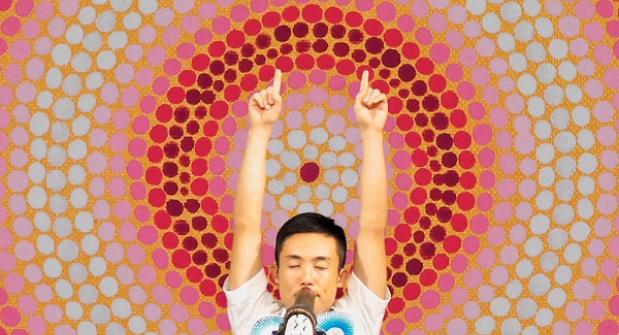
The film is the story of a Japanese Didgeridoo player, Goma, who has an international following. In the film we learn that Goma, whose talents with his Didgeridoo are prodigious (the sounds that he is able to produce from the instrument are truly astonishing) is involved in a car accident that leaves him with short-term memory loss and subject to a series of emotional disturbances. This is a rich subject to mine for a documentary. We see Goma and his band “The Jungle Rhythm Section” performing throughout. In addition, in an attempt to insert another layer to the story, the director has them play in front of a green screen on which video of Goma’s life is displayed. In 2D this would be an interesting directorial choice and an experimental way of chronicling and contextualizing the artist’s history.
Unfortunately, however, this diminishes the story in 3D. This is most likely due to the fact that the two eyes are converged on the band and there is divergence on the green screen. More troubling for the eye and brain is the 2D video on the green screen that has been converted. In the genre of documentary, this footage is known as ‘run and gun’, meaning that it was never shot with 3D composition or framing in mind and is something akin to home movies. These two factors, coupled with a large amount of text on screen, created enormous problems for me. I could not fuse the 3D comfortably and was forced to remove my glasses during the sequence. Thus bringing to mind one rule that 3D Filmmaker should never break and that is ‘thou shall not hurt your audience’.
The art of storytelling in 3D is merely in its infancy, and all of us producing 3D content have so much to learn. It would be easy to dismiss the Flashback Memories 3D as an experiment that went wrong, but that would be too simplistic and grossly unfair. In fact, whether the director intended it or not, there was one scene that was magical and worked well in 3D, that being the scene in which Goma and his band played in front of the green screen. However, these time still images of paintings that Goma produced (inexplicably after his accident) were shot in native 3D and then projected. This had a surreal immersive quality that only 3D can provide.
As evidenced by Wim Wender’s landmark film Pina, http://www.wim-wenders.com/movies/movies_spec/pina/pina.htm documentary is a genre that 3D can and will flourish in. We at the Centre advocate vociferously for its use, but we also know that the filmmaker needs to think carefully before taking their 3D journey. Ultimately Goma is a very interesting character and an extremely talented artist. This does come across in the film and we must laud Mr. Tetsuaki for deciding to employ and display his film in the 3D medium. It is my opinion and that of 3D practitioners that many of the breakthroughs in 3D will not necessarily come from Hollywood but from independent artists. However, whether it’s a big budget movie or independent art film, we must always be conscious of our audience’s comfort and never let the use of 3D detract or hinder the story.
Saturday, 5 October 2013 from 7:00 PM to 10:00 PM (PDT) Vancouver, British Columbia
Please join us in an evening of panels, films, food, drink, prizes and networking! The 2013 3D Showcase & Party by the S3D Centre + International 3D & Advanced Imaging Society celebrates the most recent creative and technical advancements in stereoscopic 3D filmmaking.
We are joined this evening by special guests, some of whom have films screening in the short film programs at VIFF. These award winning filmmakers will describe their creative process, the financing, logistics and technicalities of making 3D animation + live action productions.
7:00pm: Panel discussion with fillmakers + films Confirmed: Foxed! director James Stewart + Impromptu director Bruce Alcock
Followed by Q&A
8:15-10:30pm: Drinks, food, networking and technology stations
Quantel will be present at this event to show you the brand new Pablo Rio acquired by the S3D Centre- a system capable of HFR, 4K and S3D realtime playback!
There will be a prize given away this evening- a Fuji full HD 3D camera courtesy of Quantel!
GRAND NCEis a research network and commercialization engine whose goal is to address complex issues in digital media and transform multidisciplinary research into user-centred solutions. GRAND will explore the use and application of digital media in a variety of settings including entertainment, healthcare, education, environmental sustainability, and public policy.
NSERC aims to make Canada a country of discoverers and innovators for the benefit of all Canadians. The agency supports university students in their advanced studies, promotes and supports discovery research, and fosters innovation by encouraging Canadian companies to participate and invest in postsecondary research projects. NSERC researchers are on the vanguard of science, building on Canada’s long tradition of scientific excellence.
—
NRC-IRAP We provide innovation and funding services customized to your specific needs. Our goal? To help you accelerate the growth of your business through innovation and technology. See more athttp://www.nrc-cnrc.gc.ca/
—
Emily Carr’s S3D Centre is a national centre of excellence dedicated to advancing the art of stereoscopic 3D through research, education and training. Visit us online:http://www.s3dcentre.ca Follow us on Twitter: @emilycarrs3d
—
The Canadian Chapter of the International 3D & Advanced Imaging Society is a community of content creators and professionals whose mission is to develop the arts and technologies of 3D, advanced imaging and its innovators from within Canada. Activity takes place through educational opportunities, public showcases, awards ceremonies and group lobby efforts to realize these goals.
With over 60 companies and 800 professional members in 20 countries, the Society is open to individuals and organizations active in moving 3D and advanced imaging to an exciting new era of creative achievement and consumer support. Learn more about joining the Canada Chapter.
The S3D Centre’s Maria Lantin and Denise Quesnel will join leaders from the international 3D industry during a 3 day series of seminars and workshops. The Toronto International Stereoscopic 3D Conferenceruns Sep 20-23 and is an acclaimed unique international gathering of creative, scientific and business minds discussing, discovering and inspiring innovation in “Stereoscopic 3D” Cinema. Brought together by the 3D Film Innovation Consortium (3D FLIC), the Conference offers the highest quality discussions on the creative, scientific and business challenges and possibilities of Stereoscopic 3D.
Maria Lantin and Denise Quesnel will present on the experience and results of filming High Frame Rate 3D, notably short subjects with a variable film rate. This presentation draws on findings and best practices from the HFR experimentation that is ongoing at the S3D Centre. They are joined on the panel by Martin S. Banks, Vision Scientist of UC Berkeley, and Andrew B. Watson the Senior Scientist for Vision Research at NASA Ames Research Center.
This year, the Conference also is hosting a 3D Shorts Program curated by 3D cinema scholar Sanja Obradovic. The 3D Shorts Programme consists of six Canadian and international short stereoscopic films, animations and videos produced in the last two years. Of these films, we have our friend and Canada Chapter of the International 3D & Advanced Imaging Society James Stewart’s “Beatrice Coron’s Daily Battles”, S3D Masterclass presenter Josephine Derobe’s “Souviens-Moi”, and meetup presenter Philippe Baylaucq’s “ORA”.
Jean-Pierre Jeunet will be video calling from France (The Young and Prodigious T.S. Spivet, Amélie)
Catherine Owens (U23D, Sculpting Space)
Robert Neuman (Disney)
Demitri Portelli (Stereographer – Hugo, 47 Ronan)
Graham Clark (Stereo D)
Stephen Low (IMAX)
Hugh Murray (IMAX)
Marty Banks (Berkeley),
Andrew Watson (NASA),
April Mullen (Dead before Dawn)
Eric Tessier (Les Pee Wee 3D)
Matt Cowan (Entertainment Technology Consultants Canada Inc.)
Drew Fellman (Born to be Wild)
Jim Chabin, (President International 3D Society)
Laurie Wilcox (York University)
Robert Allison (York University)
Ali Kazimi (York University)
Buzz Hayes (True Image Company, Inc)
Gordon Harris (Christie)
Munro Fergusson (Director, NFB)
James Stewart (Director – Foxed!)
Jonathan Barker (Flight of the Butterflies 3D)
Paul Salvini (Christie)
Liane Kotler (TVO Doc Studio)
Tony Gunnarsson (IHS Screen Digest)
Florian Maier (Stereotec)
Bill White (3D International Media Partners)
Phillipe Baylaucq (Ora)
Julian Pinn (Dolby)
Tim Dashwood (Dashwood Cinema Solutions)
Peter Lude (SMPTE)
Brian Cullen (University of Waterloo)
Jeremy Lloyd (Marketing Magazine)
Jim Dorey (Editor-in-Chief MarketSaw)
Adam May (Vision 3D)
Mark Stevens (Redlab)
Ken McNeil (Creative Post Inc.)
Peter Armstrong (byDeluxe)
Ian Herring (Parallax Films)
M. Bove (MIT),
N. Schneider (MTBS.com)
Vincent Chapdelaine-Couture (McGill)
Roy Anthony (Christie)
Cristin Bargheil (Side Effects Software)
Eric Deren (Dzignlight Studios)
Ihor Petelycky (Spatial View)
Alex Farrell (Director, Media and Entertainment, RBC)
Piotr Didyk (MIT),
Stephen Palmisano (University Wollongong),
Inna Tsirlin (York University)
Denise Quesnel (Emily Carr University)
Maria Lantin (Emily Carr University)
John Helliker (Sheridan College, SIRT)
Andrew Hogue (University of Ontario Institute of Technology)
Bernhard Riecke (Simon Fraser University)
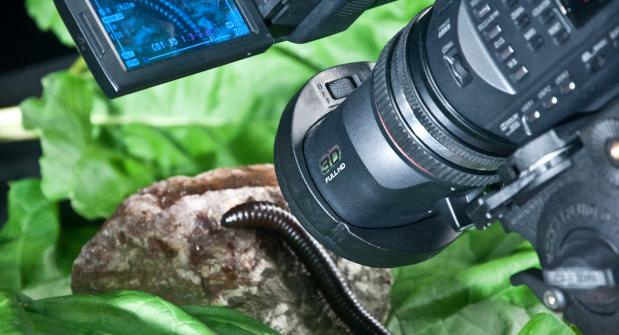
This summer we at the S3D Centre were provided with a unique opportunity to do a macro shoot in 3D. Andrea Frederickson from the Fredrickson Film Factory approached my colleague Denise Quesnel at 3D [FWD] in January. Andrea told Denise that she was inspired by the Conference and that she wanted to consider 3D as a medium for future projects. One of those projects was about bugs for kids. But she was not sure how to get close-up in 3D, which can be a problem depending on your background and the inter-axial distance between the cameras. She mentioned her friend Gary Oliver from Cinemazoohttp://cinemazoo.com who could bring the bugs to us and we told her about a camera and lens combination that we wanted to experiment with. The camera was a Panasonic Z10000 with a close-up filter adapter from Cylopital 3D in Colorado http://www.cyclopital3d.com/PANASONIC-3D-ADAPTERS.html.
Additionally we used a set of four Vivitar Lens with a diopter of +1, +2, +4, and +10 that came with the Adapter. This is readily available Prosumer technology that is relatively affordable. The lens afforded us the opportunity to get quite close-up with the bugs and arachnids which is not always advisable with Tarantulas and Scorpions. Although we have not been able to fully stereo grade, colour correct and depth grade the images this blog serves as some of our preliminary observations about the shoot (that took place at Emily Carr over a period of 6hrs) and our experiences.
The following is a question and Answer session with Andrea Frederickson of the Frederickson Film Factory regarding the 3D bug shoot that took place at Emily Carr.
Question:Can you tell me what you were hoping to accomplish by shooting the bugs in 3D with macro lens?
Answer: I have wanted to shoot insects in 3D Macro now for many years for a children’s science show called “Cute As a Bug.” I have developed the concept and hope to pitch it to the Networks as a 2D series with a 3D bonus. Distribution for 3D is still very limited but I’m really hoping to get on the bandwagon with this project. Insects seriously fascinate kids and this series is designed to educate and inform in a fun and exciting way. Capturing the physical beauty of the bugs in Macro 3D and being able to observe the mechanical detail that Macro 3D provides makes for a great learning experience. It’s truly awe inspiring to witness the utter elegance and strange beauty of the bugs so up close and personal. The 3D Macro component takes the viewer into a fantastic, secret world you can’t experience with the naked eye. Kids are going to be blown away.
Q: What made you consider the Panasonic Z1000 to capture these images?
A: Originally I had planned to shoot the test footage with two Red Cameras and a professional 3D rig. This of course is a more costly endeavor but fortuitously, through Denise Quesnel at the Emily Carr S3D Centre and the International 3D & Advanced Imaging Society headquarters at Emily Carr, we were able to seize the opportunity with the Panasonic Z1000. As luck would have it Alan Goldman had some new macro lens he was interested in testing with his high end “Prosumer” 3D camera. I inadvertently had the subject matter. It was a complimentary test that benefited 2 parties.
Q. Can you tell me about your relationship with Gary Oliver at Cinemazoo? How did you approach him regarding your idea?
A: I have been working with Gary Oliver for over 10 years. Originally he was the featured guest at my kids’ annual Halloween party the “Snake Hotel” where he would arrive with his amazing reptiles, insects and of course snakes. There would be over 40 enthralled kids packed into my living room every year. This triggered the idea for the series “Cute as a Bug.” I have huge respect for his knowledge and we have become friends with a mutual love of the natural world. Unfortunately financing was always an issue. When the Emily Carr S3D Centre said they could help we jumped at the opportunity. Gary Oliver’s new operation in White Rock, “Urban Animal Safari Rescue” which is home to a multitude of exotic and endangered animals is another project we are hoping to develop some programming for.
Q:Can you tell me about working with the S3D Centre? How did you learn about the Centre? To date what has been your experience of working with us?
A: I am really interested in 3D and was exploring 3D convergence with Gener8 for a slasher/comedy feature called “Whipperman” which I am also pitching. Luckily they told me about the then upcoming 3D[FWD] event in Feb 2013 which I attended. This is where I hooked up with the Emily Carr S3D Centre contingent and realized that they are powerhouse with international affiliations. At any rate the event was fabulous. I made tons of connections and most importantly started really learning about the technical reality of shooting 3D. Finding the S3D centre was a big break for me because suddenly I was hooked up with local artists like myself passionate about 3D. During the shoot at Emily Carr, I was really impressed with the technical professionalism that Patryk Stasieczek, Paolo Pennutti and the rest of the S3D Centre. We were finally able to get some great footage in the can with a financially realistic camera package. This helped the centre test the macro lenses and helped me get one step closer to making my series happen.
Q: What kind of discoveries did you make about the bugs/cameras while you were on set?
A: We discovered shooting insects in 3D was really very exciting as the bugs were quite delightful performers. Of course Gary Oliver’s expert “bug wrangling” abilities made this happen as he could anticipate the behavior of the various specimens and get them to explore the mini environments in a way that made it best for the camera. He really is an amazing guy. The challenges with the camera were trying to deal with maintaining the focus on the subject as opposed to the background elements. Eventually we simplified the sets for the best results and were able to focus more specifically on the most visually interesting details of the bugs. For example the millipede’s “revolving” leg the tarantula’s “complex facial features” and the “face to face” territory stand off of the two female Stick Insects. It was also cool to watch the Prickly Leaf Insects fake “blowing in the wind” their “undulating” camouflage technique as well as witnessing them laying eggs … in 3D!
Q:What is the next step for your project?
A: Now that I see the effectiveness of the Panasonic Z1000 I am going to see whether or not it is feasible to complete a 3 – 5 min sizzle reel, which conveys the complete concept for “Cute as a Bug.” Even though the Z1000 is considered a “prosumer” 3D camera package, I know that I can complete the sizzle more economically than with the Red cameras and pro 3D rig and it will still look great. I will also master a 2D version of course for practical pitching and then “thump em” with the visual ‘wow’ factor of 3D. Once the select rushes are stereo and depth graded I can look at what we’ve got and finalize the script for the sizzle. That challenge will include shooting the sync component of the hosts and then adding some razzle-dazzle 3D graphics. Also the theme music has to be hot but kid friendly. My background is extensive post and I’m keen to figure it all out and cut a really great sizzle reel. I hope that I can continue my creative collaboration with the Emily Carr S3D Centre, as they are so eager to share knowledge. I work in the film industry and at the end of the day it’s a pretty tough business. I can’t express how refreshing it is to work with artists collaborating on making something beautiful for the sake of experimentation and knowledge. It was really because the S3D Centre stepped in that I was able to make this happen.
The following is a question and Answer session with Patryk Stasieczek, a Research Assistant and Masters Student at Emily Carr regarding the 3D bug shoot that took place at Emily Carr.
Q:How many hours/minutes of footage was there?
A: The total length of unedited in-camera footage is: 01:56:33 (22.0GB). Currently the footage separated left and right, and sequenced with workable 2D footage is 00:50:37. There was a lot of set-up footage, empty feed, and coercing of the set & insects that were cut out. This length will probably go down substantially once we are able to figure out what sequences work in stereo with the Vivitar lenses and which do not.
Q: Tell me about your evaluation of the footage. What was your process for deciding what images would possibly work in 3D? Did you initially screen the footage in 2D?
A: At this moment in the post production sequence, I was looking for footage that worked within a traditional two-dimensional space, going through the sequences and cutting out the behind the scenes takes, measurements, slates, set set-ups, insect placement, etc. Essentially if it looked good in 2D it was the first starting point. Now that the editing has been done, and the fat trimmed off, and each consecutive segment of the same insect/set-display was condensed into a long workable sequence.
Q:We took images of a number of different bugs against a number of different foliage set-ups with four different macro lens magnifications. Is there one particular macro lens that you think qualitatively worked better than another?
A: The macro lenses proved to be quite an issue while capturing, as they were not designed for stereoscopic prosumer cameras like the Panasonic Z10000 we used. We shot with +1 diopter, +2, +4, and +10 diopter Vivitar macro lenses. These lenses were designed for single sensor cameras and not stereoscopic prosumer devices. Because of the single-optic calibrated design, the best macro filter lenses were +1 diopter and +2 diopter, as distortion was minimal on these two filters. They both still did have slight image distortion around the outer-left (for the left-eye sensor) and outer right (for the right-eye sensor) of the footage, as they were not designed for a stereo camera system.
Q:Is there a specific lens to distance combination that you qualitatively think worked best?
A: In reviewing my technical log of the video shoot, the lens & distance combinations that worked the best were a +1 diopter Vivitar lens with a distance of between 10-16”, a +2 diopter Vivitar lens with a distance of 11”, and in addition to this a +4 diopter Vivitar lens with a distance of 7” (though with the +4 diopter filter there was already an introduction of distortion such as chromatic aberration.
The S3D Centre hit the road for the Ministry’s Year of Science
In May 2011, Emily Carr S3D team members Alan Goldman and Sean Arden participated in the Science and the Arts Expo held at Victoria’s Royal British Columbia Museum. They provided an overview of the S3D process, gave demonstrations and screened content created at the S3D Centre. Goldman pointed out that kids see a lot of 3D movies, but may not be aware that the process of making live action stereoscopic movies differs ever so slightly than 2D. “Their faces really lit up when they saw that big mirror rig and themselves in 3D,” he said.
The S3D Team was a huge hit with the 5,000 attendees. So much so that, in June, the team was invited back to the Year of Science Grand Finale at the Vancouver Aquarium.
“The Year of Science expos aimed to show students – in an exciting and engaging way – the latest and greatest technologies and science-based careers in British Columbia,” said Jane Burnes, Assistant Deputy Minister responsible for the Year of Science. “Emily Carr University’s 3D stereoscopic exhibit added immeasurably to our events, as thousands of students entered the world of 3D while learning from the university’s inspiring team.”
Sean Arden, who led the Finale demo enthused, “Teaching kids about 3D was a really interesting experience; they were so engaged, but (they) didn’t really understand what they were seeing. I discovered that the best way for them to understand how 3D works was to teach them how their eyes work, and that was really fun.”
Science literacy
By showing the science connection to the arts in fields such as digital media, design and special effects, music, and more, the expos demonstrate how science and technology impact our everyday lives and the communities we live in, and provide students and others the opportunity to meet the real people behind the science.
As Dr. Moira Stilwell, Parliamentary Secretary for Industry, Research and Innovation to the Minister of Jobs, Tourism and Innovation, has stated, “With the support of science leaders, as well as educators and community organizations throughout BC, our government is promoting increased literacy in science so we will be well-positioned to meet future workforce demands. Projections show that in the next 10 years one in eight jobs will be in science-related occupations, so it’s essential to get young people interested in science.”
Stereo post production for the independent film maker is still an under determined workflow. There is no single solution to process 3D video. There are many plugins, scripts and softwares both free and paid to enable the 3D enthusiast and professional to output their work. This blog post looks at two plugins available for Final Cut Pro 7 that were under the $100 price point. The two plugins are Onsight OS 3D and Dashwood Stereo3D Toolbox LE*. The S3D Centre has been processing a great deal of its material using these plugins.
*Unfortunately Onsight is no longer available for download so unless you snagged a free download prior to May 2013 you might be out of luck. Our hope is that the makers of Onsight might consider releasing a pay version at the very least as they developed a helpful and efficient tool. Dashwood Stereo Toolbox LE is $99 but they offer a more comprehensive plugin/software at greater cost.
Both plugins have multiple input formats. Both can use side by side files made in RedCIne, After Effects or one of many other 3D tools. Both also accommodate separate R & L eye files. This method allows you to skip the step of pairing up your files outside of FCP. Each plugin has a different third option. Dashwood has an input option for interlaced 3D files. While Onsight has a Side by Side (Crossed) option that corrects any pairs that where flipped with the R on the L.
There are several approaches to editing 3D using these plugins.
1) Make a 2D (Left Eye) cut of your project, and lay the Right Eye in after. This might be the most time efficient as the plugins must be applied to each clip in the timeline.
2) Cut your picture in 3D. This is ideal and allows you to make edit decisions along side your 3D choices. Bring all your selections onto the timeline, apply the plugin, roughly grade the stereo and then begin editing.
3) Import all your clips. Stereo grade your material for misalignments and for convergence settings. ( Good on set camera notes will be a big help during this process. Get a good 2nd AC) Output each clip to Side by Side and edit with these as proxies. When you output, make sure to keep the naming conventions the same as your original footage. Though much time consuming transcoding takes place, this method allows you to return to higher resolution material for your final output.
This method was used for The Depths and we are currently reconnecting to the original 5K RED material.
Method 1 and 2 require a lot of rendering. Any and every edit or change made requires the clip to be rendered. Method 3 allows for standard 1080p editing in Apple Pro Res.
Both Tools share similar functions. Onsight has a course and fine fader for most of its convergence and disparity controls which allows for a more precise adjustments. For a detailed comparison see the chart below.
An additional function only available with Dashwood, is the ability to save and apply presets. Onsight requires every clip to be stereo graded from scratch. Having the option to apply a preset to a clip can save a lot of time.
A challenge we discovered is that it is difficult to apply any speed changes or most effects to a clip. Only the main eye is affected by the effect and the clip that exists in the well is unaffected by the applied change. The only work around was to export and reimport the stereo files and then apply the effect or speed change.
Both of the plugins in FCP are a great way to stereo grade a project. They cover the basics for a reasonable stereo grade. Although both have limitations, the functions and tools they provide make editing 3D possible and cost effective. The plugins are also a great learning tool for those learning how to shoot and edit in 3D. Whether you are cutting a skateboard video for YouTube shot on GoPros or you are editing large formate footage from RED Cine X, these plugins assist in making your 3D videos comfortable and enjoyable.