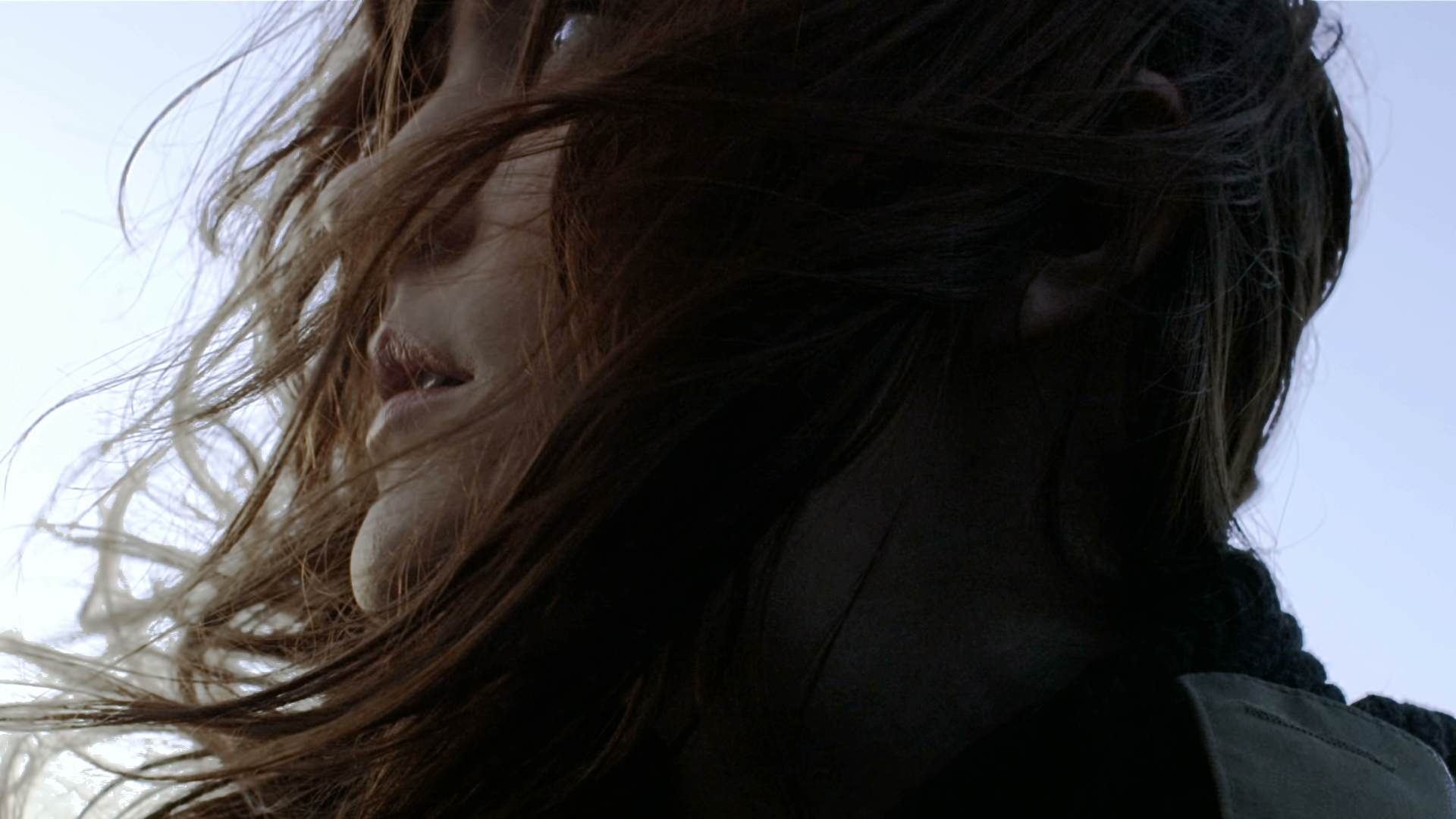
In May 2012 I mounted the installation component of my Master’s Thesis work entitled Transference. The installation was a 3 minute stereoscopic video in the Charles H Scott Gallery at Emily Carr University in Vancouver for the Masters of Applied Arts Graduation Exhibition. To enable a polarized 3D projection upon a surface instead of a screen, I used a silver based screen paint from ScreenPaintHD.
The final installation explores the physicality of stereo in a gallery space. A place where there arent any chairs, where you are wearing 3d glasses but get to move around in relation to an image. The original idea was to create a stereoscopic extension to the space. I wanted to create a hole in real space, or at least the illusion of one. The installation concept has morphed over time, since the completion of my thesis paper. It is an exploration of the physical relation to a stereo image in a an installation context. The piece is a distillation of the ideas I cover in my thesis. The installation features a woman standing on an out cropping. The viewer is at a distance from the character and can make no connection with the figure other than through a simulated understanding of space. By space I am referring to the physical qualities stereo illusion. The image cuts to a close up where the character is looking away from the observer, again thwarting any connection to the character through traditional cinema convention. I hope for this limited access to the character through the composition to force a cognizance of the observers relationship to the illusory stereo space and what that spatial relationship communicates to them. With the absence of connection through typical cinema conventions the only relationship left between the observer and the character is the relationship through the simulated S3D space.During the Masters degree I tracked my experiments and writing on a section of my own stereo blog@Adventures in Stereo.
2013 Grad student Paolo Pennuti in collaboration with Annie Briard.
Under the direction of Sean Arden, with special thanks to Dafna Vallejo.
Initial questions
How can you shoot a side by side 3D time lapse using two Canon 5d Mark II (or any other DSLR camera)?
How do you sync the two cameras?
Is it necessary to align the cameras with a 3D monitor before shooting or can you roughly align the cameras on the field without a 3D monitor, and then correct the alignment with After Effects?
Concept
Capture still pictures at regular intervals with two Canon 5d Mark II (left and right eye) for a side by side 3D time lapse.
Sync the two cameras and test the alignment with and without a 3D monitor.
Process the files with After Effects to produce the final 3D sequence.
Set – Up
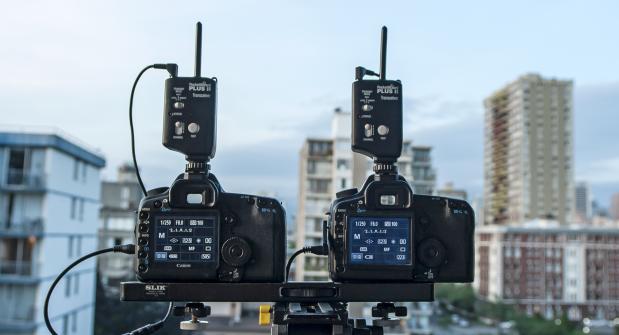
Two Canon 5d Mark II
Two Zeiss Distagon T* f 2,8 Ze 21mm EF Mount
One Canon 7d, only body without lens
One Canon Remote Controller TC-80N3
Three Pocket Wizards Plus 2
Conclusions
DSLR cameras are the most portable and cheapest devices available on the market to shoot 5k 3D still RAW images.
Three pocket wizards, another DSLR camera and a remote control are necessary in order to sync the shutter buttons of the two main cameras at constant time intervals (it is possible to avoid using another camera and the camera remote controller but it becomes necessary to manually press the shutter button to shoot).
Even though setting up alignment with a 3D monitor is recommended before shooting, it is still possible to get good results without using one. After Effects is very effective as a tool to correct most alignment issues.
For more information on the S3D Centre’s research activities in HFR and other areas, and to see our current supporting press material please visit HFR Research home.
Key words for this article: HFR = High Frame Rates. Traditionally, cinema productions are filmed at 24 frames per second, or for broadcast at 29.97 (30) frames per second. There are numerous advantages to filming in HFR, especially in 3D.
A HISTORY on HFR and Standard 24fps :
Movies have been filmed and also projected at 24 frames per second since he 1920’s, and it has become widely known as a ‘cinematic aesthetic’. However, due to the slower shutter in recording frames at only 24 per second, certain motion artifacts such as blur and light strobing become visible. Motion artifacts are of concern in stereoscopic 3D productions, where they have been proven to increase viewer discomfort and promote a less immersive experience, the opposite of what most 3D productions are trying to accomplish. These motion artifacts are greatly reduced at higher frame rates, with the result not only a more comfortable viewing experience, but also one that demonstrates hyper-reality and smoother images.
If you have a pair of red-cyan anaglyph glasses, have a look at the below image. “A window within a window”.
On August 17-18th, staff from the S3D Centre directed the first variable rate HFR shoot of its kind with talented independent crew and cast members in Vancouver BC. “L’âme Soeur (Soul Mate) 3D” is a dual short film / applied research project that takes full advantage of HFR technology. Shot on the RED Epics on a motorized Kernercam stereoscopic 3D rig in both standard and high frames rates, we used the most recent advances in technology to investigate a question we have been studying for the past year: If technology were capable of capturing and displaying a complete narrative that incorporates variable standard and high frame rates, what are the creative benefits/drawbacks of doing so? Does the utilization of HFR as a ‘tool’ in this regard change the immersive experience for the viewer? We suspect that the question of whether or not to utilize HFR in a stereoscopic 3D film within a narrative context depends largely on the creative intent of the film itself. This short film was a means to explore this research.
Initial research conducted in advance of this production consisted of a complete analysis of cameras, stereoscopic rigs, post production and display solutions that were capable of supporting HFR. The RED Epics were chosen for their ability to shoot HFR at unprecedented resolution, and the ease of a RED workflow. We used our Kernercam 3D rig with Epic mounts which proved of critical importance due to its motorization of IA (inter axial), convergence, and focus. We were unable to find a display capable of HFR playback to bring on set, so we monitored on a consumer LG monitor in standard frame rates.
Alan Goldman and myself (Denise Quesnel) had been present at NAB Show 2012 where we were in attendance at an HFR presentation. At the presentation, we observed Fraunhofer and Park Road Postdemonstrate stand alone clips at different frame rates. The clips had been created using a variety of interpolation and filming methods. An observation I made at the presentation was that it became difficult to appreciate the effects of HFR when clips were presented outside of a narrative context. If HFR is utilized to enhance and tell a better story, then I figured I would like to see it within a story. Yet there seemed to be unexpected push back from attendees at CinemaCon 2012 only a week later, when Peter Jackson and company presented 10 minutes of clips from “The Hobbit: An Unexpected Journey”. Once more, clips were presented outside of their intended narrative context and viewers had some very legitimate concerns over the footage. Comments ranged from ‘the shot with the actors talking was too realistic, it took me out of the immersive 3D experience and I was reminded I was watching a film’, to ‘the landscape and action shots were stunning and incredibly immersive.”. Douglas Trumbull has stated that HFR could benefit from being used as a selective tool, and we agree with his thoughts that some clips may be appropriate in 3D HFR and others not. Now that digital projectors exist, the firmware and software modifications needed to achieve this can be accomplished in time.
For our experiment “L’âme Soeur (Soul Mate) 3D”, we decided to shoot every shot at 24 frames (standard), and 48 and 60 frames (HFR) rather than interpolate frames in software later. We wanted to know what actual HFR shooting would be like on set and with a direct comparable in post. One concern was that switching frame rates between takes would be time consuming, but Emily Carr’s in house stereographer and research technician Sean Arden says “this is something that is common in film production for a variety of reasons, even 3d productions, one can achieve all sorts of different visual effects and tricks using higher frame rates, like super human speed illusion or time re-mapping. The only delay was in switching the output on the AJA Gen 10″ to keep the cameras in sync.” With the help of an experienced crew, including Director of Photography Oliver Millar and stereographer/camera operator David Tenniswood we were able to resolve the issues surrounding sync and the need for more light over the two day shoot. Filming HFR does require additional light, since the shutter remains open over less time as frame rates per second increase. A knowledgeable crew was key in being prepared for the need for additional lighting.
A de-brief after the shooting was completed led to the team agreeing that we had stuck very closely to our intent to use variable HFR as a creative tool during the shoot. There were times that once on set, we would look at the shot list + staging and realize the shot we had in our heads was not entirely realistic, or did not take full advantage of HFR. “Some other shots (i.e. Dima hand holding the camera/rig during Starlise’s dance performance) was never something that we anticipated being possible.” said Alan. “It will be interesting to see how our initial imaginings in the pre-planning of the test/shoot will concomitantly work (or not) in the final narrative piece. I imagine that their will be a distinct difference between pre-selected shots that we use to measure (against) other shots and the narrative flow of the film that has a beginning, middle and an end.”
In looking at the initial footage, we are overwhelmed at its potential to build a better story and also be used as a scientific AND creative learning tool for 3D stereoscopy. We are already making early observations about how the various frame rates relate to one another and can be seen on their own. The next blog post will focus on the story of “L’âme Soeur (Soul Mate) 3D”, how it was written specifically to support variable HFR 3D production, and what post production tools currently are used to support (variable) HFR 3D.
Before entering the world of Visual Effects, Sandrew’s background was neurobiological and medical research with a career spanning the pioneering eras of neuroscience and digital medical imaging. “in the last decade we’ve seen what is arguably the most significant advancement in feature film technology. Sometimes referred to as the “Digital Age of Cinema,” the early 2000’s saw Hollywood accepting the fact that film may no longer be the dominant medium for making and exhibiting movies, paving the way for digital cinema to become the default standard.”
Discussed in detail is Higher Spatial Resolution, and I can really appreciate Sandrews’ comparisons of digital cinema resolution to medical imaging resolution. It is a great example of how 3D technology crosses the boundaries between many industries.
The author also details the movement towards Higher frame rates for 3D and temporal resolution. One thing not to be forgotten is the tremendous bandwidth and storage demands from production through to delivery.
Valentini addresses one of the greatest limitations to S3D projection to date; the loss of colour depth. “But in the wings are laser projectors. The color depth will catch up.” The article also goes int detail about the size of rigs, and offers a few new technologies that will be smaller.
Hot in the news last week was the announcement that DirecTV was pulling the plug on its 24-hr 3D channel. Many thought that spelled doom and gloom for Stereo 3D as a whole, but this article has a great counter response about the international market thriving outside of N.America. Torsten Hoffman from the 3D Content Hub discusses the state of 3D content production, price drops, product availability, and great advice to any broadcaster wanting to expand into 3D network.
Q: “DirecTV says lack of content is the reason for the cut back in programming. What do others think? Is this the real reason the lack of advertising, the small customer base of 3DTVs, poor subscription models or other factors?”
A: “orry CC, not buying that one! Why is it that there is so much content buying going on in Europe and Asia. China is scooping up bunches! LG, Sony, Samsung and Panasonic are all featuring 3D channels on their smart TVs.
Some of the 3D content on DirecTV was excellent while others were just plain bad 3D. And this is not my critique, it is the voice of many others.”
This article was discovered courtesy of J. Leong, one of our active S3D Community members:
While Rian is explicit in stating that he does not have any interest in filming in 3D, and little interest in watching it, he makes some valuable reflections on ‘true depth’, and how an artist’s gallery exhibition helped open his mind to the possibilities of Stereo 3D media. “I don’t think the development of 3D will be significantly forwarded by artists “learning to use” the current technical model of stereoscopic properly, or refining how they dial it in. Technicolor was not a refinement of hand painting, it was a completely new technology. It was a different thing. I have no idea what it will be, what form it will take, where it will come from or when it will arrive, but I believe a similar quantum leap to a new technical way of capturing depth on recorded media will be what actually brings us into the 3D age. It’s going to happen. ”
Well. I was very excited in April to see one of my favourite shows, “River Monster” had been filmed and will be delivered in Stereo 3D. The following is a fantastic 17 minute behind the scenes video that has just been released. They used SI2K- SI3D as their main system for filming, and the rig weighed 20kg so the operators were able to use it steadicam style. Barney Revill, River Monsters director explains how they avoided getting stuck in the technicalities of stereo 3D to really embrace the value of the extra dimension. The majority of the parallax was at 3%, with some footage being as high as 6%. They ended up cutting the episode in Avid, and worked with burned in side by side footage for the offline which they could not modify the 3D depth. To solve the problem, they had a consultant create a set of preset plugins to use. They also took 2D underwater footage and created a kind of 3D conversion by manipulating the blacks and whites. The editor explains how he tried to keep shots of similar depth grouped together to avoid the eyes working to hard. All the depth grading was completed at SkyTV 3D department after the film was cut, during the online process. This video is full of really fantastic information from the perspective of the director, TV personality and editor.
We have been following the Vision Performance Institute’s (VPI) work for several months now, and they have some great findings on the speed of stereopsis response time. There is a considerable amount of interest in the sort of tools VPI is creating for vision therapy, and individuals who have 3D vision disorders. There are great images describing the technology on the website.
Article Focus: If you think that converting a motion picture from 2D to 3D is a post production process, think again. Stereo D just wrapped up the conversion of director Timur Bekmambetov’s Abraham Lincoln: Vampire Hunter from 2D to 3D, and the job began before a single frame was shot.
This article goes into great detail about the methods behind the film and discusses the early planning by the team behind “Abraham Lincoln: Vampire Hunter” to create this 2D-3D converted film. They discuss how they went into the topic of monocular depth cues to utilize stereo 3D, and how this surpassed their creative expectations. They also took on the challenge with Stereo D of trying to master notoriously difficult conversion shots, and completed extensive tests before production began to ensure their success. It sounds as though Stereo D operates in a similar manner to our own local Gener8- they began the conversion process alongside the VFX pipeline and shooting schedule in order to keep the deadline.
Milton Adamou with the Quantel Pablo System. Image via Creative Cow.
The author of this article completes a fantastic cross comparison about the international market for 3D BluRay- an analysis of the purchase cost of 3D BluRays in Europe, Asia and North America, 3D premiums (including taxes) and advice to independent 3D film producers on 3D BluRay (and online) distribution.
Italian horror filmmaker Dario Argento has presented his “Dracula 3D” this week. The film is a throwback to its gothic origins with a massive improvement in Stereo 3D technology. Argento wanted to be able to take his film to a new level of horror by using the depth created with Stere 3D. A video interview with samples of the film can be found on the website.
If you enjoyed Ultimate Wave Tahiti 3D, this is pretty much guaranteed to be a hit. This looks like it will be a great story, good editing and really beautiful footage.
“STORM SURFERS 3D is an epic, character-driven adventure documentary following two best friends on their quest to hunt down and ride the biggest and most dangerous waves in Australia. Aussie tow-surfing legend Ross Clarke-Jones and two-time world champion Tom Carroll enlist the help of surf forecaster Ben Matson and together they track and chase giant storms across the Great Southern Ocean.”
“Stream TV Networks, which develops glasses-free 3D technology for TV sets, said iPad, iPhone and Apple TV users will be able to beam movie or application images to upcoming glasses-free 3D TV sets based on the company’s autostereoscopic technology.”
This is almost guaranteed to help move Stereo 3D into the North American market- Apple actually had been granted a patent in 2010 based on its lenticular mirror style screen with a programmable raster barrier. This is similar to the experience of raster barrier screens, a technology used in Soviet cinema in the 1940’s. This Stream TV device would enable not only Apple devices, but Android and tablet as well.
Humans Invent and Sharp Labs are at it again with their newest article- 3D expert Jonathan Mather from Sharp Labs deconstructs a 3D smartphone. (See their last column on a HOLODECK here). Have you ever looked under the bonnet of a smartphone? And not just any smartphone, but a 3D smartphone.
This article outlines many new Stereo 3D technologies used by the smartphone, such as Wide angle 3D App (similar to the 2D panorama apps) which is available for free, 3D camera hardware, interaction in 3D, and issues with scale.
The book is in Italian, but shows great promise that there is finally a book published specific to Stereo 3D editing (and on Avid too). Now if only it can be translated into other languages. I contacted the author, and he mentioned the book would likely be published in English if the publisher recieves enough requests. I am currently waiting for a review on the book in the Italian language.
Great news for Stereo 3D editors and colourists- DaVinci Resolve 8.2 for Mac is now out of Beta mode and has been released. It offers better support for RED R3D files, more CinemaDNG, & Mac OSX Lion as well as Mountain Lion support.
To Convert Or Not To Convert Is That The Question?
By Alan Goldman
Recently there has been a lot of chatter and gnashing of teeth about the state of 3D theatrically (for actual citations please see the cinematographers mailing list (http://www.cinematography.net/). Seemingly many Cinematographers and Stereographers are expressing their concern regarding the lack of native (shot stereoscopically) 3D movies that are being shot. Admittedly these individuals have a vested interest in seeing these movies produced ‘live’ as the work keeps them gainfully employed. They are critical of the fact that many 2D movies are being converted into 3D. Citing issues around the depth of the shot, roundness of objects and ‘card boarding’ of human figures.
Undeniably their concerns are legitimate. It is baffling that with the plethora of 3D movies that continue to be released more films are not shot natively. The Beam Splitter Rigs are getting lighter and the technical issues like polarization from the mirror have largely been solved. The answer may lay in the risk associated with shooting 3D. Hugo this year’s Oscar nominee for best picture that is lauded by critics and industry insiders is rumored to be largely a conversion (because of technical problems incurred on-set). Another movie that recently has received the native tag is Prometheus, Ridley Scott’s latest Sci-Fi opus yet a small percentage of the film (according to my sources) was converted. In Hollywood reward is always more important than risk.
It is arguable that 3D conversions are technically inferior. It is clearly an issue worth debating especially when the conversion process is imitating what can be captured in two eyes. Some of the conversions that I have had the opportunity to see lately (The Avengers) have been technically sound but do not contain very interesting 3D. One can hardly fault the filmmaker when they never intended to make the movie in 3D. Yet, other movies shot natively trumpet the use of 3D (Piranha 3DD) merely as an attention grabber. ‘B’ fare will always be part of the lexicon of Hollywood. Historically 3D has been associated with the ‘B’s’ genre (e.g. Creature of the Black Lagoon and House of Wax). However, for 3D to be successful today it is important for the medium to gain acceptance across the spectrum of all content based film genres. It is important that filmmakers consider the 3D space to accentuate their stories. Great content is always going to supersede an inferior technical experience.
House of Wax may not have used conversion even if they had the opportunity.
Tim Bennison the COO of Gener8 a company that specializes in conversions recently came and spoke at one of our Meetups . It was clear from his presentation that they employ a highly sophisticated conversion process. To his credit Tim never argued for one process over the other (native vs. conversion). However, what he said was that conversion does have a role to play in the production of 3D content. He added that if the filmmaker knows from the start that the movie is going to be converted “that helps them visualize the depth of the shot/space” before shooting. In turn this helps conversion companies like his maximize the depth and volume of any given 2D shots.
With smaller budgets Indy 3D moviemakers who have a story that needs telling in 3D space still may be better off shooting natively. And movies intended as ‘native’ 3D productions initially clearly have technically challenges that can only be solved through the process of conversion. As Hollywood seems committed to continuing to working with companies who do 2D to 3D conversions clearly its no longer an argument about which process is better. It’s a discussion about how the two can work together to make the medium of 3D more vital.
Optical Imaging and Display Systems Group at Sharp Labs Europe is interviewed in this article , and explains how modern 3D technology will be implemented across multi-platforms, and not just within the entertainment/theatrical sphere. “The ultimate 3D display is a holographic display. Many people don’t realise but there is one thing missing from today’s stereoscopic 3D displays. Despite the depth that they show, the objects always appear in focus, in a holographic display even the correct focus of the light is recreated to form a perfect replica of the real world. However, this is not without the addition of significant technical complexity.”
OPPORTUNITY: Online Stereo content delivery website 3DeeCentral (run by Spatial View) connects your mobile devices, internet enabled tvs and computer to a huge range of 3D content. Their headquarters are in Toronto, Canada with offices in US and Belgium. Contact 3DeeCentral if you are interested in getting your next Stereo project some airtime.
This article has an interesting statistic that the China and broader Asia market offers major 3D opportunities. With Vancouver’s great economic and cultural connections to Asia, this could prove a great way for British Columbians to grow their business opportunities.
Meanwhile, 3net Stereo 3D content producers/network only continues to explode in growth. If you enjoyed U2 3D, you will enjoy this new season featuring performances by Red Hot Chili Peppers, The Shins, Foster the People, Feist and more, all filmed this season in stereo 3D.
Dial M for Murder is not only a fantastic Hitchcock classic, it also was originally shot in Stereo 3D. Now it is finally going to be released in the way it was intended to be screened, and with a new 4K scan from print and restoration.
Toshiba releases information on its newest line of 3DTVs: a wide range of small to large screens, Full HD 1080p display, 100Hz. The premium model (VL900A) has passive play featuring Dual Play, and the lower priced TL900A model utilizes active shutter. These 3DTVs will b e available starting July through August, with new BluRay players available from May and October.
All programs, DVDs, BluRays, home videos, and even photos can be transformed into S3D with the IOGEAR technology. The consumer is given full control of how much 2D to 3D effect they wish to view.
“People who have a 3D TV set use it, like it, and want more content for it,” said John Barrett, Director, Consumer Analytics, Parks Associates in his report entitled “3D TVs: Adoption, Use, and Purchase Intentions” (May 2012). “3D TV is of course a classic chicken-and-egg scenario. The limited amount of 3D content undermines the value of the technology, which dampens adoption, which removes the incentive for more content. 3D TV usage will correlate with the amount of content available.”
Researchers have found ways for Stereo 3D to save lives. “Unlike a conventional 2D mammography, which takes a static image of the top and side of the breast, a 3D mammography takes 15 low-dose pictures from multiple angles. Instead of reviewing a flat image, doctors can view the entire breast tissue one millimeter at a time, representatives said.
“This 3D tomosynthesis technology is truly a giant step forward for mammography in its role in finding early, more curable breast cancer.”
S3D Centre partners with Atomized Creative to create a stereoscopic 3D snowboarding video; Sean explains how they filmed using four rigs in total- one motorized Genus Hurricane beamsplitter rig with two RED Epics, one fig rig with SI2Ks, and two GoPro 3D rig setups. Read about the details and see the behind the scenes video here.
MediaScreen 2012 Survey :: Vancouver Economic Commission
The MediaScreen 2012 surey marks the first time ever that BC’s film, television and interactive digital media partners have united to capture and quantify the important contribution the screen-based industries are making to the province. Your contribution would be valuable to this short survey, ending on June 28th.
Pixar, Image Engine and Moving Picture Company are identified in this article as great ambassadors for the digital media sector is BC. Many of these digital media companies are completing project in Stereo 3D, and they are poised to take Vancouver’s talent and digital economy to the next level.
The 38th National Stereoscopic Association Convention, 3D–Con is happening again July 25-30 2012 in Costa Mesa, California. Jim Chabin, Lenny Lipton, Brian May will keynote and there will be image competitions, art gallery, workshops and a trade fair.
Dimension 3 Expo in Paris has just concluded. “Space Junk 3D” has received the Grand Prize at the festival, and coverage of the expo can be found here.
Of great interest to our Eurpoean friends: This year’s VFX Advantage 2012 conference’s topic is “Making the Most of Visual Effects and Stereo 3D”. July 4-5 2012 in Ravensbourne, London hosted by the Director’s Guild.
The next ‘Star Trek’ game is to be 3D Vision Ready and best in Stereo 3D technology yet. Because the game has been planned with stereo 3D intent from the concept stages, we can expect a better than average stereoscopic PC gaming experience from this release. The NVIDIA team have worked to make the most immersive experience possible with the technology. Have a look at the video.
Great news for underwater cinematographers/filmmakers: DEEP Pulsar/Atom 3D Digital Cinema beam splitter system is now shipping, from Gates Underwater Products in collaboration with 3ality Technica. This housing accommodates the RED EPIC, Canon C500 and many others. Have a look at their website to find local dealers.
If you have been wondering what to do with your S3D short film, or even that idea for a S3D short you have been thinking about, look no further. Deadline to submit is Nov 16 2012, and winners will be flown to Hollywood and accommodated for 5 days and 4 nights in a four-star hotel while they get to tour a major Hollywood studio and have the opportunity to go on set with one of Hollywood’s top 3D stereographers.
NBC has described in detail the broadcast system for US residents, and BBC has also explained their comprehensive plans last month. Unfortunately for Canadians, they will not receive 3D broadcast of the London 2012 Summer Olympics because the broadcast consortium has decided it would be too expensive to deliver. The broadcasting consortium likely had conducted its investigations and trials into Olympic 3D content delivery too late, considering NBC and BBC’s own investigations occurred immediately following the completion of the Beijing and Vancouver Olympics.
Pixar’s latest Stereo 3D animation feature “Brave” hits theatres on June 22nd, and CGMeetup as released a fantastic behind the scenes video on the production.
David Newman, GoPro’s Senior Director of Software Engineering (p.k.a. CineForm CTO) has confirmed that there is a new HERO2 firmware update for GoPro 3D to improve exposure accuracy between cameras. Additionally, CineForm Studio 1.2 has been launched this week. Visit http://www.Cineform.com for the download links.
News of particular interest comes to DIT (Digital Intermediate Technicians) and Stereographers as Matrox announces a new Thunderbolt™ Docking Station at $249, an ultra low price in September 2012.
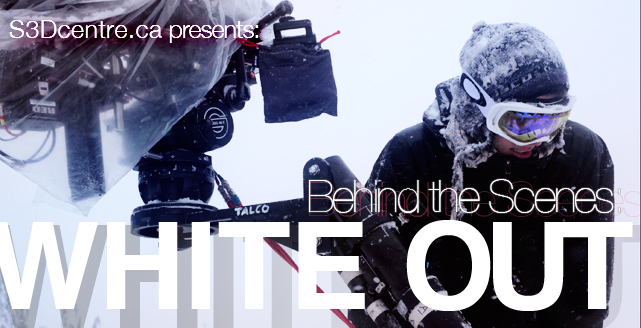
When we decided to shoot for a day on Grouse Mountain, we knew there might be snow and wind but there was a lot of snow and wind. Director and Stereographer, David Tenniswood didn’t let that deter us. If the mountain was open then we were shooting. The plan was to be on the mountain, in position and shooting by 930 -10. The morning proved to be grueling as the wind and snow were particularly strong. We set up camp and our first camera position next to the first big transition jump in the Quicksilver Snowboard Park. There was a small tent for set up, alignment and monitoring.
Rig 1 was two RED Epic’s with 25mm Zeiss Super speeds. Our DoP, Oliver Millar, had spent sometime in the back with the technicians from Panavision figuring out which 2 lenses were optically close enough to shoot with. The cameras we mounted on a modified Hurricane rig. The rig was outfitted with the bolster bracket, allowing for heavier cameras and 2 modified Arri dove tails. Typically the Hurricane has Manfrotto quick release plates, but these were not sufficient to hold the REDs. Because of all the jostling, moving and adjustments this experimental setup required, we need on set monitoring. We built up a custom carrying case with an 23″ LG monitor. To mux our signal we used the Matrox MC100. A super handy flip flop box that outputs 3D over dual SDI or HDMI.
Rig 2 was a pair of Si2Ks on a fig rig. Emily Carr has a pair of Schneider 8mm machine lenses that open to f2. We were able to get some decent material with this rig. We mounted a 3rd GoPro with the usable image area taped off to give the operator some feed back on what he was shooting. The Cinedeck recorder was wired into his back pack.
Rig 3 and 4 were two 3D GoPro setups. These we mounted to ski poles and gave them to some of the pro riders to shoot with. I can’t express how great these little cameras are. We go some great material with them. Very excited to get some of the Hero 2 cameras. The final short is close to completion and will be released shortly. If the post production gods are good we will have a screening at the next 3D Meetup / Master Class. More details to follow on that one. The project was a great first foray for the S3D Centre for an on location shoot. Many thanks go out to Grouse Mountain Resort, Oliver and Dave of Atomized Creative and the crew and riders who made it all happen. Special thanks to the Mackenzie Sheppard who put this together.