Categories
news S3D

3D[FWD] International Conference on 3D Technology to be Hosted in Vancouver January 24 & 25

Speaker Line-up To Include 3D Thought Leaders from Disney, Pixar, IMAX, Sony and more! Tickets start at $59 at 3dsociety.ca

Vancouver, CAN January 16, 2013 | Emily Carr’s S3D Centre and The International 3D Society will host 3D[FWD], a conference focused on the business of 3D, on January 24th and 25th at the Vancity Theatre. The conference brings together leaders from a cross-section of industries, such as healthcare, advertising, entertainment, and digital media to explore the impact of 3D technology in today’s marketplace and for the future.

Leaders and innovators in 3D from Hollywood, London, and Canada (including Academy Award winners), will showcase, discuss, and debate some of the latest developments in 3D and explore how the 3D transformation will affect business. With more than 50 major 3D movies scheduled for release in 2013, millions of 3DTV sets being sold in the global marketplace, and an abundance of stereoscopic consumer products to be launched, it is an opportune time to learn how 3D can be used as a powerful business tool.

Topics to be covered include Storytelling in 3D, Canada’s Evolving 3D Landscape, Finance and Content Licensing, Post Production, 3D Conversion, and Advertising and Marketing in the 3D Space. 

Confirmed speakers include:

  • Adam May, Head of Production, Vision3
  • Buzz Hays, Founder, True Image Co. Inc.
  • Colin Jenken, Technical Art Director, Gener8
  • David Brenner, CEO, Principal Media
  • Grant Anderson, Executive Director, Sony Pictures Studios
  • Ian Herring, Founder, Parallax Film Productions
  • James Stewart, Director/Producer, Geneva Film Co.
  • Josh Hollander, Director of 3D Production, Pixar
  • Mark Lasoff, Visual Effects Supervisor, Gener8
  • Matthew Smith, Stereographer, Vision3
  • Robert Neuman, Stereographic Supervisor, Disney Animation Studios
  • Hugh Murray, Senior VP, IMAX

For the latest updates, more information and ticket purchase go to www.3Dsociety.ca.

3D[FWD] conference also signifies the launch of the first Canadian Chapter of the International 3D Society.  The International 3D Society merged with the 3D@Home Consortium in August to create the world’s foremost organization of companies and individuals committed to the success of 3D storytelling, technical achievement, and consumer adoption. Member companies include: The Walt Disney Studios Motion Pictures, DreamWorks Animation (DWA), Sony Pictures Entertainment, Samsung, IMAX, ESPN 3D, 3net, CCTV China, bSkyb UK, 3D Consortium France, Korea Telecomm, Panasonic, Sony Electronics, Sony Playstation, StereoD, Intel, Microsoft, Vizio, 3ality Technica, RealD, Masterimage 3D, XPAND, and Dolby, among others.

About the International 3D Society & 3D@Home Consortium
The International 3D Society & 3D@Home Consortium advances 3D content, products and adoption through recognition, networking, and communication for professionals and consumers. With over 60 companies and 500 professional members, the organization honors the year’s best during its 3D Technology and 3D Creative Awards programs; hosts worldwide meetings, workshops and demonstrations; and manages many online resources to assist consumers and professionals to further understand and integrate 3D into their lives. Visit: www.International3DSociety.com, www.3DatHome.org, and 3DUniversity.net to explore the full range of 3D information available.

About the S3D Centre at Emily Carr University of Art + Design
The S3D Centre at Emily Carr University of Art + Design’s mission is to advance the art of Stereoscopic 3D. Our applied research programs and training activities focus on the creative applications made possible by experimenting with S3D production technologies and processes. With the support of our partners and students, our aim is to teach, train and discover the aesthetic and creative possibilities of Stereoscopic 3D. Find out more at s3dcentre.ca and ecuad.ca.

For more Information contact:
Executive Director, Communications, Emily Carr University
604.839.3078, bpatterson@ecuad.ca

Categories
news S3D

WIN 2 passes to TT3D: Closer to the Edge screening 12/12/2012

Join the S3D Centre with DOXA’s Motion Picture FIlm Series, Pacific Motosports & Vancouver BMW Ducati for a special screening of TT3D: Closer to the Edge !

Win a set of two tickets to come to either the 7:00pm or 9:15pm screening at the Park Theatre- in Stereoscopic 3D!

To enter, just send an email to S3DCentre@ecuad.ca with the subject TT3D, and answer to this question: Where does the annual TT road race take place?

Good luck, and we hope to see you there! Winners will be notified 12/12 at 12pm!
___

“If it doesn’t excite you, you’re not alive,” says one particularly avid fan of the world famous TT. The same holds true for TT3D: Closer to the Edge, director Richard De Aragues’s debut documentary.

Razor sharp in its execution, TT3D captures not only the adrenalin-fueled rush of the race itself, but also conveys the culture of the participants and their families. At the centre of the action is one Guy Martin, a rider with bravado to spare, and an accent so thick it often warrants subtitles. Desperate to win his first TT, Guy pits his skill and ability, as well as apparent fearlessness, against some of the fastest men and women on the planet.

As the bucolic English countryside is interrupted by screaming motorcycles and some truly horrific accidents, the ability of 3D technology (via cameras on overhead helicopters, and mounted on riders’ helmets and bikes) places you in the driver’s seat as it were. Infamous for claiming the lives of riders, one mistake at speeds upwards of 200KM leaves little room for error, the TT is a Mecca for motorcyclists around the globe. TT3D captures the courage, madness and triumph of the race in all its intensity.

“It’s a saturnalia of excitement, saturated with thrills and a sense of danger that is almost spiritual.”
— The Guardian

TT3D: Closer to the Edge

Wednesday, December 12, 2012
7:00pm and 9:15pm
Park Theatre, 3440 Cambie Street, Vancouver, BC

Tickets: $12 in advance online; $15 at the door

TT3D-Guy-Martin-motocykle-3d

Categories
news S3D

Effective Pre-Production and Production of Variable HFR projects (Part 2 of 2)

For more information on the S3D Centre’s research activities in HFR and other areas, and to see our current supporting press material please visit HFR Research home.

We advise the reading of the first HFR Blog #1 Here , and Effective Pre-Production and Production of Variable HFR projects (Part 1 of 2) before reading on

Key words for this article:  

  • HFR = High Frame Rates. Traditionally, cinema productions are filmed at 24 frames per second, or for broadcast at 29.97 (30) frames per second. There are numerous advantages to filming in HFR, especially in 3D.
  • VFR = Variable Frame Rates. This is the use of multiple frame rates within the same container/sequence. Does the utilization of HFR as a ‘tool’ in this regard change the immersive experience for the viewer? We suspect that the question of whether or not to utilize HFR in a stereoscopic 3D film within a narrative context depends largely on the creative intent of the film itself.
  • SFR = Standard Frame Rate (24fps in North America, 25fps in Europe)

To re-iterate: We are researching not only the standalone benefits of higher frame rates in S3D, but also the effect of VARIABLE HFR on aesthetic and immersion in the context of a single narrative.

Production Considerations

FIRST THINGS FIRST in regards to the camera:

1.  A camera capable of shooting HFR must be used, and one that provides quick switching between recording frame rates and camera timebase. A noticeable delay on camera will discourage the experimentation of HFR on set.

Cameras capable of HFR in genlocked S3D:

Red Epic (up to 120fps 4K, 300+ 2K), Red One (up to 60fps 4K, 120fps 2K), Phantom 65 (4K up to 141fps, 2K up to 169fps), Phantom FLEX (2K up to 1560fps), Arri Alexa (2K up to 120fps), Arri Flex D-21 (2K up to 60fps). Unavailable when we were preparing for our shoot, now the Sony F65 CineAlta has been announced and shoots 4K up to 72fps, and 120fps at 2K.

2.  Remember to match the in camera timebase to the recording frame rate. This is an important but easily confused step for HFR projects. A non-matching timebase and frame rate will result in a VariSpeed product, NOT an HFR product. This is of upmost importance to double check, as the genlock device on your camera configuration could cause a slip in sync (resulting in temporal offset) OR reset of timebase.

Metadata

Our shooting specs:

Rig: Kernercam S3D rig with motorized IA, convergence, and focus on Preston controllers.
Cameras: RED Epic filmed at 4096×2160 resolution at 59.94, 48.95 and 23.98fps timebase/recording frame rate with a shutter angle of 180 degrees.

Why 24, 48, and 60fps?

The use of 24fps in this production –as the SFR– was chosen due to our North American location, and audience familiarity with the frame rate aesthetic.

48fps was chosen because it is simple to double the 24 frame rate, and if it is required in double flash for projection, this could be done easily. Also since The Hobbit was filmed at 48fps, we were curious to see what the aesthetic was like.

60fps was chosen with television in mind. 60fps performs well on 60Hz, 120Hz and 240Hz TVs without compensation in the motion. 60fps is double the frame rate of regular broadcast television at 30fps, so we considered this might make the frame rate easier for testing in a broadcast environment.

motion_analysis

On Shutter Speed/Angle :

Shutter speed is the amount of time the shutter is open to expose the sensor / media. 

Frame rate is the number of frames per second.

 Shutter angle (in degrees) is the film equivalent to shutter speed and is used by most professional systems.

–    360 degree shutter = exposure time to be 100% of frame time
–     270 degree shutter = 75% of frame time
–     180 degree shutter = 50% of frame time
–    90 degree shutter = 25% of frame time

This excellent article by Red Digital Cinema covers shutter angle in a easy to understand method (with examples) : http://www.red.com/learn/red-101/shutter-angle-tutorial

This is where shutter angle relates to HFR. From the article:

“By far the most common setting for cinema has been a shutter angle near 180 degrees, which equates to a shutter speed near 1/48 of a second at 24 fps. Any larger, and motion appears more smeared since the end of blur in one frame extends closer to the start of blur in the next frame. Any smaller, and the motion appears more stuttered and disjoint since the blur gap increases, causing frames to become more like discrete images.”

It was the DPs and Stereographers choice to keep the shutter angle for our film at 180 degrees for creative purposes and the above reasons concerning judder/blur.

270 degrees was used on The Hobbit for what appears to be creative/aesthetic reasons, and that particular shutter angle introduces a bit of a cinematic looking blur back into the picture. We had looked at many tests of shutter angles with HFR completed by Fraunhofer and Park Road Post, and it is very clear that each shutter angle also has its own aesthetic. Many HFR enthusiasts claim 270 and even 360 degree shutter angles in HFR content produces a better looking image. More testing will be needed to explore these claims, and this is an area in which the SMPTE HFR work group is very active. Results should be available WInter/Spring 2013, and we will have an idea after watching The Hobbit on what this combination of 270 degree shutter angle/48fps looks like.

In conclusion (for now)

The production of VFR HFR 3D content was remarkably similar to that of a normal SFR 3D film project. We were unable to monitor out in HFR during production, as we were unable to access monitors / tools needed to do so. At the time we could not find any HD-SDI devices from Matrox, AJA or Blackmagic that were able to signal out at the HFR, but that may no longer be the case now. There was no delay on camera to switch between frame rates, it was just a couple pushes of a bottton although we had to be cautious of retaining genlock. The only main difference is that we shot each scene in 24, 48, and 60fps. That may have meant more takes in the long run in order to get coverage. Otherwise shooting S3D in HFR was very akin to filming a non HFR production.

Categories
news S3D

Effective Pre-Production and Production of Variable HFR projects (Part 1 of 2)

For more information on the S3D Centre’s research activities in HFR and other areas, and to see our current supporting press material please visit HFR Research home.

We advise the reading of the first HFR Blog #1 Here before reading on.

Key words for this article:  

  • HFR = High Frame Rates. Traditionally, cinema productions are filmed at 24 frames per second, or for broadcast at 29.97 (30) frames per second. There are numerous advantages to filming in HFR, especially in 3D.
  • VFR = Variable Frame Rates. This is the use of multiple frame rates within the same container/sequence. Does the utilization of HFR as a ‘tool’ in this regard change the immersive experience for the viewer? We suspect that the question of whether or not to utilize HFR in a stereoscopic 3D film within a narrative context depends largely on the creative intent of the film itself.

To re-iterate: We are researching not only the standalone benefits of higher frame rates in S3D, but also the effect of VARIABLE HFR on aesthetic and immersion in the context of a single narrative.

On Pre-Production and Concept Development for the Research

The concept and storyline of “L’âme Soeur (Soul Mate) 3D” was created with the intent of experimenting with variable frame rates from the beginning (both standard 24fps and HFR). Variable frame rates will be referred to this point forward as VFR. We were initially inspired by the idea of HFR after hearing Wim Wenders keynote at the 2011 Toronto International S3D Conference. The accomplished filmmaker expressed his thoughts about his landmark S3D documentary “Pina” being considered a candidate for HFR capture at one point in pre-production. As Wenders explains about his decision to film in 3D: “The two-dimensional cinema screen is simply not capable of capturing Pina Bausch’s work, either emotionally or aesthetically. When I watched her dance for the first time twenty-five years ago, I was captivated and deeply moved. I was able to understand human movement, gestures and feelings in a whole new way. And this magic is what I would like to translate to the screen […] 3D gives us the possibility of taking the audience directly onto the stage, into the middle of the event.” With “Pina” already being such a shining example of the art and technical achievement of S3D filmmaking, the thought of it also being filmed in HFR was striking. Would such a graceful, raw example of dance and human emotion that “Pina” is, become elevated with the use of HFR? Or would the use of HFR, noted for its ‘ultra-real’ definition, work against the beauty and emotion of the film? It is hard to imagine now what audience reaction may have been, but we did suspect that the use of HFR might have worked both for and against the film if its use was indeed employed.

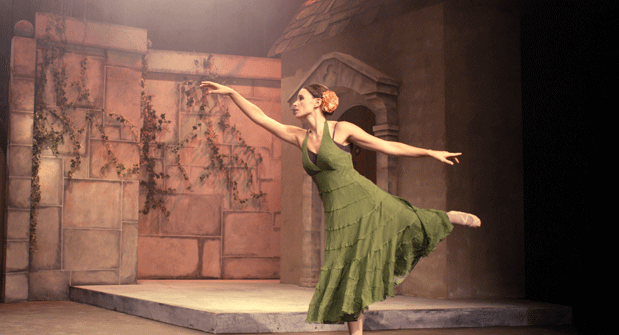
Dancer1

A screenshot from  “L’âme Soeur (Soul Mate) 3D”. Does HFR/VFR affect the aesthetic of graceful dance?

Our interest in the topic grew as it was announced The Hobbit was filming in 48fps, and a year later audience reactions from CinemaCon 2012 was widely mixed. There had been reports of the HFR implementation working both for and against clips demonstrated, but as I have noted previously, this could also be due to the fact that the clips were not shown in the context of a narrative and furthermore were incomplete in VFX, grading and audio.

The debate for HFR rages on in the meanwhile, and during this time the initial seed of thought that VFR could have real creative strengths grew into a full-fledged idea. We decided to model the story of  our film around the actual capabilities of what we suspected VFR and HFR could demonstrate. The initial shot list that encompassed experiments surrounding VFR/HFR was later discarded as we realized these ‘tests’ had no meaningful relevance once they were placed into a story narrative. For example, we could not find a legitimate way to test various shutter angles, gigantism, miniaturization, refraction/reflection, and temporal frequency all within the structure of a story. If we were to complete ‘tests’, they should remain just that- TESTS that result in comparative analysis of the effects of various VFR/HFR shots. So we ended of altering the shot list to contain the priority shots:

1.    What do PEOPLE look like in HFR? (CU, MS, WS)

2.    What does stationary movement/fast action look like?

3.    How does HFR effect reflection?

4.    How does HFR effect depth (foreground/background)

5.    How does HFR affect REALISM?

We built the composition, framing, staging and action all within the structure of these five priorities. And the truth is while on location, we ended up altering our shots on several occasions to respond to the observations/desires we had at that time, while in the moment.  For example, the decision to accommodate a request from a crew member to attempt a hand held shot resulted in one of the more interesting compositions of the shoot. On another occasion more dolly movement was used in a scene to address concerns around strobing/blur in moving S3D shots, and test these concerns on the spot.

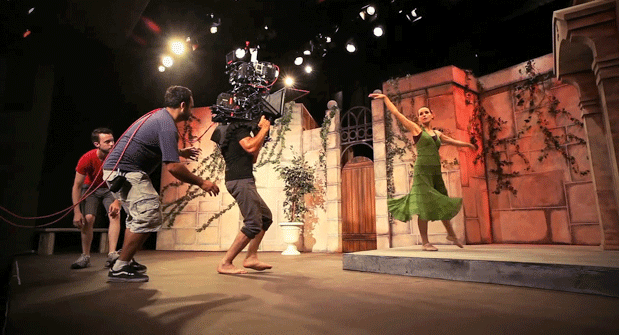
HFRWorkshop
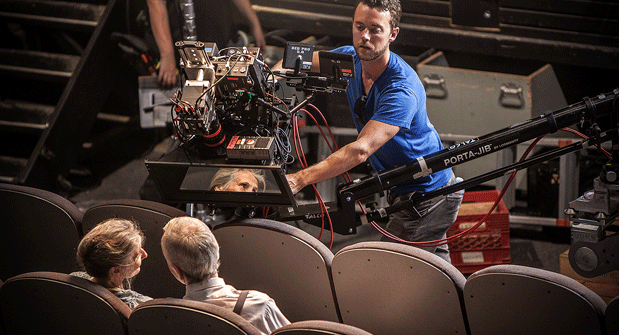
A Kernercam S3D rig with two Red Epics mounted on a shoulder. To see the video in action, visit our Vimeo site.

So what is the “L’âme Soeur (Soul Mate) 3D” story exactly?

Deeply inspired by the success of “Pina”, we decided that the narrative and action sequences of the story would revolve around dance. We believed that this was an artful departure from other HFR experimentation that filmed martial arts and boxing content.

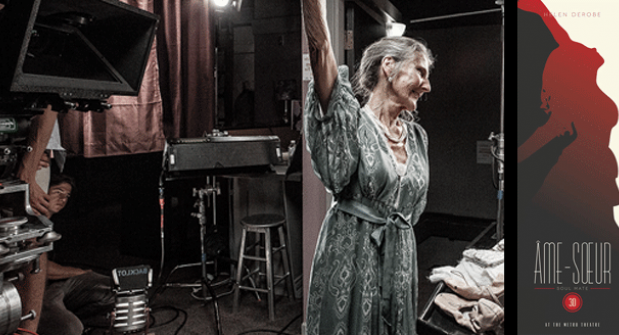
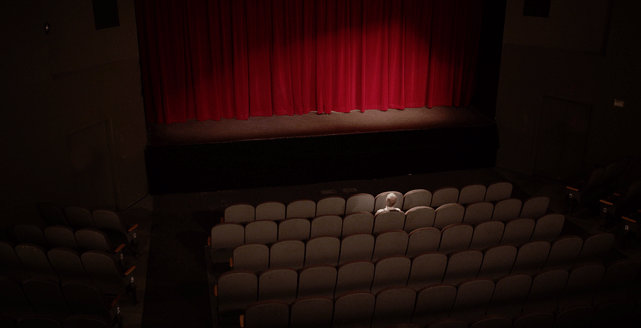
Synopsis: A return to the theatre ensures that an elderly husband and wife couple is able to escape once more into their youth- and their youth means nothing without the devotion and love they have formed over their long lives. Elderly dancer Helen Derobe has always been a person of few words, preferring to show rather than tell. Her husband is everything to her and she finds herself becoming more dependent on him. Lately she is unable to use words to describe what her husband means to her, so she reminds him once more- through dance, which had initially brought them close together.

Pre-Production Considerations

As I previously mentioned, we had imagined early on the use of an elaborate shot list that tests many of the theorized HFR and VFR capabilities. Once we realized this would be tremendously difficult to do (both time and space issues) it was thinned out.

The final shot list as it appeared on set:

Shotlist

You may notice it looks like a very traditional shot list, not one that explains any S3D or HFR/VFR components. We found the Shot list would be confusing to most of the camera crew, and instead we decided for the directors/producers to use the Shot list as a tool to guide the shots since the HFR/VFR components were already planned within it. Rather we would allow the DOP and Stereographers to have complete creative control of the lighting and Stereo, while using the shot list as a guide for framing.

A storyboard was discussed, and even drafted but it was decided that the boards would not help much due to the space that we were filming in being very customizable. We were working with a stage that allowed for the action and even camera equipment to be adjusted as we felt fit. We theorized that we would change our intial staging/framing ideas once we actually begin working inside the space, and this proved to be very much true.

The only very relevant stereo 3D tool that was created before production, and is still currently being used isa stereo depth script for post production.  For excellent examples of depth scoring, and to hear what Brain Gardner has to say about perception and the art of 3D storytelling, visit here:http://magazine.creativecow.net/article/perception-and-the-art-of-3D-storytelling

We also spent a considerable amount of time on props and set decoration. In our attempt to test out what HFR looked like, we wanted to play with lots of mirrors and surfaces provided reflection/refraction. Not exactly what most S3D productions would consider pleasant, but we did want to see if HFR affected the common issues around reflection (which can be very distracting in that they do not mimic normal perception in real life. They often float within the Stereo 3D depth). It was important with all these reflective surfaces that we avoid light flares, and this was considered in pre-production before dressing the set.

This ends part 1 of this topic. Stay tuned for Part 2 on Effective Pre-Production and Production of Variable HFR projects on November 13th.


Categories
news S3D

For Immediate Release: Emily Carr’s S3D Centre Creates Variable HFR FIlm

A new live action short, created at the Emily Carr University of Art + Design’s Stereoscopic 3D (S3D) Centre, incorporates scenes shot at 24, 48, and 60 fps to demonstrate the creative potential of using variable frame rates within a narrative context.

The production, L’Ame Soeur (Soulmates) 3D, incorporates variable frames rates as both a creative and technical tool.

“As the film and broadcast industries move toward higher frame rate 3D productions, it is important that researchers look at the implications both on a technical and perceptual level,” described Dr. Maria Lantin, Director of Emily Carr’s Stereoscopic 3D Centre. “With this research we specifically address the notion of using frame rate as an additional component to storytelling and audience engagement.”

The S3D Centre’s variable HFR research offers the creative community a valuable exploration of how variable frame rates can be used to tell compelling stories.

Motion artifacts such as judder and blur are often visible at standard frame rates like the 24fps of traditional cinema. Productions shot at higher frame rates create a different viewing experience by showing fine movement detail — instead of more resolution in the image there is more resolution in time.

The Centre’s research into variable frame rates suggests that the choice of frame rate can influence viewer comfort and become another cue in the perception of narrative in live action films.

A video overview of the research is available at http://vimeo.com/s3dcentre/abouthfrresearch

The S3D Centre’s footage was captured using RED Epic cameras, capable of capturing images at up to 60 uncompressed frames per second. Each scene was filmed at 24fps, 48fps, and 60fps with the intent of delivering a final product that incorporates these three frame rates. The use of a particular frame rate in a given shot is derived from creative observation and experimentation into variable frame rates as a storytelling tool.

The final short will be delivered for both projection and broadcast television.

With the upcoming release of The Hobbit trilogy filmed at 48 fps, a wide audience will become aware of the look and feel of higher frame rates. The goal of the Emily Carr S3D Centre is to increase the knowledge base in the proper application of HFR in production and post-production.

The Centre is part of the Society of Motion Picture and Television Engineers (SMPTE) working group on HFR and a member of the GRAND Network Centre of Excellence linking Canadian universities that are active in stereoscopic 3D research.

The research is made possible by generous contributions from TELUS, the Natural Sciences and Engineering Research Council (NSERC) through the College and Community Innovation (CCI) Program, and the GRAND Network Centre of Excellence. The S3D Centre gratefully acknowledges the support of Western Economic Diversification, the Industrial Research Assistance Program, and the Canadian Foundation for Innovation.

Categories
news S3D

S3D Centre to join panel at High Frame Rate 3D Cinema Workshop

The S3D Centre team members Alan Goldman and Denise Quesnel will be joining HFR experts Christie Digital Systems, York University, Screen Industries Research and Training Centre – SIRT, Real-D, and more on the 3D Film and Innovation Consortium (3D FLIC) hosted  “High Frame Rate 3D Cinema Workshop” October 30th, 2012. (EDIT: Re-Sceduled to November 20th due to technical issues).

The S3D Centre will be speaking on the topic Planning, Pre-production, Production: What do I need to consider in a HFR 3SD/2D project? with SIRT’s John Helliker, and Rob Burton of Arc Animation. The afternoon will consist of HFR 3D and 2D demonstrations on a HFR enabled Christie Digital Cinema Projector. We will be showing some of our HFR material from the “Soul Mates 3D” production at this time.

The S3D Centre was in Toronto last year for the Toronto International Stereo 3D Conference. You can read a report on the event here.

For complete information, please vist the Eventbrite page.

Categories
news S3D

Stereoscopic Projection for Installation

In May 2012 I mounted the installation component of my Master’s Thesis work entitled Transference. The installation was a 3 minute stereoscopic video in the Charles H Scott Gallery at Emily Carr University in Vancouver for the Masters of Applied Arts Graduation Exhibition. To enable a polarized 3D projection upon a surface instead of a screen, I used a silver based screen paint from ScreenPaintHD.

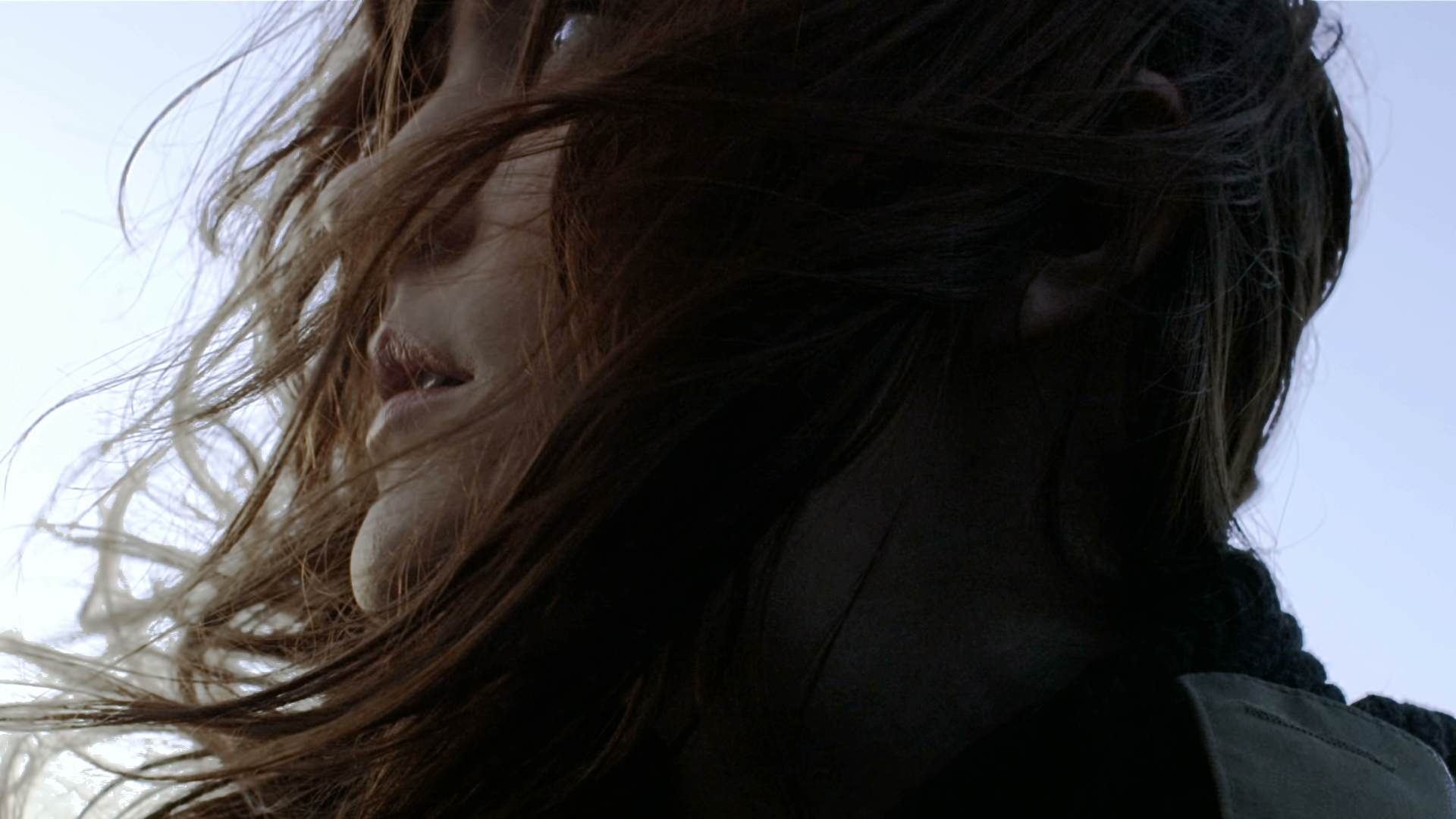
The final installation explores the physicality of stereo in a gallery space. A place where there arent any chairs, where you are wearing 3d glasses but get to move around in relation to an image. The original idea was to create a stereoscopic extension to the space. I wanted to create a hole in real space, or at least the illusion of one. The installation concept has morphed over time, since the completion of my thesis paper. It is an exploration of the physical relation to a stereo image in a an installation context.  The piece is a distillation of the ideas I cover in my thesis. The installation features a woman standing on an out cropping. The viewer is at a distance from the character and can make no connection with the figure other than through a simulated understanding of space. By space I am referring to the physical qualities stereo illusion.  The image cuts to a close up where the character is looking away from the observer, again thwarting any connection to the character through traditional cinema convention. I hope for this limited access to the character through the composition to force a cognizance of the observers relationship to the illusory stereo space and what that spatial relationship communicates to them. With the absence of connection through typical cinema conventions the only relationship left between the observer and the character is the relationship through the simulated S3D space.During the Masters degree I tracked my experiments and writing on a section of my own stereo blog@Adventures in Stereo.Transference_0
Categories
news S3D

Side by Side 3D Time Lapse Tests

2013 Grad student Paolo Pennuti in collaboration with Annie Briard. 

Under the direction of Sean Arden, with special thanks to Dafna Vallejo.

Initial questions

How can you shoot a side by side 3D time lapse using two Canon 5d Mark II (or any other DSLR camera)?

How do you sync the two cameras?

Is it necessary to align the cameras with a 3D monitor before shooting or can you roughly align the cameras on the field without a 3D monitor, and then correct the alignment with After Effects?

Concept

Capture still pictures at regular intervals with two Canon 5d Mark II (left and right eye) for a side by side 3D time lapse.

Sync the two cameras and test the alignment with and without a 3D monitor.

Process the files with After Effects to produce the final 3D sequence.

Set – Up

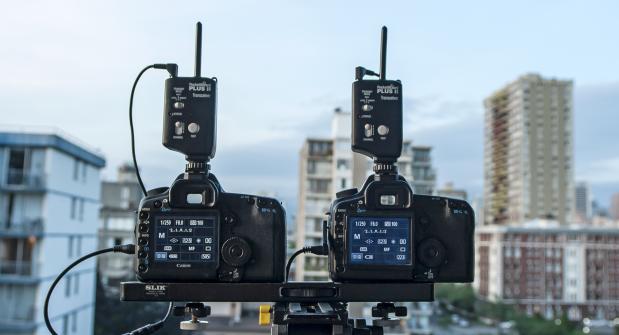
Two Canon 5d Mark II

Two Zeiss Distagon T* f 2,8 Ze 21mm EF Mount

One Canon 7d, only body without lens

One Canon Remote Controller TC-80N3

Three Pocket Wizards Plus 2

Conclusions

DSLR cameras are the most portable and cheapest devices available on the market to shoot 5k 3D still RAW images.

Three pocket wizards, another DSLR camera and a remote control are necessary in order to sync the shutter buttons of the two main cameras at constant time intervals (it is possible to avoid using another camera and the camera remote controller but it becomes necessary to manually press the shutter button to shoot).

Even though setting up alignment with a 3D monitor is recommended before shooting, it is still possible to get good results without using one. After Effects is very effective as a tool to correct most alignment issues.

Categories
news S3D

Variable HFR (High Frame Rate) Film Blog #1

For more information on the S3D Centre’s research activities in HFR and other areas, and to see our current supporting press material please visit HFR Research home.

Key words for this article: HFR = High Frame Rates. Traditionally, cinema productions are filmed at 24 frames per second, or for broadcast at 29.97 (30) frames per second. There are numerous advantages to filming in HFR, especially in 3D.

A HISTORY on HFR and Standard 24fps :

Movies have been filmed and also projected at 24 frames per second since he 1920’s, and it has become widely known as a ‘cinematic aesthetic’. However, due to the slower shutter in recording frames at only 24 per second, certain motion artifacts such as blur and light strobing become visible. Motion artifacts are of concern in stereoscopic 3D productions, where they have been proven to increase viewer discomfort and promote a less immersive experience, the opposite of what most 3D productions are trying to accomplish. These motion artifacts are greatly reduced at higher frame rates, with the result not only a more comfortable viewing experience, but also one that demonstrates hyper-reality and smoother images.

HFR-2

If you have a pair of red-cyan anaglyph glasses, have a look at the below image. “A window within a window”.

HFR-3

On August 17-18th, staff from the S3D Centre directed the first variable rate HFR shoot of its kind with talented independent crew and cast members in Vancouver BC. “L’âme Soeur (Soul Mate) 3D” is a dual short film / applied research project that takes full advantage of HFR technology. Shot on the RED Epics on a motorized Kernercam stereoscopic 3D rig in both standard and high frames rates, we used the most recent advances in technology to investigate a question we have been studying for the past year: If technology were capable of capturing and displaying a complete narrative that incorporates variable standard and high frame rates, what are the creative benefits/drawbacks of doing so? Does the utilization of HFR as a ‘tool’ in this regard change the immersive experience for the viewer? We suspect that the question of whether or not to utilize HFR in a stereoscopic 3D film within a narrative context depends largely on the creative intent of the film itself. This short film was a means to explore this research.

Initial research conducted in advance of this production consisted of a complete analysis of cameras, stereoscopic rigs, post production and display solutions that were capable of supporting HFR. The RED Epics were chosen for their ability to shoot HFR at unprecedented resolution, and the ease of a RED workflow. We used our Kernercam 3D rig with Epic mounts which proved of critical importance due to its motorization of IA (inter axial), convergence, and focus. We were unable to find a display capable of HFR playback to bring on set, so we monitored on a consumer LG monitor in standard frame rates.

HFR-5

Alan Goldman and myself (Denise Quesnel) had been present at NAB Show 2012 where we were in attendance at an HFR presentation. At the presentation, we observed Fraunhofer and Park Road Postdemonstrate stand alone clips at different frame rates. The clips had been created using a variety of interpolation and filming methods. An observation I made at the presentation was that it became difficult to appreciate the effects of HFR when clips were presented outside of a narrative context. If HFR is utilized to enhance and tell a better story, then I figured I would like to see it within a story. Yet there seemed to be unexpected push back from attendees at CinemaCon 2012 only a week later, when Peter Jackson and company presented 10 minutes of clips from “The Hobbit: An Unexpected Journey”. Once more, clips were presented outside of their intended narrative context and viewers had some very legitimate concerns over the footage. Comments ranged from ‘the shot with the actors talking was too realistic, it took me out of the immersive 3D experience and I was reminded I was watching a film’, to ‘the landscape and action shots were stunning and incredibly immersive.”. Douglas Trumbull has stated that HFR could benefit from being used as a selective tool, and we agree with his thoughts that some clips may be appropriate in 3D HFR and others not. Now that digital projectors exist, the firmware and software modifications needed to achieve this can be accomplished in time.

For our experiment  “L’âme Soeur (Soul Mate) 3D”, we decided to shoot every shot at 24 frames (standard), and 48 and 60 frames (HFR) rather than interpolate frames in software later. We wanted to know what actual HFR shooting would be like on set and with a direct comparable in post. One concern was that switching frame rates between takes would be time consuming, but Emily Carr’s in house stereographer and research technician Sean Arden says “this is something that is common in film production for a variety of reasons, even 3d productions, one can achieve all sorts of different visual effects and tricks using higher frame rates, like super human speed illusion or time re-mapping. The only delay was in switching the output on the AJA Gen 10″ to keep the cameras in sync.” With the help of an experienced crew, including Director of Photography Oliver Millar and stereographer/camera operator David Tenniswood we were able to resolve the issues surrounding sync and the need for more light over the two day shoot. Filming HFR does require additional light, since the shutter remains open over less time as frame rates per second increase. A knowledgeable crew was key in being prepared for the need for additional lighting.

http://vimeo.com/s3dcentre/hfr-steadicam

HFR (High Frame Rate) Hand-Held with Kernercam 3D Rig and RED Epics from Emily Carr S3D on Vimeo.

A de-brief after the shooting was completed led to the team agreeing that we had stuck very closely to our intent to use variable HFR as a creative tool during the shoot. There were times that once on set, we would look at the shot list + staging and realize the shot we had in our heads was not entirely realistic, or did not take full advantage of HFR. “Some other shots (i.e. Dima hand holding the camera/rig during Starlise’s dance performance) was never something that we anticipated being possible.” said Alan. “It will be interesting to see how our initial imaginings in the pre-planning of the test/shoot will concomitantly work (or not) in the final narrative piece. I imagine that their will be a distinct difference between pre-selected shots that we use to measure (against) other shots and the narrative flow of the film that has a beginning, middle and an end.”

In looking at the initial footage, we are overwhelmed at its potential to build a better story and also be used as a scientific AND creative learning tool for 3D stereoscopy. We are already making early observations about how the various frame rates relate to one another and can be seen on their own. The next blog post will focus on the story of “L’âme Soeur (Soul Mate) 3D”, how it was written specifically to support variable HFR 3D production, and what post production tools currently are used to support (variable) HFR 3D.

HFR-6