Intricate Rituals is the first Art & Technology New Media Mentorship program, presented at New Media Gallery. Bringing together ten students from Emily Carr University’s New Media + Sound Art major and MFA program to develop new media artwork for display.
The Intricate Rituals exhibition examines technology as both subject and object, tracing intimate and entangled encounters between body, media, and movement. Through interactive installations, performance, sound, and video, the exhibition reflects on the limits, thresholds, and choreographies that shape our ever-evolving digital culture. What emerges when our relationship to technology becomes a site of inquiry, and at times, a site of friction?
Featuring works by Khalil Alomar, Anat Elkayam, Miranda Firmston, Lennox Johnston-Yu, Trini Landajo, Joseph Lu, Leonor Martinez, Hailey Park, Luigi Pulido, and Rafael Zen.
This exhibition is open 10am – 5pm Thursday – Saturday from February 12 to March 7, 2026. The opening reception will take place Thursday, February 12th, at 6pm, with performances starting 7pm.
This mentorship program was supported by Emily Carr University and the Basically Good Media Lab.
Special thanks to Peter Bussigel, Julie Andreyev, hope akello, Jae Lew, and Chris Jung.
On March 20th in The Basically Good Media Lab, we hosted an artist talk by our very own 3rd year NMSA Student and Free Tools Research assistant Kyla Dooley!
In contemporary art, where boundaries are constantly pushed and redefined, Kyla Dooley stands out from the crowds, blending New Media innovation with a playful spirit.
Drawing inspiration from eclectic sources, she meticulously crafts each piece, weaving together elements of humor, and technology. Rejecting the boundaries of traditional categorizations like “conceptual art,” Dooley embraces a label of her own making: “conceptually based”. Rejecting the elitism sometimes associated with contemporary art, she uses humor as both a tool of engagement and a form of protest.
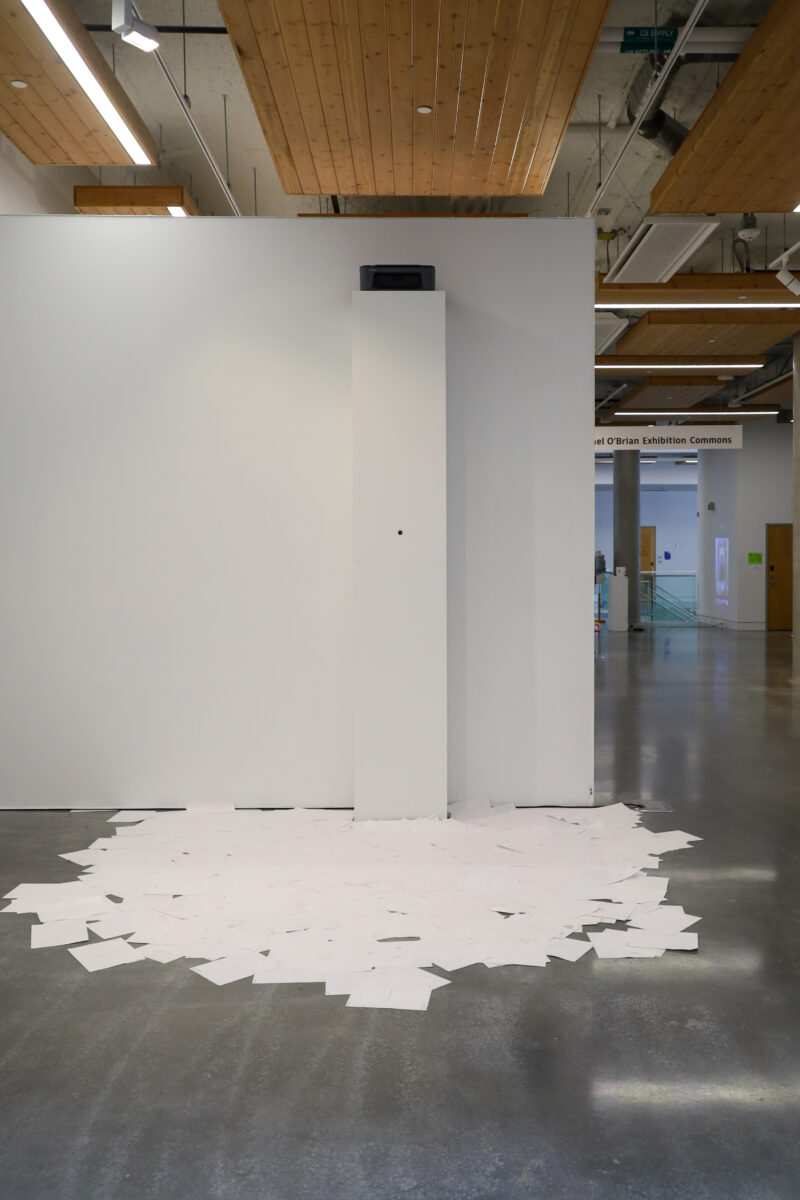
Dooley invites people from diverse backgrounds to join a conversation that goes beyond the gallery walls with her interactive art pieces. For example, her creation ‘the Printer’ acts like an oracle, changing how we see everyday objects, while ‘Fish Move in Three Dimensions’ disrupts the ordinary experience of walking downstairs by turning them into a space for showcasing videos that evoke feelings of melancholy and awareness of our physical movement in three dimensions.
In a one on one interview Kyla explains further her concepts, methods, and allows for a deeper understanding of her art in all its “conceptually based” ways.
Your label of “conceptually-based” art is intriguing. Could you elaborate on what that means to you and how it differs from traditional conceptual art? How does this label reflect your artistic philosophy and approach?
I think it’s easier to understand the label by talking about what it’s not. For explanation purposes, I would argue the opposite of a conceptually-based practice would be a material practice – as in, someone whose work derives from developing their work hands-on, eg. sketching out forms, testing a medium’s formal capacities, making lots of things and seeing what sticks, etc.
My process, on the other hand, is largely premeditated before I physically intervene with any of the material I intend to use. I start with an idea, like “What if a printer was voice-activated?” or “What if there was art in the stairwell?” and then cater the medium and process to supporting that idea. That said, I’m not working in a strictly purist conceptual art approach wherein every detail is laid out ahead of time. I’ll typically have the base idea and then get my hands on the material and try an approach then come back to the idea, think about what’s working and what’s not, iterate the material again, and continue this process until I’m (mostly) satisfied with the work. Alas, “conceptually-based” is the least pretentious and most accurate term I’ve come to refer to my practice with.
Your art seems to challenge conventional perceptions and expectations, inviting viewers to engage with ordinary objects in unexpected ways. What drives you to explore these unconventional approaches, and what do you hope viewers take away from interacting with your pieces? I think that challenging conventional perceptions and expectations is one of the best capacities of art (and maybe even one of the qualities that makes something art at all). If you take the piece I did with the printer as a case study, the reason that piece works is because I’ve developed an unusual interaction around the object. A printer that sits in an office is just a printer, but a printer that sits on a ten-foot-tall plinth and prints out cheeky responses at the beck and call of the audience is a special experience.
It’s unusual and surprising and because of that, gets us thinking and considering the object with a fresh set of eyes. For me, it’s a game of push and pull between the expected and unexpected. The work needs to have some point of recognizability that makes it approachable but in the same act, do something unusual and extraordinary that sets people out of their routine. Each piece has its own political agenda, but broadly speaking, I hope people can walk away from my art with a renewed sense of the malleability of the world around us. As artists, we’re in one of the few industries where play is not only encouraged, but required for the job. It’s a massive privilege to be in that head space and something I hope I can share even if it’s just for a moment through an art encounter.
Can you walk us through your creative process when developing interactive art pieces like “the Printer” or “Fish Move in Three Dimensions”? How do you blend humor, technology, and conceptual elements seamlessly in your work? Sneaky how you’ve woven compliments into these questions – thank you. I briefly touched on my process above so I’ll focus on the latter half of this question. Working with each of these individual components – humor, technology, conceptual elements – was/is rarely a conscious decision. I don’t think we have much say in the kind of art we make. And by that I mean, I don’t think we have much control in what we’re interested in. I don’t think I could force myself to be interested in painting if I tried (though ironically the endeavor in and of itself could be an interesting art project…). I’m interested in the things that I’m interested in, and I’m gonna make art that I think is interesting.
For me, those endeavours happen to be described as conceptual and playful but these aren’t attributes I willfully chose one day. However, I will say, that I have very consciously chosen to put the art first when making art. I realize this sounds like a redundant statement, but I think there’s a big push in contemporary art right now to linguistically proclaim virtuosity in art. Aka, the quality of the art has become inferior to the way you’re writing and talking about it. I loathe this condition. If an artwork is heavily relying on a written statement to communicate its “meaning” then the text has superseded the necessity of the artwork at all. At that point, you may as well just read an essay on the topic since the art itself isn’t contributing anything.
Within my own practice, I have to be excited about the art as art. If it’s not interesting to me then why the hell would anyone else care about it? And respectively, I grow tired of things pretty easily, so that standard of interesting is always in flux.
Humor appears to be a central element in your work, serving both as a tool of engagement and a form of protest against elitism in contemporary art. How do you navigate the balance between humor and deeper conceptual themes in your art? “Humor … as a tool of engagement and a form of protest against elitism in contemporary art” – damn, I’m gonna steal that line for my next artist statement (I’m only half kidding). This is a really thoughtful question and insightful analysis. I don’t think I’ve ever approached a work with humor at fear of it being disregarded as thematically unsubstantiated because of such qualities. Humor is complicated and nuanced and that complexity is often prime material to navigate a piece around conceptually. A good joke is usually a good artwork.
A friend recommended I watch the movie Brazil a couple of months ago (it was incredible and I would highly recommend it) and afterwards I was reading a review of the film that cited it as “a superb example of the power of comedy to underscore serious ideas, even solemn ones”; it was a really validating moment for my practice. So I wouldn’t say it’s a balancing act, so much as a matter of ensuring the humor is supporting the concept and vice versa.
Your art often extends beyond the confines of the gallery, inviting people from diverse backgrounds to join a conversation. How do you see the role of interactive art in fostering community engagement and dialogue, particularly in today’s digital age? I think that interactive art, like humor, is a great strategy for making art more accessible to a broader audience. As you mentioned above, the art world is ridiculously elitist. Artworks are put behind literal and metaphorical walls and described in unnecessarily complicated art world jargon; it all sends a very clear message about who is welcome in those spaces. It’s uncomfortable staring at a lukewarm oil painting feeling like you don’t get it. But when an artwork is interactive, there’s immediately an entry point to engage with the work that takes precedence over the forlorn quest to “get it.” And then once you’ve sustained engagement, you may actually have a shot at conveying some idea/experience/dialogue.
I’m not saying making art interactive is the only/best way to do this (in fact there’s a lot of shitty interactive art that doesn’t achieve this) but I do think it’s a particularly pertinent and effective method, especially within the state of our attention economy. I’m also a firm believer you can make your work accessible to a broad audience without sacrificing complex ideas. An elegant example of this duality is Nick Cave’s Soundsuits.
For more from Kyla, check her artworks @kyladooley on Instagram or at kyladooley.com!
2017 is going to be year zero for VR and volumetric experiences. Make no mistake: this will change all digital life as we know it today. And it will change your work, no matter what your discipline. But sketching in VR is still hard. It shouldn’t be. This 3-hour workshop will introduce you to the basics of thinking in 3D, give you a brief overview of the current VR device landscape, and – most importantly – provide you with a process for rapidly testing your VR ideas using paper, a camera, and Mozilla’s Aframe library. We’ll provide the Cardboard headset. You’ll provide the laptop, smartphone (at least Android 6.0+, or an iPhone 5 or later), a willingness to write code and a beginners mind.
This video is a proof of concept for a true digital colour infrared system designed by Jesse Andrewartha in collaboration with Emily Carr University’s S3D Centre.
The experiment replicates the colour shifts of Kodak Aerochrome 1443 color infrared film. This unique film used green, red and infrared wavelengths to produce a false colour RGB image. In the 90’s it was possible to purchase short ends of 9.5″ Aerochrome and cross-process in a custom C-22/E-6/C-41/E-4 hybrid formula. Cine film of this stock was a special order item and virtually non-existent. In 2011, the film became unavailable when the film was discontinued. Any remaining stocks on the market are dwindling fast, expired, exorbitantly priced, and Kodak has stated that it has no plans to reformulate the emulsion. A replacement was required, and digital cinema tools seemed a likely place to find a solution.
The method shown here, utilizing the RED Scarlet, distinguishes itself by not only achieving true spectral discernment and control over the individual Green, Red and Infrared channels but also permitting the application of the technology to 4K, or larger, sound-sync filmmaking.
We will be following up this work with a more comprehensive test and shoot next month.
Mike Pan will cover how textures interact with light. i.e. specular maps and gloss functions, with the ultimate goal being cinematic realism, which is actually different from what our eyes can see. His presentation will include some definitions of basic concepts and processes of texturing a model and how they are applied.
Aaron Hilton will talk about the cinematic use of Light and Shadow to drive the VR narrative; the art of light and shadow. He will also cover how the lack of an avatar representing the user can be worked around. Light and contrast can be used to direct attention. Creating a gradient of dark to light to help orient someone to where they need to go next.
The presentations will be followed by a period for Q & A.
We will close the evening with prize draws for: EA Games, Video Copilot Optical Flares plugins for Adobe After Effects and we will also be giving away three $99.00 licenses for Allegorithmic’s Substance Bitmap2Material 3. Bitmap2Material is an incredibly powerful tool that helps you generate full, seamlessly tiling materials from any bitmap image. This now includes all PBR (Physically-Based Rendering) channels, based on the most accurate conversion algorithm out there. Check it out here:
Snacks will be provided by our wonderful caterer Heather Ferguson.
Many thanks to our sponsors: Conquer Mobile, G-Technology & Emily Carr University of Art & Design.
VanVR, VanCG Meetup, and S3D Centre at Emily Carr University presents: “How To Build A Virtual World”
NOTE: doors will open at 6:30 PM. Presentations will begin at 7:30 PM. SEATING IS LIMITED. No tickets will be sold at the door.
Collecting the parts for your 3D world. Sourcing available 3D models, creating your own, capturing the world with photogrammetry and depth cameras.
Mike Pan will share his expertise with Blender: overview of the workflow in Blender, accessing models online, importing them into Blender, optimizing the model, exporting it for the VR platform of your choice.
PartickWirt from Corbel 3D will explain the process of creating models using photogrammetry.
Aaron Hilton of Conquer Mobile will discuss recent developments in 3D scanning technology and give us a demonstration of his Occipitals’ Structure Sensor used for on the fly object scanning.
Matthew McCauley founder of GeoSim will talk to us about their high end-to-end system for scanning and modeling entire cities in 3D. The models feature high spatial precision and visual fidelity, and are interactive and parametric. Proprietary street level data collection enables entirely new kinds of city analysis and visualization.
The presentations will be followed by a period for Q & A.
We will close the evening with prize draws for: EA Games, Video Copilot Optical Flares plugins.
Food will be provided by our wonderful caterer Heather Ferguson.
Dr. Ken Perlin
Professor & Researcher, NYU Media Research Lab
Ken Perlin, a professor in the Department of Computer Science at New York University, directs the NYU Games For Learning Institute, and is a participating faculty member in the NYU Media and Games Network (MAGNET). He was also founding director of the Media Research Laboratory and director of the NYU Center for Advanced Technology. His research interests include graphics, animation, augmented and mixed reality, user interfaces, science education and multimedia. He received an Academy Award for Technical Achievement from the Academy of Motion Picture Arts and Sciences for his noise and turbulence procedural texturing techniques, which are widely used in feature films and television, as well as the 2008 ACM/SIGGRAPH Computer Graphics Achievement Award, the TrapCode award for achievement in computer graphics research, the NYC Mayor’s award for excellence in Science and Technology and the Sokol award for outstanding Science faculty at NYU, and a Presidential Young Investigator Award from the National Science Foundation. Dr. Perlin currently serves on the program committee of the AAAS. He was general chair of the UIST2010 conference, and has been a featured artist at the Whitney Museum of American Art.
Dr. Perlin received his Ph.D. in Computer Science from New York University, and a B.A. in theoretical mathematics from Harvard University. Before working at NYU he was Head of Software Development at R/GREENBERG Associates in New York, NY. Prior to that he was the System Architect for computer generated animation at Mathematical Applications Group, Inc. He serves on the Advisory Board for the Centre for Digital Media at GNWC, and has served on the Board of Directors of both the New York chapter of ACM/SIGGRAPH and the New York Software Industry Association.
Series to assist Vancouver-area businesses and individuals in the creation of virtual reality experiences, environments. Read more.
PART 1: The Business of VR begins this month: Is VR a bubble? We’ll ask key content producers, investors, and luminaries to give us the broad perspective.
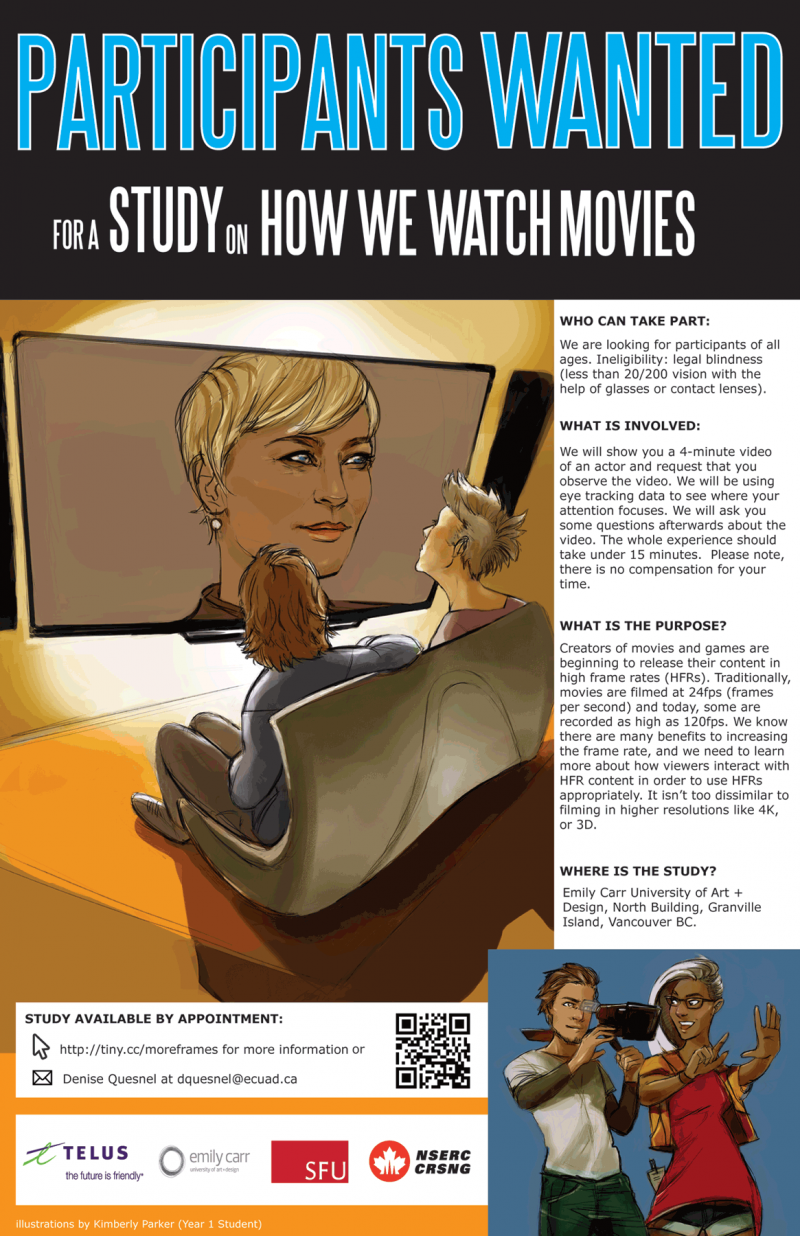
We are currently doing experiments on the use of Variable Frame Rates (VFRs) consisting of both High Frames Rates (HFRs) and standard frame rates (as 24fps). We are seeking participants to be part of this study. The time requirement is 15minutes, not including travel time to and from Emily Carr University of Art + Design. Too book your appointment, or to find out more, please visit our Participate page.




 Ken Perlin, a professor in the Department of Computer Science at New York University, directs the NYU Games For Learning Institute, and is a participating faculty member in the NYU Media and Games Network (MAGNET). He was also founding director of the Media Research Laboratory and director of the NYU Center for Advanced Technology. His research interests include graphics, animation, augmented and mixed reality, user interfaces, science education and multimedia. He received an Academy Award for Technical Achievement from the Academy of Motion Picture Arts and Sciences for his noise and turbulence procedural texturing techniques, which are widely used in feature films and television, as well as the 2008 ACM/SIGGRAPH Computer Graphics Achievement Award, the TrapCode award for achievement in computer graphics research, the NYC Mayor’s award for excellence in Science and Technology and the Sokol award for outstanding Science faculty at NYU, and a Presidential Young Investigator Award from the National Science Foundation. Dr. Perlin currently serves on the program committee of the AAAS. He was general chair of the UIST2010 conference, and has been a featured artist at the Whitney Museum of American Art.