What if a media lab wasn’t simply a place for experimenting with technology, but a space shaped by the people, ecologies, and communities that surround it?
This question is at the heart of Andrés Fernández Roncancio’s doctoral research. As a virtual Researcher-in-Residence at the Basically Good Media Lab (BGML), Andrés is exploring how university media labs can be collaboratively imagined through relationships among local communities, institutions, technologies, and the more-than-human world, in a dialogue between Latin America and the Global North.
A PhD candidate in Communication at Universidad de La Sabana in Colombia, Andrés works at the intersection of strategic design, participatory research, and media innovation. His research focuses on Sabana Centro, a rapidly growing region north of Bogotá, where he is developing a conceptual model for a university media lab rooted in the territory’s social, cultural, and ecological realities. Rather than importing existing models, the project asks what becomes possible when a media lab is co-designed with the people who will use it.
Drawing on participatory action research, speculative design, Actor-Network Theory, and critical perspectives on technology, Andrés approaches media labs as living infrastructures in which knowledge is created collectively. His research examines how these spaces can support cross-disciplinary collaboration while recognizing that innovation is shaped by relationships, shared values, and local contexts as much as by technology itself.
During his residency, Andrés has been working with BGML Director Dr. Julie Andreyev to investigate how ecological thinking and multispecies perspectives might inform the future of media labs. BGML’s longstanding exploration of art, ecology, and emerging technologies has provided an opportunity to consider how creative research environments can acknowledge more-than-human participants and foster deeper forms of care, reciprocity, and environmental awareness.
Uniones by A. Fernández
These conversations have had a significant influence on Andrés’ project. Inspired by BGML’s biophilic considerations in research, he is expanding his work to explore how future media labs might meaningfully incorporate living systems into their collaborative processes—particularly in biodiverse regions such as Sabana Centro, where questions of environmental stewardship and development are closely intertwined.
The residency is also an opportunity for dialogue between Colombia and Canada. Alongside documentary research, interviews with media lab practitioners across Latin America, North America, Europe, and Oceania, and participatory workshops with communities in Colombia, Andrés is building a framework that connects local knowledge with international perspectives. The project suggests that meaningful innovation emerges through exchange rather than replication, creating space for different cultures, territories, and ways of knowing to inform one another.
Ultimately, this research imagines media labs as places where technology, community, and ecology converge. By bringing together perspectives from the Global South and Global North, Andrés’ research contributes to an ongoing conversation about how collaborative research spaces can become more inclusive, place-based, and responsive to the challenges of the future.
Andrés Fernández Roncancio is a PhD candidate in Communication at Universidad de La Sabana, Colombia, where he teaches Strategic Design, Innovation, and Digital Culture. Alongside his academic work, he is a strategic design and innovation consultant who has led design-driven initiatives across Latin America for more than a decade. His research explores participatory design, speculative design, and media studies through community-driven approaches to technology and innovation.
As part of a residency at the Basically Good Media Lab (BGML) at Emily Carr University of Art + Design (ECU), French digital artists Antoine Boucherikha & Anne Hélou worked with students, staff, and faculty on their latest immersive audio project “EndoPlaneto”.
EndoPlaneto is an immersive sound journey following Harriet, a paleobiologist exploring distant exoplanets after the loss of her partner, Shu. This early prototype installation blends field recordings from British Columbia and France with fictional species and biomes, revealing a poetic, ecological universe where sound becomes living matter and listening an act of exploration.
The goals of their month-long residency were to anchor the project in a real territory by enriching EndoPlaneto’s fiction through direct recordings of living ecosystems, to test a creative methodology that combines field recording, sound design, and interactive implementation, to foster dialogue between artistic creation, scientific research, and mediation within an academic and cultural ecosystem open to hybrid practices, and to present an early immersive prototype to diverse audiences, including students, XR professionals, and the general public.
They visited multiple locations in and around Vancouver, BC, with their sound recording equipment to explore natural sites & capture soundscapes.
Field recordings in progress, pictures by Anne Hélou
The second phase of their residency involved processing their captured soundscapes, designing the immersive sound experience, & starting work on the first prototype for “EndoPlaneto.” in Unity using Wwise.
Antoine at work in the Basically Good Media Lab.
After their initial recordings & prototyping, workshops were held in the Integrated Motion Studio at Emily Carr and the Center for Digital Media (CDM), where Antoine & Anne took students & faculty through their creative process. They also showcased some of the field recordings they had done and had live demos of the recording equipment & the in-progress immersive experience.
Workshop at Emily Carr
Workshop at CDM
As part of the residency, a public exhibition of the prototype was also held at V-Unframed, hosted by the Alliance Française de Vancouver.
EndoPlaneto will continue its development in France, and soon in Taiwan and Japan, with renewed support from Pictanovo.
About the Creators:
Antoine Boucherikha: Antoine Boucherikha is a French composer and sound designer exploring the relationship between sound, ecology, and interactivity. Mixing electroacoustics, field recording, and XR, his works blend sensory immersion, inclusion, and ecological awareness.
Anne Hélou: Anne Hélou is a French graphic designer. Combining craft, image, and digital experimentation, her collaborative practice explores design as a living process of exchange and shared meaning.
Antoine & Anne’s XR residency is supported by The Basically Good Media Lab, Emily Carr University of Art & Design, Center for Digital Media, Alliance Française, and the Consulate General of France in Vancouver.
In the fall of 2024 and spring of 2025, BGML partnered with Canadian Association for Sound Ecology and The Only Animal to investigate how listening, sound-making and land-based material art practices can help foster care for more-than-human lifeworlds. The project explored sound walks, sound improvisation workshops, readings, discussions, natural dye workshops and botanical printmaking, led by IBPoC artists.
Events took place on both the east and west coast of Canada (Turtle Island). The project cultivated attentive, collaborative, and decolonial practices across diverse events. Participating artists/facilitators included Rita Kompst (xʷməθkʷəy̓əm [Musqueam]), Toni-Leah C. Yake (Kanyen’kehà:ka [Mohawk]), Anju Singh, Liz Ellis, Adrian Avendaño, Lara Felsing (Métis), Audiotopie and the Branching Songs Ensemble among many other community members whose experiences, presentations, and discussions generated reflective and thoughtful approaches to decolonial land-based practice. The project culminated with an Equinox Roundtable gathering at ECU campus in March 2025. It brought together the researchers to share and discuss the thematic outcomes (see below)
land-based instrument making
Lara Felsing’s Shallow Breath gratitude blankets
Soundwalk held during the Equinox Roundtable
The Listening in Relation Final Reportdocuments all the events and includes details on the research, thematic outcomes, and forward-looking questions.
The THEMATIC OUTCOMES from the Listening in Relation project are:
Decolonial Relations & Kinship: The practices of decolonization and kinship were expanded through readings, presentations, conversations, and workshops across events.
Protocols of Field Recording: A Slow Social Club workshop by Anju Singh directly addressed ethical considerations while field recording; relatedly, Rita and Zoe Kompst led a workshop on Musqueam harvesting protocols, a method that could be applied to ‘sonic’ harvesting techniques.
Land-Based Methods & Material Practices: Decolonial relations and heightened kinship are deeply connected to sustainable applications of land-based methods and materials. The Keynote Panel held during the Equinox Roundtable offered grounded examples of decolonizing practice, as each keynote spoke to their individual and communal relationships with reciprocal, land-based, and cultural harvesting practices.
Soundwalking, Soundscape Design, and Sound Art: The project featured a number of soundwalks, soundscape compositions, and sound art workshops which prompted collective reflections on listening and composition. During the Equinox Roundtable, a collection of soundscapes were also available for concurrent listening in a ‘soundscape listening room’.
For an expanded review on themes and further reflections, see the individual event descriptions in the LiR Final Report. Thematic trends and questions for future research are also listed throughout the report.
Adrian Avendano giving a improvisational soundmaking workshopRita and Zoe Kompst giving a natural dye workshop
Trees and forests have a crucial role to play in climate change mitigation and they are critical multispecies habitats. The Branching Songs project aims to draw attention to the ecological significance of trees, their importance to sustaining life on Earth, and how listening to them may grow empathy for multispecies flourishing.
Branching Songs seeks to expand our perceptions about trees and forests by investigating how multispecies sound art may offer insights into the vital contributions of trees to human and more-than-human life. Focusing on old trees in Vancouver area and the Sunshine Coast, including those affected by the Transmountain Pipeline expansion and clear-cutting, the project elevates the voices of these inhabitants and ecosystems, highlighting their role in supporting both human and nonhuman life.
Led by Julie Andreyev, an artist, ECU associate professor, and co-director of the Basically Good Media Lab along with a team of ECU and community researchers —Maria Lantin, Simon Overstall, Lara Felsing, Giorgio Magnanensi, Sam Street, Keira Madsen, Cara Jacobsen, Leanne Plisic, Myles Feltenberger and Emma Pallay — Branching Songs draws inspiration from acoustic ecology, multispecies creativity, and performance, to forge new relations with trees as participants in immersive media and sound art.
Interspecies sounds, land-based practices, and Indigenous ways of knowing
By integrating creativity, technology, Indigenous ways of knowing and scientific inquiry, projects like Branching Songs invite us to reimagine our relationship with trees and forests, inspiring a renewed sense of wonder and reverence for the intricate web of life that surrounds us.
The project explores decolonial and land-based methods, by adapting Indigenous ways of knowing into the artistic process. Lara Felsing, an interdisciplinary Métis artist and recent MFA grad from ECU, created a noninvasive method for attaching contact microphones to trees. Drawing inspiration from Métis Ribbon Tree healing ceremonies, Lara devised ‘ribbons’ fashioned from recycled plant-based fabrics and combined them with her own harvesting and natural dying techniques. Through this adaptation, trees become active collaborators, woven into the fabric of sound art.
With Felsing, the team created Tree Feelers, instruments, sourced from the land, as touch interfaces to compose interspecies sounds, forging a harmonious dialogue between humans and nature.
Watch Recital With a Forest
Branching Songs is a complex and multifaceted project, composed of performances, installations, and workshops.
One of the performances, called Recital With a Forest, is a site-specific multispecies sound art staged in an intact old growth forest on the Sunshine Coast threatened by clear-cutting by BC Timber. Hand-crafted instruments with contact mics, biosensors, and local cast-off materials facilitated the collaboration with trees. In the performance, the Ensemble responds to the emergent soundscape of the forest, improvising sonic dialogues with elements like wind and bird songs, silent pauses highlight human-made sounds, fostering a nuanced relationship with the living forest ecology. Rooted in care and gratitude, this immersive experience embodies reciprocity between humans and forests, weaving a sonic tapestry of touch, tree acoustics, and forest vitality—a harmonious multispecies dialogue.
1 – Branching Songs Ensemble (left to right: Julie Andreyev, Myles Feltenberger, Giorgio Magnanensi, Keira Madsen, Simon Overstall) performing Recital With a Forest in Tuwanek Springs Forest, Sunshine Coast 2023. Photo courtesy of Keira Madsen. / 2 – Julie Andreyev using a Tree Feeler, as part of the Recital With a Forest performance in Tuwanek Springs Forest, Sunshine Coast 2023. Photo courtesy of Keira Madsen.
On March 20th in The Basically Good Media Lab, we hosted an artist talk by our very own 3rd year NMSA Student and Free Tools Research assistant Kyla Dooley!
In contemporary art, where boundaries are constantly pushed and redefined, Kyla Dooley stands out from the crowds, blending New Media innovation with a playful spirit.
Drawing inspiration from eclectic sources, she meticulously crafts each piece, weaving together elements of humor, and technology. Rejecting the boundaries of traditional categorizations like “conceptual art,” Dooley embraces a label of her own making: “conceptually based”. Rejecting the elitism sometimes associated with contemporary art, she uses humor as both a tool of engagement and a form of protest.
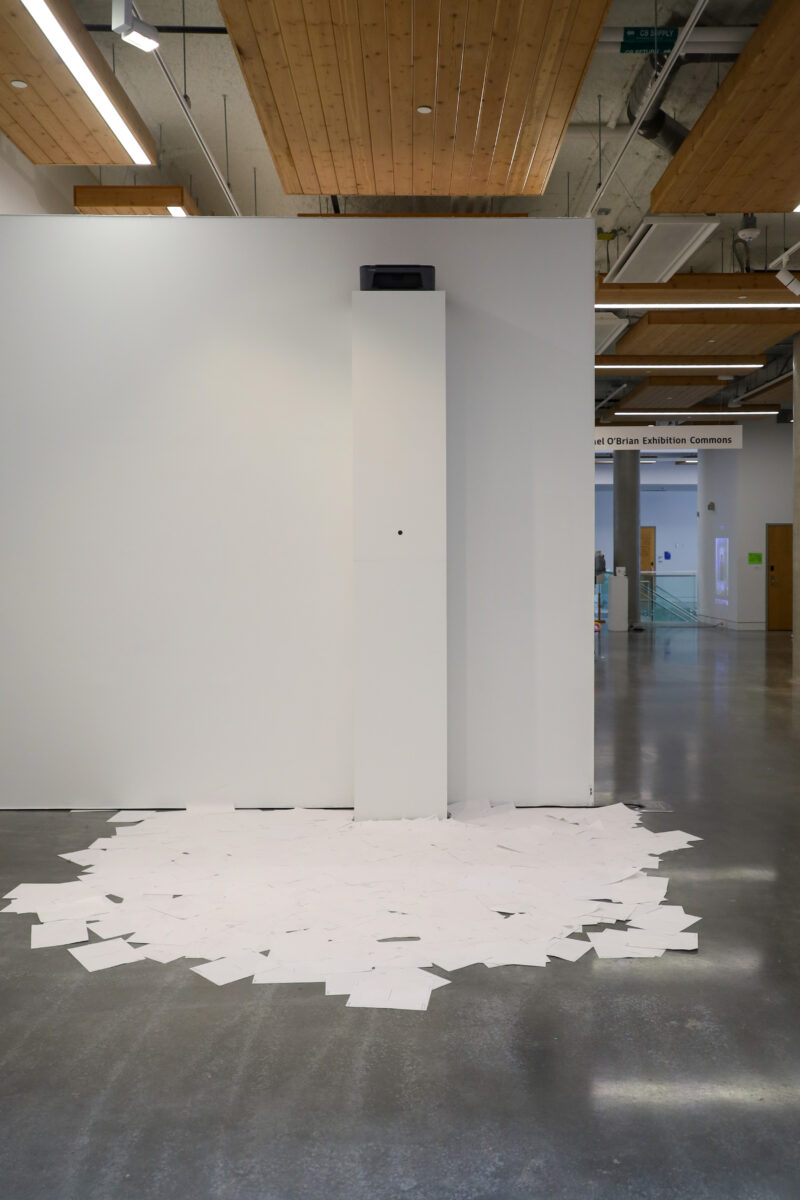
Dooley invites people from diverse backgrounds to join a conversation that goes beyond the gallery walls with her interactive art pieces. For example, her creation ‘the Printer’ acts like an oracle, changing how we see everyday objects, while ‘Fish Move in Three Dimensions’ disrupts the ordinary experience of walking downstairs by turning them into a space for showcasing videos that evoke feelings of melancholy and awareness of our physical movement in three dimensions.
In a one on one interview Kyla explains further her concepts, methods, and allows for a deeper understanding of her art in all its “conceptually based” ways.
Your label of “conceptually-based” art is intriguing. Could you elaborate on what that means to you and how it differs from traditional conceptual art? How does this label reflect your artistic philosophy and approach?
I think it’s easier to understand the label by talking about what it’s not. For explanation purposes, I would argue the opposite of a conceptually-based practice would be a material practice – as in, someone whose work derives from developing their work hands-on, eg. sketching out forms, testing a medium’s formal capacities, making lots of things and seeing what sticks, etc.
My process, on the other hand, is largely premeditated before I physically intervene with any of the material I intend to use. I start with an idea, like “What if a printer was voice-activated?” or “What if there was art in the stairwell?” and then cater the medium and process to supporting that idea. That said, I’m not working in a strictly purist conceptual art approach wherein every detail is laid out ahead of time. I’ll typically have the base idea and then get my hands on the material and try an approach then come back to the idea, think about what’s working and what’s not, iterate the material again, and continue this process until I’m (mostly) satisfied with the work. Alas, “conceptually-based” is the least pretentious and most accurate term I’ve come to refer to my practice with.
Your art seems to challenge conventional perceptions and expectations, inviting viewers to engage with ordinary objects in unexpected ways. What drives you to explore these unconventional approaches, and what do you hope viewers take away from interacting with your pieces? I think that challenging conventional perceptions and expectations is one of the best capacities of art (and maybe even one of the qualities that makes something art at all). If you take the piece I did with the printer as a case study, the reason that piece works is because I’ve developed an unusual interaction around the object. A printer that sits in an office is just a printer, but a printer that sits on a ten-foot-tall plinth and prints out cheeky responses at the beck and call of the audience is a special experience.
It’s unusual and surprising and because of that, gets us thinking and considering the object with a fresh set of eyes. For me, it’s a game of push and pull between the expected and unexpected. The work needs to have some point of recognizability that makes it approachable but in the same act, do something unusual and extraordinary that sets people out of their routine. Each piece has its own political agenda, but broadly speaking, I hope people can walk away from my art with a renewed sense of the malleability of the world around us. As artists, we’re in one of the few industries where play is not only encouraged, but required for the job. It’s a massive privilege to be in that head space and something I hope I can share even if it’s just for a moment through an art encounter.
Can you walk us through your creative process when developing interactive art pieces like “the Printer” or “Fish Move in Three Dimensions”? How do you blend humor, technology, and conceptual elements seamlessly in your work? Sneaky how you’ve woven compliments into these questions – thank you. I briefly touched on my process above so I’ll focus on the latter half of this question. Working with each of these individual components – humor, technology, conceptual elements – was/is rarely a conscious decision. I don’t think we have much say in the kind of art we make. And by that I mean, I don’t think we have much control in what we’re interested in. I don’t think I could force myself to be interested in painting if I tried (though ironically the endeavor in and of itself could be an interesting art project…). I’m interested in the things that I’m interested in, and I’m gonna make art that I think is interesting.
For me, those endeavours happen to be described as conceptual and playful but these aren’t attributes I willfully chose one day. However, I will say, that I have very consciously chosen to put the art first when making art. I realize this sounds like a redundant statement, but I think there’s a big push in contemporary art right now to linguistically proclaim virtuosity in art. Aka, the quality of the art has become inferior to the way you’re writing and talking about it. I loathe this condition. If an artwork is heavily relying on a written statement to communicate its “meaning” then the text has superseded the necessity of the artwork at all. At that point, you may as well just read an essay on the topic since the art itself isn’t contributing anything.
Within my own practice, I have to be excited about the art as art. If it’s not interesting to me then why the hell would anyone else care about it? And respectively, I grow tired of things pretty easily, so that standard of interesting is always in flux.
Humor appears to be a central element in your work, serving both as a tool of engagement and a form of protest against elitism in contemporary art. How do you navigate the balance between humor and deeper conceptual themes in your art? “Humor … as a tool of engagement and a form of protest against elitism in contemporary art” – damn, I’m gonna steal that line for my next artist statement (I’m only half kidding). This is a really thoughtful question and insightful analysis. I don’t think I’ve ever approached a work with humor at fear of it being disregarded as thematically unsubstantiated because of such qualities. Humor is complicated and nuanced and that complexity is often prime material to navigate a piece around conceptually. A good joke is usually a good artwork.
A friend recommended I watch the movie Brazil a couple of months ago (it was incredible and I would highly recommend it) and afterwards I was reading a review of the film that cited it as “a superb example of the power of comedy to underscore serious ideas, even solemn ones”; it was a really validating moment for my practice. So I wouldn’t say it’s a balancing act, so much as a matter of ensuring the humor is supporting the concept and vice versa.
Your art often extends beyond the confines of the gallery, inviting people from diverse backgrounds to join a conversation. How do you see the role of interactive art in fostering community engagement and dialogue, particularly in today’s digital age? I think that interactive art, like humor, is a great strategy for making art more accessible to a broader audience. As you mentioned above, the art world is ridiculously elitist. Artworks are put behind literal and metaphorical walls and described in unnecessarily complicated art world jargon; it all sends a very clear message about who is welcome in those spaces. It’s uncomfortable staring at a lukewarm oil painting feeling like you don’t get it. But when an artwork is interactive, there’s immediately an entry point to engage with the work that takes precedence over the forlorn quest to “get it.” And then once you’ve sustained engagement, you may actually have a shot at conveying some idea/experience/dialogue.
I’m not saying making art interactive is the only/best way to do this (in fact there’s a lot of shitty interactive art that doesn’t achieve this) but I do think it’s a particularly pertinent and effective method, especially within the state of our attention economy. I’m also a firm believer you can make your work accessible to a broad audience without sacrificing complex ideas. An elegant example of this duality is Nick Cave’s Soundsuits.
For more from Kyla, check her artworks @kyladooley on Instagram or at kyladooley.com!
Pepper’s Ghost New Media & Performing Arts Collective presents:
Re:Verb – a Mixed Reality Dance Performance
Inspired by the poem, “Stealing Flowers” by Julie Peters, and brought to life with dancer Alejandra Caballero, the choreography by Olivia C. Davies seeks to express the nuances of love and loss with an affirmation of hope. A parallel story unfolds in a virtual environment reflecting the poetic words and the dancers’ movements. Using motion capture, speech analysis, and game engine technologies, the performance emerges as two interacting realities.
2017 is going to be year zero for VR and volumetric experiences. Make no mistake: this will change all digital life as we know it today. And it will change your work, no matter what your discipline. But sketching in VR is still hard. It shouldn’t be. This 3-hour workshop will introduce you to the basics of thinking in 3D, give you a brief overview of the current VR device landscape, and – most importantly – provide you with a process for rapidly testing your VR ideas using paper, a camera, and Mozilla’s Aframe library. We’ll provide the Cardboard headset. You’ll provide the laptop, smartphone (at least Android 6.0+, or an iPhone 5 or later), a willingness to write code and a beginners mind.
Mike Pan will cover how textures interact with light. i.e. specular maps and gloss functions, with the ultimate goal being cinematic realism, which is actually different from what our eyes can see. His presentation will include some definitions of basic concepts and processes of texturing a model and how they are applied.
Aaron Hilton will talk about the cinematic use of Light and Shadow to drive the VR narrative; the art of light and shadow. He will also cover how the lack of an avatar representing the user can be worked around. Light and contrast can be used to direct attention. Creating a gradient of dark to light to help orient someone to where they need to go next.
The presentations will be followed by a period for Q & A.
We will close the evening with prize draws for: EA Games, Video Copilot Optical Flares plugins for Adobe After Effects and we will also be giving away three $99.00 licenses for Allegorithmic’s Substance Bitmap2Material 3. Bitmap2Material is an incredibly powerful tool that helps you generate full, seamlessly tiling materials from any bitmap image. This now includes all PBR (Physically-Based Rendering) channels, based on the most accurate conversion algorithm out there. Check it out here:
Snacks will be provided by our wonderful caterer Heather Ferguson.
Many thanks to our sponsors: Conquer Mobile, G-Technology & Emily Carr University of Art & Design.
VanVR, VanCG Meetup, and S3D Centre at Emily Carr University presents: “How To Build A Virtual World”
NOTE: doors will open at 6:30 PM. Presentations will begin at 7:30 PM. SEATING IS LIMITED. No tickets will be sold at the door.
Collecting the parts for your 3D world. Sourcing available 3D models, creating your own, capturing the world with photogrammetry and depth cameras.
Mike Pan will share his expertise with Blender: overview of the workflow in Blender, accessing models online, importing them into Blender, optimizing the model, exporting it for the VR platform of your choice.
PartickWirt from Corbel 3D will explain the process of creating models using photogrammetry.
Aaron Hilton of Conquer Mobile will discuss recent developments in 3D scanning technology and give us a demonstration of his Occipitals’ Structure Sensor used for on the fly object scanning.
Matthew McCauley founder of GeoSim will talk to us about their high end-to-end system for scanning and modeling entire cities in 3D. The models feature high spatial precision and visual fidelity, and are interactive and parametric. Proprietary street level data collection enables entirely new kinds of city analysis and visualization.
The presentations will be followed by a period for Q & A.
We will close the evening with prize draws for: EA Games, Video Copilot Optical Flares plugins.
Food will be provided by our wonderful caterer Heather Ferguson.